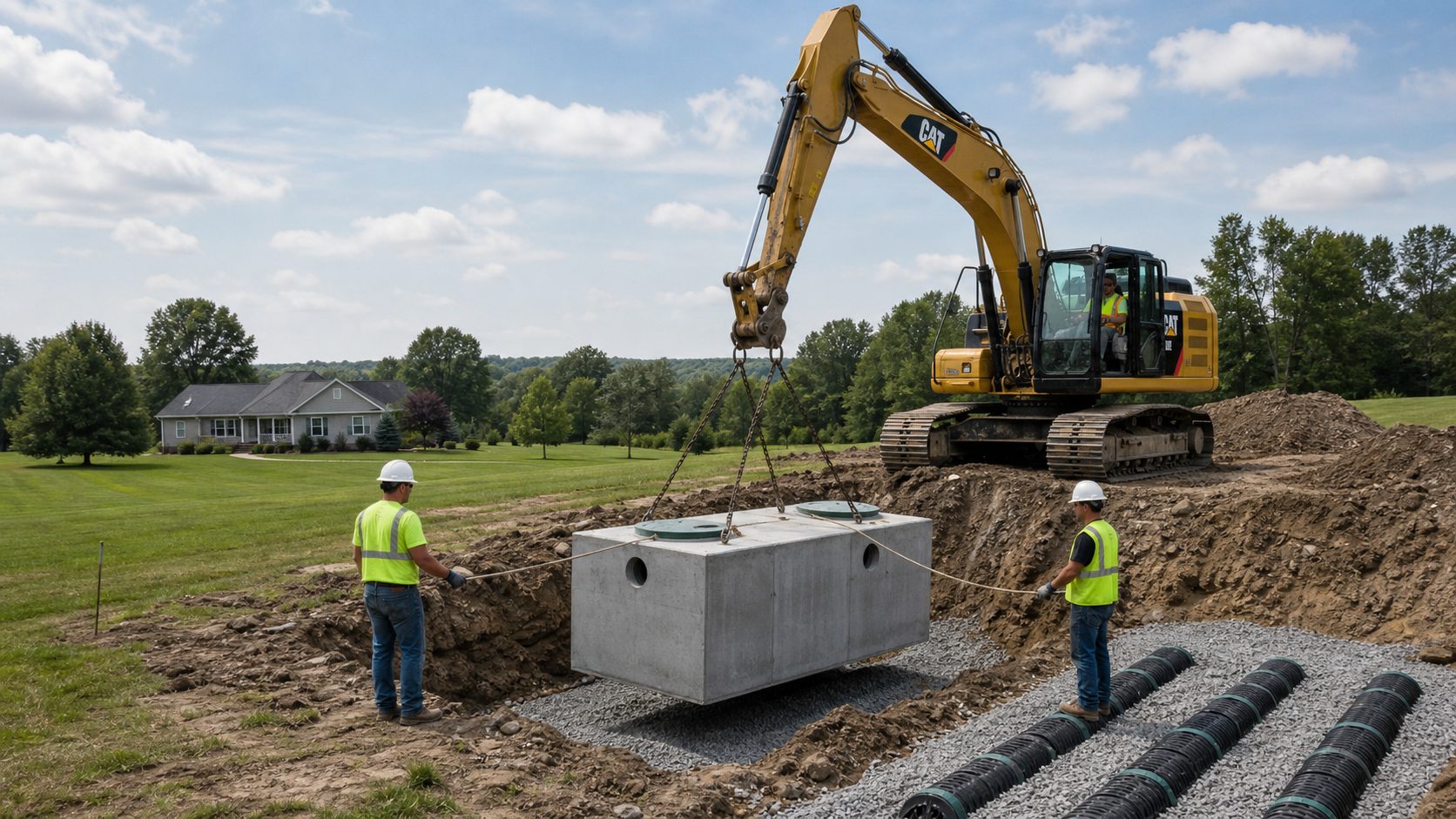
If you are building a home, replacing a failing system, or converting a seasonal property to year-round use in Central New York, septic installation is likely your single largest site work expense. This guide covers what septic systems cost in the Oswego, Oneida, Madison, Cayuga, and Onondaga county area, what drives the price up or down, and what the permit process looks like county by county.
Septic System Installation Cost in Central New York
For a conventional gravity septic system serving a typical 3-4 bedroom home in Central New York, expect to pay $8,000 to $15,000. That includes the tank, distribution box, leach field, excavation, pipe, stone, and backfill. Engineered or mound systems for difficult soil conditions run $15,000 to $30,000+.
| System Type | Cost Range | When It's Required |
|---|---|---|
| Conventional Gravity | $8,000 – $15,000 | Good percolation, adequate soil depth, flat to moderate grade |
| Raised/Mound System | $15,000 – $25,000 | High water table, shallow bedrock, poor perc |
| Engineered System | $20,000 – $35,000 | Failed perc test, environmental constraints, lakefront |
| Pump System (low-pressure) | $12,000 – $20,000 | Uphill grade from house to field, long distance |
| Tank Replacement Only | $3,000 – $6,000 | Tank failed but field is still functional |
What Determines the Cost
Two things drive septic installation cost more than anything else: soil conditions and system type. If your soil percolates well (sandy loam, gravel-based), you get a conventional gravity system and the install is straightforward. If your soil is heavy clay, if bedrock is close to the surface, or if the water table is high, you are looking at an engineered or mound system that costs two to three times as much.
The Percolation Test
Before any septic system can be designed or permitted, you need a percolation (perc) test. This involves digging test holes, filling them with water, and measuring how fast the water drains. The county health department uses these results to determine what type of system your site requires.
Perc tests in Central New York run $400 to $1,000 depending on the number of holes required and whether a licensed engineer needs to be involved. In Oswego County and Oneida County, the county health department typically requires 3-6 test holes at the proposed leach field location.
Get the perc test done before you buy land for a new build. We have seen people purchase lots in Oswego County and southern Oneida County where the soil conditions make conventional septic impossible. That $10,000 system suddenly becomes a $25,000 mound system, or in worst cases, the lot cannot support any on-site system at all.
County-by-County Permit Requirements
Every county in Central New York handles septic permits through their county health department, but the specific requirements, fees, and timelines vary:
| County | Permit Fee | Review Time | Notes |
|---|---|---|---|
| Oswego County | $200 – $400 | 2 – 4 weeks | Strict lakefront requirements near Oneida Lake and Lake Ontario. Deep test holes often required. |
| Onondaga County | $300 – $500 | 3 – 6 weeks | Skaneateles Lake watershed has additional protections. Engineered designs often required near waterways. |
| Madison County | $150 – $350 | 2 – 3 weeks | Generally straightforward. Soil conditions vary significantly from north (clay) to south (shale). |
| Cayuga County | $200 – $400 | 2 – 4 weeks | Lakefront properties on Owasco and Cayuga Lakes have enhanced requirements. |
| Oneida County | $250 – $450 | 3 – 5 weeks | Some areas require engineered designs regardless of soil conditions. Variable enforcement across towns. |
Conventional vs. Engineered Systems: What's the Difference?
A conventional gravity system is the simplest and cheapest. Wastewater flows from the house to a septic tank (typically 1,000 or 1,500 gallons), then by gravity to a distribution box, and out through perforated pipes into a stone-filled leach field. The soil does the final treatment. This works when you have at least 3-4 feet of suitable soil above bedrock or the water table, and the ground percolates within the county's acceptable range.
An engineered system adds treatment technology to compensate for poor soil conditions. This might mean a mound system (where the leach field is built above grade with imported sand), a pressure distribution system (pump-dosed to distribute effluent evenly), or an advanced treatment unit that pre-treats the wastewater before it reaches the soil. These systems require a licensed professional engineer to design them, which adds $2,000-$5,000 to the project cost before any digging starts.
Installation Timeline: What to Expect
From first phone call to functional system, a typical septic installation in Central New York takes 4 to 8 weeks. The breakdown:
- Perc test and soil evaluation, 1-2 weeks (schedule dependent)
- System design, 1-2 days for conventional, 1-2 weeks for engineered
- County permit review, 2-6 weeks depending on county and complexity
- Installation, 2-4 days for conventional, 3-7 days for mound/engineered
- Final inspection, scheduled with county, typically same week
The actual dig and install is the fast part. Permitting is where projects stall. If you are planning a spring build, start the perc test in fall so the permit is in hand when the ground thaws.
Septic System Components and What They Cost
- Septic tank (1,000-1,500 gallon concrete), $1,200 to $2,500 delivered and set
- Distribution box, $150 to $400
- Leach field pipe and stone, $1,500 to $4,000 depending on field size
- Excavation and backfill, $2,500 to $6,000 (the bulk of the labor cost)
- Pump and controls (if needed), $1,500 to $3,000
- Imported fill/sand (mound system), $2,000 to $8,000
- Engineering design (engineered systems only), $2,000 to $5,000
Signs Your Existing System Is Failing
If you already have a septic system and are wondering whether you need a replacement, watch for these indicators:
- Sewage backing up into the house through drains or toilets
- Standing water or soggy ground over the leach field, especially when it hasn't rained
- Strong sewage odor in the yard near the tank or field area
- Unusually green, lush grass over the leach field (it is being fertilized by raw effluent)
- Slow drains throughout the house that plumbing work doesn't fix
- County health department notice of system failure
A failing system does not always mean a full septic system replacement. Sometimes the tank needs pumping, a pipe has collapsed, or the distribution box has shifted. We can evaluate the situation and tell you whether a repair will solve the problem or if you need a new system.
Lakefront and Waterfront Properties
Properties near Oneida Lake, Lake Ontario, Owasco Lake, Cayuga Lake, and Skaneateles Lake face stricter septic requirements than inland properties. County health departments enforce larger setback distances from the water, may require enhanced treatment systems, and have more rigorous inspection requirements. Skaneateles Lake watershed properties (the source of Syracuse's unfiltered drinking water) face the most restrictive requirements in the region.
If you are buying or building on waterfront, budget for an engineered system regardless of soil conditions. The county will very likely require it.
Why Work With an Excavation Contractor for Septic
Some homeowners hire a plumber or a dedicated "septic installer" for this work. That can work fine for simple replacements. But for new construction where the septic is part of a larger site work package, foundation dig, driveway, grading, utility trenching, using your excavation contractor for the septic makes more sense. The equipment is already on site, the site work is coordinated, and you avoid the scheduling conflicts that come from having three different contractors trying to access the same piece of dirt.
At Backwell, septic installation is one piece of what we do. We handle foundation excavation, grade sites, install utilities, and build driveways. When we handle the septic as part of the overall site package, the project moves faster and costs less than parceling out each trade separately.
Get an Honest Assessment
We will look at your property, review the soil conditions, and tell you what type of system you need and what it will cost. No upselling engineered systems where conventional will work. No surprises after the permit comes back. We have been installing septic systems across Oswego, Oneida, Madison, Cayuga, and Onondaga counties for years, and we will give you a straight answer on day one.
Get a Free Estimate
We handle the permits, the coordination, and the heavy lifting. One call gets the ball rolling.
Request Your Free Estimate