Driveway and Culvert Design in Central New York
Driveway permits and culvert pipes for new houses, barns and lots. Backwell finds the road owner, gets the culvert sized and the permit filed, and builds the driveway.
Permit. Culvert. Driveway.
Which agency approves your driveway and what it wants.
Whoever owns the road. The town highway superintendent for town roads, the county DOT for county roads, and NYSDOT for state highways. Each sets its own culvert and entrance requirements.
Onondaga County lists a $15 fee for a residential access permit, a $500 deposit returned after inspection, and a $1,000,000 insurance policy naming the county as additional insured plus workers' compensation. Commercial access is $555.
If the driveway crosses a roadside ditch, usually yes. The road owner decides. In Cortlandville, for example, the highway superintendent specifies the pipe size, type and length, with a 30 foot minimum, and the applicant buys the pipe and sloped end sections.
When the road owner asks for plans, the pipe is sized from the drainage area reaching the ditch, the design storm, the ditch grade, cover over the pipe, and the end treatment. The pipe is set at the ditch line so water does not pond.
NYSDOT requires a permit to build or modify a driveway on a state highway. The owner or contractor applies through PermiTrack, the driveway follows NYSDOT residential driveway standards, and contractors must show insurance and may need a surety bond.
Not in Onondaga County. Modifications to existing driveways in the county right-of-way, such as widening or repaving, need a Work in the Right of Way permit with a sketch showing the work relative to the road center.
Plans are prepared and stamped by a New York licensed Professional Engineer (PE). Backwell coordinates the design, the town permit submittal, and the site work.
Send the address and where the driveway goes through the form. Estimate in 1 hour.
Who approves your driveway depends on who owns the road
A new driveway in New York needs a permit from whoever owns the road it connects to: the town highway superintendent for a town road, the county DOT for a county road, or NYSDOT for a state highway. The road owner decides whether a culvert pipe is needed under the driveway, how big it is, and how the entrance is built. Many towns will not release a building permit for a new house until the driveway permit has been applied for.
Backwell figures out which agency owns the road, gets the driveway and culvert designed to that agency's standard, files the permit, and builds the driveway, culvert and ditch work.
Plans are prepared and stamped by a New York licensed Professional Engineer (PE). Backwell coordinates the design, the town permit submittal, and the site work.
Town roads: the highway superintendent
On a town road, the town highway superintendent reviews driveway and culvert work. Towns set their own rules by local law, and they differ. The Town of Cortlandville (Cortland County) publishes a typical set:
- The superintendent reviews the proposed work and may require detailed plans before a permit is issued.
- For a new driveway entrance on a town road, the applicant buys any required culvert pipe and sloped end sections.
- The culvert pipe size, type and length are as specified by the highway superintendent, with a minimum length of 30 feet.
- The town highway department installs new driveway culverts and pays to maintain or replace them; the owner pays for the driving surface.
Other towns handle installation differently, so this gets checked for your town. State Highway Law section 149 also lets a town superintendent, with town board consent, permit drainage, sewer and water pipes in a town highway. That is the provision behind permits for pipes that run in the town right-of-way.
County roads: Onondaga County DOT example
Onondaga County requires an Access Permit for all new driveways on county roads, including residential, commercial, agricultural, construction and temporary drives. The county's published requirements:
- Form: Access Permit Form 1502. The applicant fills in the first page and signs the last. For a new structure, the town's code enforcement officer also signs.
- Fees: Residential $15 per drive. Field $15. Construction and temporary $25. Commercial $555.
- Deposit: $500, returned after the work is done and the county inspects it.
- Insurance: a $1,000,000 policy naming Onondaga County as additional insured, plus workers' compensation.
- Staking: the driveway location is staked so the county can verify sight distance and drainage requirements at the location you want.
- Where: emailed to Highwaypermits@ongov.net or mailed to OCDOT, 6230 East Molloy Road, East Syracuse, NY 13057. Checks payable to Onondaga County CFO.
- Term: permits are valid one year from approval.
Changes to an existing driveway on a county road (widening, repaving) and other work in the county right-of-way need a separate Work in the Right of Way permit, Form 1501, with a site plan or sketch showing the work relative to the center of the road. Fees and deposits for that permit are set case by case.
Other counties run their own permit programs. The road owner is checked for every job.
State highways: NYSDOT highway work permit
If the house fronts a state highway, NYSDOT says you need a permit from the department to build or modify a driveway. What NYSDOT publishes:
- Either the property owner or the contractor applies, through NYSDOT's online system, PermiTrack.
- Residential driveways are built to NYSDOT's Residential Driveway Standards (Highway Design Manual Chapter 5, Appendix 5A) and Standard Sheet 608-03.
- Homeowners doing their own work are exempt from the insurance requirements. Contractors must be listed on the permit and show proof of insurance, and may need a surety bond (form PERM 44).
- Fees follow the NYSDOT Permit Fee Matrix.
- Applications start with the local NYSDOT Resident Engineer; NYSDOT lists maintenance residencies by county.
How a driveway culvert gets sized
A driveway that crosses a roadside ditch needs a pipe big enough to carry the ditch flow without flooding the road or washing out the driveway. When the road owner specifies a pipe, that is the size. When the road owner asks for detailed plans, or the ditch carries water from a large area, the culvert is sized by calculation. The PE's sizing looks at:
- The drainage area that reaches the ditch at your driveway, and its ground cover and slope
- The design storm the road owner uses
- The ditch grade upstream and downstream, so the pipe sits at the ditch line, not above or below it
- Cover over the pipe for the loads it will carry
- Pipe material and end treatment (sloped end sections, headwalls, stone at the outlet)
- How much water can pond at the inlet before it reaches the road
The most common failures are a pipe set too high (water ponds upstream and soaks the road base), a pipe too short (driveway shoulders wash into the ditch), and a pipe crushed by trucks because it lacks cover.
Long private driveways
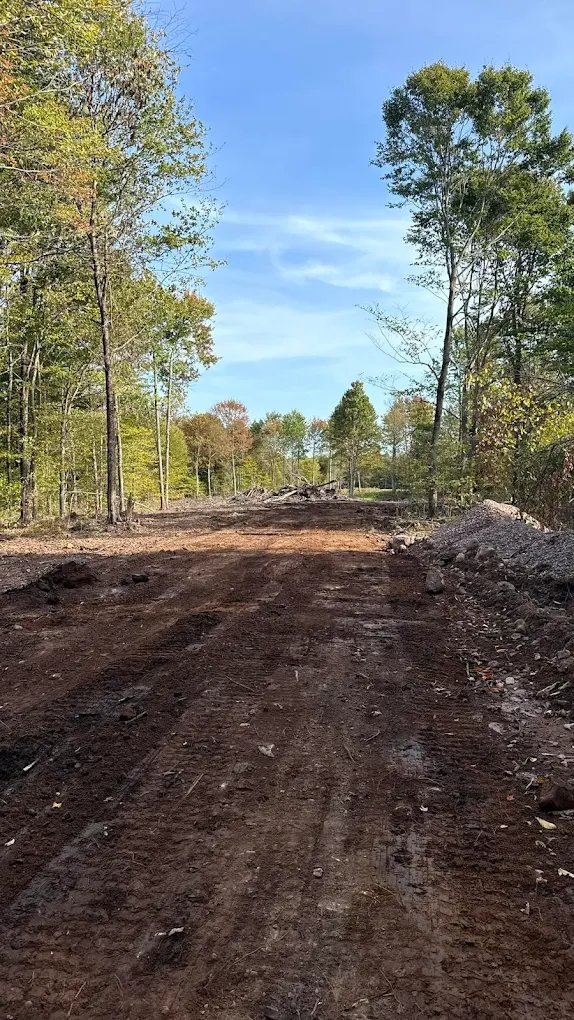
A long driveway to a house set back on a rural lot is its own small road. Past the road permit, the design covers grade, crown or cross slope, cross culverts where the driveway crosses swales, stone thickness, and room for a fire truck and a delivery truck to turn around. If the driveway, house pad and septic clearing together disturb one acre or more, the NYSDEC construction stormwater permit (GP-0-25-001) also applies. See erosion control plan.
How it works with Backwell
- Send the address and where you want the driveway. A photo from the road helps. Estimate in 1 hour.
- Find the road owner. Town, county or state, and which permit form and standard apply.
- Stake and check. Driveway location, sight distance, ditch line, and whether a culvert is needed.
- Design. Culvert size and invert, driveway profile and cross section, drawn when the road owner asks for plans.
- Permit. Application, insurance certificates, deposit and fee to the road owner. For new houses, this runs alongside the building permit; see residential site plan.
- Build. Backwell sets the culvert to grade, builds the driveway base, shapes the ditches and restores the shoulder. See site preparation and storm drainage.
- Inspection. The road owner inspects. On Onondaga County roads, the $500 deposit comes back after the county's inspection.
Common problems and the fix
Building permit is on hold for the driveway
The Town of Clay's new home checklist lists a driveway permit (town road or county road) and says it must be applied for before the building permit is released. Apply for the driveway permit at the same time as the building permit, not after.
Driveway on a county road but the house is in a town
The county owns the access, and the town still issues the building permit. On Onondaga County roads, the town's code enforcement officer signs the county access permit for a new structure.
Existing culvert is crushed or plugged
On a county road, replacing or modifying the driveway in the right-of-way needs the county's work permit. On a town road, the highway superintendent sets the replacement pipe. Some towns, like Cortlandville, maintain and replace driveway culverts themselves.
Ditch water floods the driveway every spring
Usually the culvert is set too high or too small. The fix is a correctly sized pipe set at the ditch line with stone at both ends, and sometimes regrading the ditch upstream with the road owner's permission.
Driveway drains toward the garage
The Residential Code requires hard surfaces within 10 feet of a foundation to slope at least 2 percent away from the building. The driveway profile is set on the grading plan. See grading and drainage plan.
Timeline
Permit timing is set by the road owner. Onondaga County access permits are valid for one year once approved, and the deposit is returned after inspection. The written estimate lists the schedule for design, permit and construction on your job.
Sources
Rules change. These are the documents this page is based on, checked October 2026.
- Onondaga County Department of Transportation, Permits (Access Permit and Work in the Right of Way)
- NYSDOT, Residential Driveway Permits
- NYSDOT, Permits overview
- Town of Cortlandville, Highway Department work permits (driveway culverts)
- NYS Highway Law 149, permits for pipes and crossings in town highways
- Town of Clay, residential new house building permit application and procedures (2025)
- Residential Code of New York State 2025, Chapter 4 Foundations (R401.3, R404.4, R405.1), UpCodes
- NYSDEC, Stormwater Permit for Construction Activity (GP-0-25-001 page, forms, eNOI)