Erosion Control Plan and Small Site SWPPP in Central New York
One acre or more of disturbance means a SWPPP and DEC permit coverage before you dig. Backwell gets the plan prepared, files the eNOI, installs the controls and builds the site.
SWPPP. eNOI. Controls.
When the NYSDEC construction stormwater permit applies to a small site.
When construction disturbs one or more acres of soil, or less than one acre that is part of a common plan of development or sale that will disturb one acre or more. The permit is NYSDEC GP-0-25-001, effective January 29, 2025 through January 28, 2030.
No. The 5,000 square foot to one acre trigger in GP-0-25-001 applies in the New York City Watershed east of the Hudson River. New York City has its own triggers. In Central New York the state trigger is one acre or the common plan rule, and local laws are checked for the parcel.
If it disturbs one acre or more, yes. Outside Appendix C watersheds, a single-family home disturbing one to five acres needs a SWPPP with erosion and sediment controls only. In the Onondaga Lake watershed, it also needs post-construction stormwater practices.
If the project is in a city, town or village MS4 with review authority over construction, that municipality reviews the SWPPP and signs the MS4 SWPPP Acceptance Form before the eNOI is filed. If it lacks review authority, an MS4 No Jurisdiction Form is used.
Work can start as of the authorization date in DEC's Letter of Authorization. In certain cases, including projects in an MS4 without review authority, that date is 60 business days after the eNOI is submitted.
Most permitted sites need a Qualified Inspector at least every 7 calendar days during disturbance. A single-family home disturbing one to five acres outside Appendix C watersheds, and agricultural construction under five acres, are exempt from that requirement but still need trained contractor maintenance inspections.
Plans are prepared and stamped by a New York licensed Professional Engineer (PE). Backwell coordinates the design, the town permit submittal, and the site work. The permit requires engineering components of a SWPPP to be prepared by or under a New York licensed PE.
Send the address and what is being built through the form. Estimate in 1 hour.
Who needs an erosion control plan
In New York, if your project disturbs one acre or more of soil, you need coverage under the NYSDEC stormwater permit for construction activity and a written Stormwater Pollution Prevention Plan (SWPPP) before you dig. That includes a single new house on a big rural lot once the clearing, driveway, house pad, septic and spoil areas add up past one acre. Smaller jobs can still need one if they are part of a larger subdivision plan.
Backwell gets the small-site SWPPP prepared, files the electronic Notice of Intent, gets the town's sign-off where the town has review authority, then installs and maintains the controls while the site work is going on.
Plans are prepared and stamped by a New York licensed Professional Engineer (PE). Backwell coordinates the design, the town permit submittal, and the site work.
The current permit: GP-0-25-001
NYSDEC's SPDES General Permit for Stormwater Discharges from Construction Activity, GP-0-25-001, took effect January 29, 2025 and expires January 28, 2030. It replaced GP-0-20-001. Owners or operators who disturb one or more acres must get coverage under this permit or an individual SPDES permit.
The disturbance triggers, straight from Part I.A of the permit
- One or more acres of soil disturbance.
- Less than one acre that is part of a common plan of development or sale that will ultimately disturb one or more acres. Example: one lot in a subdivision.
- Less than one acre where NYSDEC has determined a permit is required because of a potential water quality violation or significant pollutant contribution.
- 5,000 square feet or more, but less than one acre, in the New York City Watershed east of the Hudson River.
- Separate 20,000 square foot and 5,000 square foot impervious triggers inside New York City.
The 5,000 square foot trigger people hear about applies to the NYC East of Hudson watershed only, which is downstate. In Central New York, the state trigger is one acre, or less than one acre inside a larger common plan. Town and village local laws can add their own rules, and that gets checked for the parcel.
Small site SWPPP: erosion control only, or more?
Appendix B of the permit sorts projects into two tables.
Table 1: erosion and sediment controls only
These projects need a SWPPP with erosion and sediment controls, but no permanent stormwater practices:
- A single-family home disturbing one to five acres that is not in an Appendix C watershed and does not discharge directly to an impaired (303(d)) water listed in Appendix D
- Single-family subdivisions with 25 percent or less impervious cover at build-out, under the same watershed conditions
- A barn or other agricultural building, silo, stock yard or pen, disturbing one to five acres
- Pond construction, slope stabilization, spoil areas to be vegetated, and demolition where vegetation will be re-established
Table 2: add post-construction stormwater practices
These projects also need permanent stormwater management practices (SMPs) designed into the plan:
- A single-family home located in an Appendix C watershed, or discharging directly to a listed 303(d) segment
- A single-family home that disturbs five or more acres
- Multi-family developments, including duplexes and townhomes
Why it matters in Onondaga County: the Onondaga Lake watershed
Appendix C of GP-0-25-001 lists the watersheds requiring enhanced phosphorus removal. The Onondaga Lake watershed is on it, alongside the NYC East of Hudson watershed and the Greenwood, Oscawana and Kinderhook Lake watersheds. Two things change if your site is inside the Onondaga Lake watershed and needs permit coverage:
- A single-family home moves from Table 1 to Table 2, so the SWPPP must include post-construction stormwater practices designed to the enhanced phosphorus removal standards in the state design manual.
- Soil stabilization is faster. Statewide, once disturbance stops in an area, stabilization must start by the end of the next business day and be finished within 14 calendar days. In Appendix C watersheds and on sites discharging to listed impaired waters, it must be finished within 7 calendar days.
MS4 towns in the Syracuse area
Onondaga County lists the automatically designated MS4s in the Syracuse Urbanized Area. In Onondaga County they include the towns of Camillus, Cicero, Clay, DeWitt, Geddes, LaFayette, Lysander, Manlius, Marcellus, Onondaga, Pompey, Salina and Van Buren; the villages of Baldwinsville, Camillus, East Syracuse, Fayetteville, Liverpool, Manlius, Marcellus, Minoa, North Syracuse and Solvay; the City of Syracuse; and Onondaga County. In Oswego County the list includes Hastings, West Monroe, Central Square, Phoenix and Oswego County, and in Madison County the Town of Sullivan. The county notes that the Town of Schroeppel received a DEC waiver.
Under the permit, if your project is inside an MS4 municipality that has review authority over construction, the town has to review and accept the SWPPP and sign the MS4 SWPPP Acceptance Form before the eNOI is filed. If the municipality does not have review authority, an MS4 No Jurisdiction Form is used instead. Within five business days of receiving DEC's Letter of Authorization, a copy goes to the MS4 that reviewed it.
How the permit process runs
- Send the address and the plan for the lot. House, driveway, septic, barn, pond or clearing. Estimate in 1 hour.
- Measure the disturbance. Clearing, grading, driveway, house pad, septic area, stockpiles and access all count. This decides whether the permit applies and which table you fall under.
- Check the watershed. Is the site in the Onondaga Lake watershed or another Appendix C watershed, or does it discharge to a listed impaired water?
- Prepare the SWPPP. Erosion and sediment controls are designed to the New York State Standards and Specifications for Erosion and Sediment Control (the Blue Book, November 2016). Table 2 projects add stormwater practices designed to the New York State Stormwater Management Design Manual. Under the permit, any part of a SWPPP that involves the practice of engineering must be prepared by or under the direct supervision of a New York licensed PE.
- SWPPP Preparer Certification and MS4 sign-off. The preparer certification is attached to the eNOI. In MS4 towns with review authority, the town signs the acceptance form.
- File the eNOI. The Notice of Intent is filed electronically through DEC's nForm portal.
- Letter of Authorization. Construction can start as of the authorization date in DEC's LOA. In certain cases, including projects in an MS4 that does not have review authority, the authorization date is 60 business days after the eNOI is submitted. Plan for it.
- Install controls and build. Backwell installs the stabilized entrance, silt fence, inlet protection and other measures, then does the clearing, grading and site work.
- Inspect and maintain. The permit requires the plan, the permit, the LOA and the signed forms to be kept on site.
- Close out. Once all disturbed areas reach final stabilization, a Notice of Termination is filed with the Qualified Inspector's final stabilization certification.
Inspections on a small residential site
Part IV.C of the permit requires a Qualified Inspector to inspect most permitted sites at least once every 7 calendar days while soil disturbance is ongoing, and at least once every 30 days during a winter shutdown with temporary stabilization in place. The permit exempts a few project types from the Qualified Inspector requirement, including a single-family home disturbing one to five acres that is not in an Appendix C watershed and does not discharge directly to a listed impaired water, and agricultural construction disturbing one to under five acres. Those sites still need the routine maintenance inspections by the trained contractor described in the permit.
In the Onondaga Lake watershed, a single-family home with permit coverage does not get that exemption, so plan for weekly Qualified Inspector visits.
Common problems and how the plan handles them
"It is only one house, we do not need a permit"
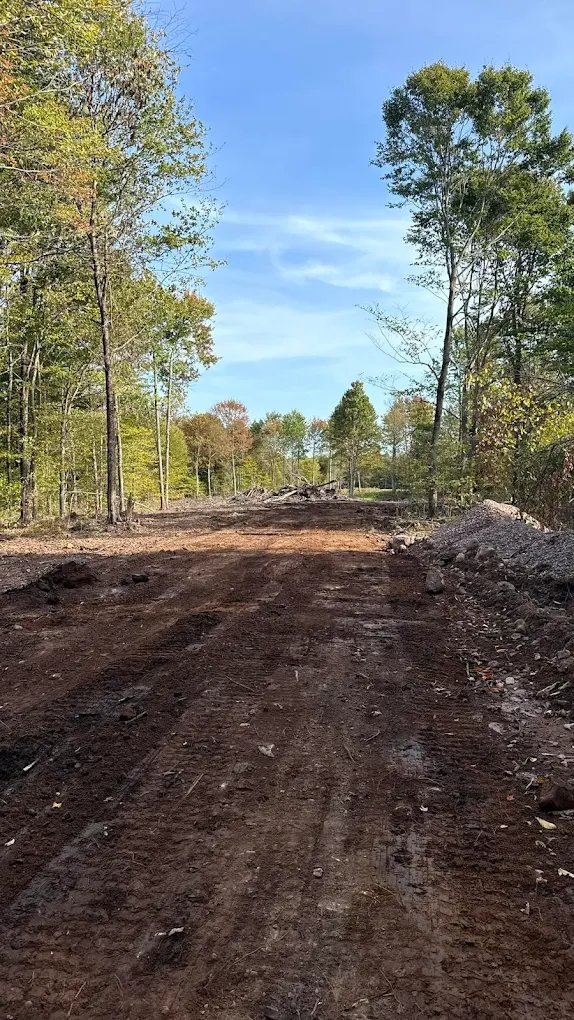
Count the disturbance before you decide. A long driveway, a cleared building envelope, a septic field, a spoil pile and a lay-down area add up quickly on a rural lot. Clearing for a driveway and house pad on a 10 acre parcel can pass one acre without anyone noticing.
Lot in a subdivision
If the lot is part of a common plan of development or sale that will disturb one acre or more, the permit can apply even when your lot alone disturbs less. The developer may already hold coverage, and that has to be sorted out before work starts.
Steep ground or a stream at the bottom of the lot
Silt fence alone does not do much on a long slope. The plan breaks up the slope, diverts clean water around the work, and stabilizes as each area is finished. See grading and drainage plan.
Winter
The permit allows a reduced inspection schedule during a winter shutdown only if all disturbed areas have temporary stabilization and the right office has been notified. The plan includes the shutdown steps.
Pond or barn project on farmland
Ponds and agricultural buildings disturbing one acre or more are Table 1 projects. Agricultural building work disturbing one to under five acres is also exempt from the Qualified Inspector requirement. DEC's permit page notes some agricultural projects are exempt from coverage entirely in certain cases. See pole barn and garage plans.
Timeline
The SWPPP comes first, then the MS4 acceptance where the town has review authority, then the eNOI and DEC's Letter of Authorization. In certain cases the LOA authorization date is 60 business days after the eNOI. Site work starts on or after the authorization date. Close-out comes when the site is stabilized and the Notice of Termination is filed.
Sources
Rules change. These are the documents this page is based on, checked October 2026.