Steep Slope Septic Hillside Design in Central NY
New York draws a line at 15 percent slope, but that line applies to the field area, not your whole lot. Here is what the rules allow on hillsides and how the field gets laid out.
The short answer
Appendix 75-A calls slopes over 15 percent unacceptable for septic fields. The state design handbook makes clear that limit applies to the field and its reserve area, not the whole lot, and lays out how trenches can be built on 15 to 20 percent ground with a waiver, wider spacing and careful construction. Mounds stop at 12 percent, raised systems at 15, and absorption beds at 8.
How to tell slope is your problem
A 15 percent slope drops 15 feet over 100 feet. If you walk the lawn and lean into the hill, or water sheets across the yard after a storm, the slope is probably in play. Surveyed contours on the plot plan settle it. Hillside lots also bring perched water seeping out mid slope, thin soil on the shoulders and erosion during construction.
What New York rules say
| System | Slope limit | Source |
|---|---|---|
| Any onsite system site | Over 15% unacceptable without a specific waiver or local approval | Appendix 75-A.4; handbook 9.6.4 |
| Raised system | 15% or less | Appendix 75-A.9(b) |
| Mound | 12% or less | Appendix 75-A.9(c) |
| Absorption bed | 8% or less | Appendix 75-A.8(g) |
| Sites over 20% | Should not normally be considered for residential systems | Handbook 9.6.4 |
Trenches on any slope must run parallel to the contours with bottoms as level as possible.
Three ways to handle a hillside
1. Trenches in natural soil on 15 to 20 percent slopes
The state handbook says many health departments have seen satisfactory results from very carefully built trenches in natural soil on slopes over 15 up to 20 percent. It explains the 15 percent limit is mostly about equipment safety, and that from a hydraulic view trenches work on steeper ground. It recommends this over cutting and filling the hill, because it keeps the soil structure and limits compaction and erosion. Conditions:
- Native soil must perc 1 to 60 minutes per inch.
- Trenches run parallel to contours, up to 60 feet each way from a drop box.
- Trenches get wider spacing the less vertical separation there is: 10 feet apart with 2 feet of separation, 9 feet with 3, 8 feet with 4, and 7 feet with 5. On slopes up to 15 percent the normal 4 foot spacing applies.
- All Table 2 distances are met.
Since the site is over 15 percent, it still needs a specific waiver or other approval from the local health department.
2. Regrade to 15 percent
Sites with at least 1 foot of unsaturated permeable soil and slopes up to 20 percent can be graded with cut and fill to reach 15 percent. The disturbed soil has to stabilize before perc and deep hole tests, ditches, berms and curtain drains control water, and the grading should happen in dry weather to limit compaction and smearing.
3. Mound or raised system on moderate slopes
On slopes up to 12 percent a mound is laid along the contour and kept as narrow as possible up and down the hill, no wider than 20 feet. On a sloped site its basal area counts only the area under the absorption bed and the downhill taper. A raised system works up to 15 percent. Both need a diversion ditch or curtain drain uphill so runoff stays out of the fill.
Getting effluent down the hill evenly
The handbook says drop boxes and serial distribution are often used on slopes of 10 percent or more. Drop manholes slow the flow to lower lines and can be used with gravity. Serial distribution, where each line fills before spilling to the next, is allowed with dosing systems only. Gravity lines are limited to 60 feet; dosed or pressure lines to 100 feet. Pressure distribution is often the cleanest answer on a hillside, and when the only good soil is uphill of the house, the handbook supports pumping to it with dosing built in.
How it works with Backwell
- Send the address. Estimate in 1 hour.
- Topo and soils. Contours of the field area, plus deep holes on the bench or shoulder with the deepest soil.
- Design. Plans are prepared and stamped by a New York licensed Professional Engineer (PE), with the waiver request if over 15 percent.
- Submittal. County health department, plus watershed review where it applies.
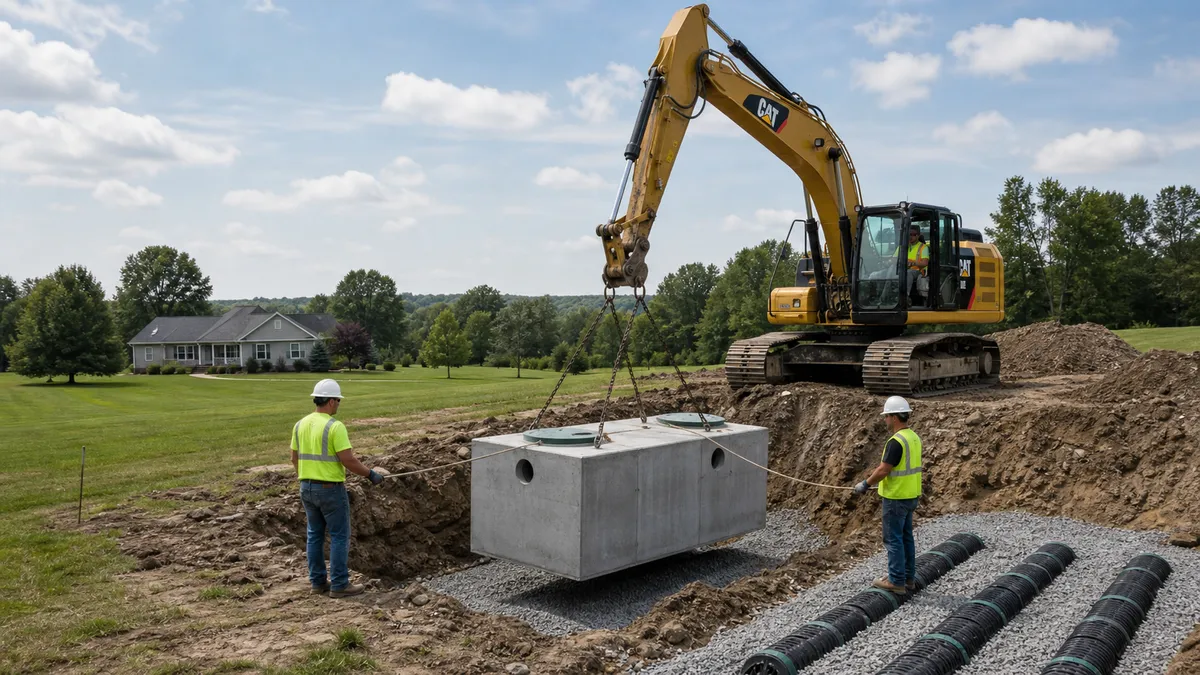
- Build. Trenches on contour, and heavy equipment kept off the downslope area that receives the effluent.
- Stabilize and certify. Seed, erosion control, PE check before backfill where required.
What it costs
| Item | Typical published figure | Where the number comes from |
|---|---|---|
| Perc test plus deep hole | $400 to $800 | Backwell perc test page |
| Engineered design, when required | $1,500 to $3,500 | Backwell perc test page |
| Pressure distribution system | $13,000 to $19,000 | Backwell system types page |
| Engineered mound | $22,000 to $28,000 | Backwell system types page |
| Conventional gravity system, for comparison | $8,000 to $13,000 | Backwell system types page |
| Onondaga County sewage plan review, under 1,000 gpd | $310 application; $186 redesigned project; $62 amended project | Onondaga County Local Law 11 of 2025, effective January 1, 2026 |
| Cayuga County plan review | $150 new system; $100 conventional trench repair; $150 other repair types | Cayuga County Health Department forms |
Installed ranges are typical Central New York figures Backwell publishes on its septic system types page. They are ranges, not a quote. Your number comes back in writing after we see the address and the test results.
What the health department checks
- Slope across the field and reserve area, not the whole lot.
- Trench layout on contour and trench spacing against the separation table.
- Upslope water control.
- Waiver justification for anything over 15 percent.
- For mounds, the downslope area kept free of heavy equipment and compaction.
Central New York specifics
In the Skaneateles Lake watershed, slopes over 15 percent are part of the rules' environmentally sensitive area definition, and disturbing 5,000 square feet or more of soil there is barred unless erosion and sediment controls are in place. USDA describes Honeoye soils on till plains, hills, ridges and drumlins as well drained, the profile trenches want. Mardin and Volusia soils on sloping uplands carry a dense fragipan with seasonal wetness above it; shallow water moving over a layer like that is what an upslope curtain drain is meant to intercept.
Timeline
Waiver review adds time. Regraded ground must stabilize before testing. Raised fill must settle six months with a freeze and thaw unless granular fill is compacted in lifts. Build in dry weather.
Costs. Scope. Questions.
What a septic design on a sloped lot costs in Central New York.
Appendix 75-A calls slopes over 15 percent unacceptable. The state handbook says that applies to the field and reserve area only, and that sites over 15 percent need a specific waiver or local approval. Sites over 20 percent should not normally be considered.
Up to a 12 percent slope. The mound runs along the contour, the absorption area is no wider than 20 feet, and a diversion ditch or curtain drain goes uphill.
Possibly, with a waiver. The handbook describes trenches in natural soil on 15 to 20 percent slopes with soil percing 1 to 60 minutes per inch, trenches on contour, and wider spacing of 7 to 10 feet depending on separation.
Only as part of a design. The handbook allows grading slopes up to 20 percent down to 15 percent where there is at least 1 foot of permeable soil, but the soil must stabilize before testing and the health department should be contacted first.
Drop boxes, serial distribution with dosing, or pressure distribution. Pressure distribution doses every line at once and is often the simplest answer on a hillside.
Backwell publishes typical Central New York installed ranges of $13,000 to $19,000 for pressure distribution and $22,000 to $28,000 for an engineered mound. Send the address for a written number.
Sources
- 10 NYCRR Appendix 75-A.4, Soil and site appraisal, Table 2 separation distances (NYS DOH)
- 10 NYCRR Appendix 75-A.7, Distribution devices, pressure distribution and dosing (NYS DOH)
- 10 NYCRR Appendix 75-A.8, Conventional subsurface treatment systems (NYS DOH)
- 10 NYCRR Appendix 75-A.9, Alternative systems: raised systems, mounds, sand filters (NYS DOH)
- 10 NYCRR Appendix 75-A.11, Specific waivers (NYS DOH)
- NYS DOH Residential Onsite Wastewater Treatment Systems Design Handbook, 2012 edition (posted by Onondaga County Health Department)
- NYS DOH fact sheet: Need for Licensed Design Professionals, Residential Onsite Wastewater Treatment Systems
- 10 NYCRR Section 131.1, City of Syracuse Skaneateles Lake watershed rules and regulations
- Onondaga County Health Department, Septic Systems and Public Sewers
- USDA NRCS Official Soil Series Description: Honeoye
- USDA NRCS Official Soil Series Description: Mardin
- USDA NRCS Official Soil Series Description: Volusia
- Backwell, Septic system types and published Central New York price ranges
- Backwell, Perc test and site evaluation price table
Rules and fees change. Everything above was checked against the linked documents in October 2026. Designs are prepared and stamped by a New York licensed Professional Engineer (PE); Backwell coordinates the design, the health department submittal and the install.