Septic Engineer in Syracuse, NY
The city itself is on public sewer. The septic work around Syracuse is in the towns just past the sewer lines. PE stamped designs, perc and deep hole testing, and the Onondaga County Health Department submittal.
Fees. Process. Answers.
Septic design for Syracuse, NY, from soil test to county approval.
Almost never. The City of Syracuse is in the county Consolidated Sanitary District and runs on public sewer. Septic designs come up for Syracuse mailing addresses that sit in surrounding towns outside the sewer lines, such as southern Onondaga, southern DeWitt, LaFayette and Pompey.
The Bureau of Public Health Engineering at the Onondaga County Health Department, John H. Mulroy Civic Center, 421 Montgomery Street, Syracuse, phone (315) 435-6600. The town building department issues the building permit.
The county fee schedule lists $310 for a full application on a system under 1,000 gallons per day, $62 for an amended project or a revised plan review, $186 for a redesigned project, $93 for a site investigation and $62 for a repair inspection. Those are county fees only. Design and install are priced in writing.
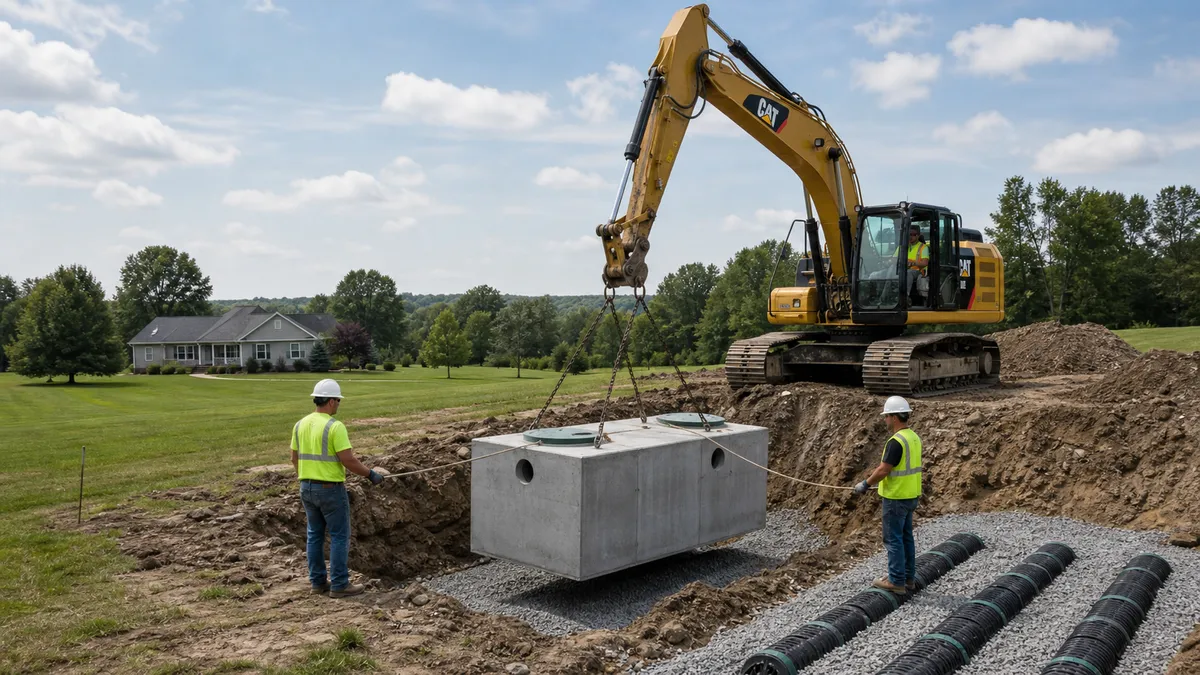
Designs are prepared and stamped by a New York licensed Professional Engineer (PE). Backwell coordinates the testing, the design, the health department submittal and the install.
Very limited means a standard trench field does not fit the soil as mapped. The real answer comes from the test pit and perc holes. Most limited lots end up with a shallow trench, raised bed or mound design instead of a conventional field.
Send the address and what you are building or fixing through the form. Estimate in 1 hour.
Septic engineer in Syracuse, NY: what it is and who needs one
A septic engineer in Syracuse is the person who tests the soil on an unsewered lot, designs a system that meets New York's Appendix 75-A, and gets that design approved by the Onondaga County Health Department. Inside the city line you will almost never need one, because Syracuse is served by the county sewer system. Where you will need one is the ring of towns around the city where the sewer lines stop: southern DeWitt, the southern two thirds of the Town of Onondaga, all of LaFayette, and most of Pompey.
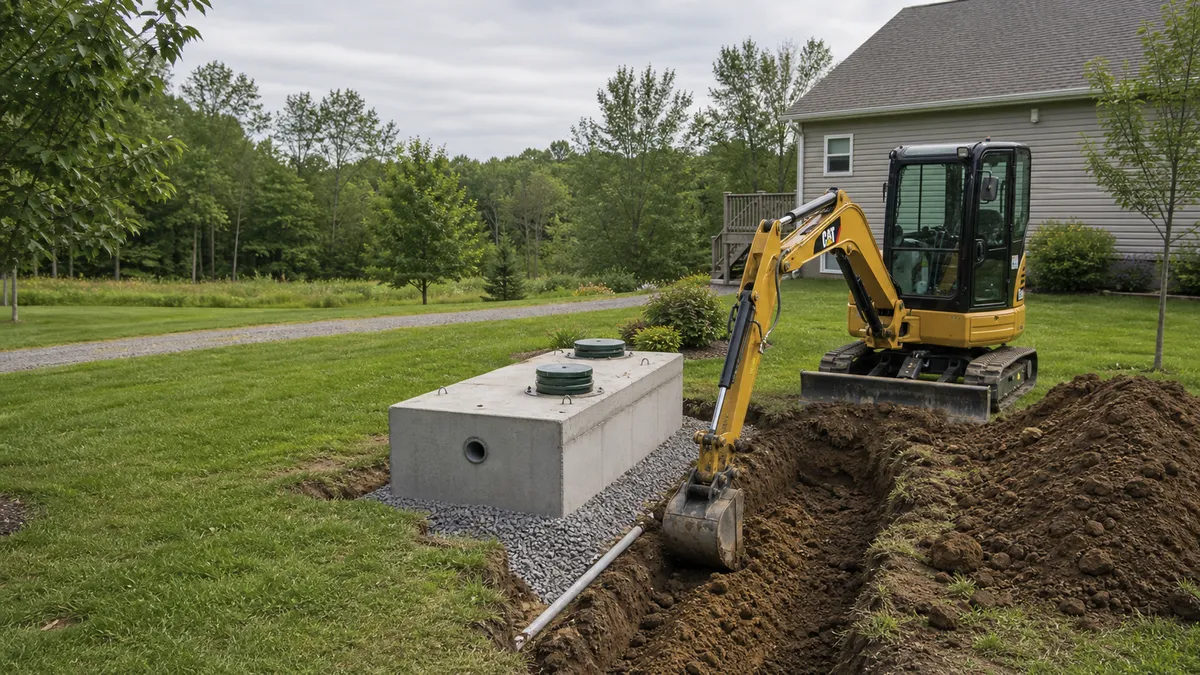
Backwell coordinates the testing, the design, the county submittal, and the install. Designs are prepared and stamped by a New York licensed Professional Engineer (PE).
Syracuse is sewered. The towns around it are mixed.
Onondaga County's Department of Water Environment Protection (WEP) lists the City of Syracuse in its Consolidated Sanitary District, and the city runs on a combined sewer system that feeds the Metropolitan Syracuse Wastewater Treatment Plant on Hiawatha Boulevard. So a house inside the city does not need a septic design. A Syracuse mailing address is a different story. Plenty of 132xx addresses sit in towns where public sewer covers only part of the map.
What the towns themselves say about where sewer stops:
- Town of Onondaga: the town master plan says the northern third is in the county sanitary district, and much of the land outside it has soils with severe limitations for septic absorption fields. Lots without public water and sewer need 2 acres under town zoning.
- Town of DeWitt: the 2017 comprehensive plan update says the area south of Woodchuck Hill and Nottingham Roads, outside the Doubletree neighborhood, did not have public sewage disposal, and neither do parts of the neighborhoods east and west of Maple Drive.
- Town of LaFayette: the 2021 comprehensive plan says there is no public sewer anywhere in the town.
- Town of Pompey: the master plan names only the Pompey Pines, The Preserve and Spruce Ridge developments on the north end as served by public water and sewer.
WEP also says being inside the sanitary district does not by itself mean a property is, or can be, connected. If you are not sure, that is the first question to settle before anyone digs a test pit.
Soils in Syracuse and the system they point to
The soils mapped inside the city line give a preview of what the towns around it look like. On the hills you get Honeoye till and Camillus soils over shale. On the valley floors and old lake shores you get Palmyra gravelly outwash. The numbers below cover the land inside the city boundary, with built-over urban land left out of the named series.
| Soil series | Share of land | What it is (USDA) | What it usually means for the design |
|---|---|---|---|
| Palmyra | 18% | very deep, well drained gravelly outwash over stratified sand and gravel | Drains well, sometimes too well. Soil faster than 1 minute per inch is not suitable as is under 75-A. |
| Honeoye | 17% | very deep, well drained loamy glacial till | Often deep enough for a conventional trench field. The perc rate and the 6 foot test pit still decide it. |
| Camillus | 10% | moderately deep, well drained soil over weathered calcareous shale | Shale shows up inside the 4 feet a conventional field needs, which points to shallow trench or raised designs. |
| Cazenovia | 9% | very deep, moderately well drained loamy till | Usually enough soil. Watch for spring water perched on denser till. |
| Ontario | 5% | deep or very deep, well drained loamy till on drumlins and till plains | Usually workable for conventional or shallow trenches. Drumlin slopes can push past the 15 percent limit. |
| Howard | 3% | very deep, well drained gravelly outwash on valley terraces | Fast soil. Good depth, but the design has to slow the effluent down where perc is very rapid. |
USDA septic absorption field ratings, the City of Syracuse boundary: very limited 79 percent, somewhat limited 21 percent of rated land. Leading limits: fast seepage in the bottom layer, depth to bedrock, slow water movement.
For the unsewered towns ringing the city, the same USDA ratings show where the hard sites are. Around the Jamesville hamlet, about 78 percent of rated land comes up very limited for a conventional field, with shallow limestone along the Onondaga Escarpment as a leading reason. In LaFayette it is 74 percent, driven by seasonal wetness and slope. In the Town of Onondaga it is 79 percent, mostly from a high seasonal water table. A rating of very limited means a standard trench field does not fit the soil as mapped. It does not mean the lot cannot have a septic system. It means the design has to answer the limit with a shallow trench, a raised bed, a mound, or a different spot on the lot.
Who approves a septic design for a Syracuse area lot
All of this runs through one county office downtown: the Bureau of Public Health Engineering, Onondaga County Health Department, John H. Mulroy Civic Center, 421 Montgomery Street, Syracuse. The bureau reviews and approves individual sewage disposal plans, realty subdivisions and public sewer extensions, and works with WEP's Plumbing Control section and local code officers. Once a plan is approved, the county guidelines say one copy goes to the town where the project is, one stays on file, and the rest go back to the person who submitted it.
The building permit itself comes from the town, not the city. Inside the city line, permits go through the City of Syracuse Central Permit Office at 300 South State Street, but that office is not where a septic design gets approved.
How a septic design in Syracuse works
- Send the address. Use the form. Estimate in 1 hour.
- Confirm sewer or septic. If a public sewer can serve the lot, you do not need a septic design.
- Perc holes and a deep test pit. At least two staked perc holes in the design area (30 inches deep for a conventional system) and a test pit logged to 6 feet for mottling, water and rock.
- Stamped design. A scaled plan with the tax map number, nearby wells, elevations and system details. Designs are prepared and stamped by a New York licensed Professional Engineer (PE).
- County submittal. Plan and fee go to the Bureau of Public Health Engineering, 421 Montgomery Street, Syracuse: 3 plan copies outside the lake watersheds. Once approved, a copy goes to the town.
- Town building permit. The town code office where the lot sits (Onondaga, DeWitt, LaFayette, Pompey or another) issues the building permit. The approved septic plan is part of that file.
- Install and inspection. County inspection on 24 hours notice. Inside plumbing is done by a plumber licensed through Onondaga County Plumbing Control, and fill systems get the engineer's fill certification first.
What it costs
The county fee schedule sets the health department side for a lot under 1,000 gallons per day: $310 full application, $186 redesigned project, $62 amended project or revised plan review, $93 site investigation, $62 repair inspection. The fee is paid with the plans and covers the county's review and construction inspection. Testing, design and install are priced in writing.
What the health department checks
The county reviews the plan against New York's Appendix 75-A and its own design guidelines. For Syracuse area lots the separations that bite are usually the well distance on rural lots in Onondaga, LaFayette and Pompey, and the stream and wetland distance along Onondaga Creek and Butternut Creek.
- Flow and tank. 110 gallons per day per bedroom for new construction. Tank size follows the bedroom count.
- Usable soil. Conventional: 4 feet over rock, clay or high water, with water 2 feet below the trench bottom. Shallow trench: 2 to 4 feet. Raised bed: 1 to 2 feet, water 1 foot down. Mound: water 1 foot down, rock 2 feet down, native perc faster than 120 minutes per inch, slope under 12 percent.
- Separations. Field, raised bed or mound: 100 feet to wells (200 if upgrade in the drainage path), 100 feet to water and wetlands, 20 to the house, 10 to the lot line, measured from the toe of any fill. Tank: 50 feet to wells and water.
- Site limits. No field over 15 percent slope or below the 10 year flood level, system above the 100 year flood level, no soil faster than 1 minute per inch unless modified, and 50 percent expansion area where possible.
Common Syracuse problems and how the design handles them
Bought land south of the city and the listing said perc tested
The problem: A perc number from years ago, or from the wrong spot on the lot, does not carry a design. The county guidelines require at least two perc holes inside the actual design area plus a 6 foot test pit next to it.
How the design handles it: We test where the field will really go, at the depth the system will really sit, and the PE designs from those results.
Escarpment lot with rock under the lawn
The problem: South and east of the city the Onondaga Escarpment puts limestone close to the surface. Benson soils carry rock at 10 to 20 inches.
How the design handles it: The test pit finds the rock depth. If there is 1 to 2 feet of usable soil, a raised bed built on fill is the usual answer. If there is less, the design moves the field to deeper ground on the lot.
Adding a bedroom on an older system
The problem: New York's guidance says a home alteration that adds bedrooms needs the existing system evaluated by a licensed design professional.
How the design handles it: The PE checks the tank, the field and the soil against the new bedroom count. If the old system cannot carry it, the plan shows the upgrade.
Timeline
Testing can happen most of the year, but spring tells the truth about water. The county guidelines note that some alternative system sites need the evaluation done during the season of wetness. Raised beds add time: the county will not give formal approval or release the building permit until the fill is placed and the engineer certifies it, and onsite or general fill needs 6 months of settling, including a freeze and thaw, unless imported sand is compacted in 6 inch lifts.
Sources
Soil shares and ratings come from the USDA NRCS soil survey (SSURGO) for Onondaga County, summarized for the City of Syracuse boundary. Regulations and fees as published by the agencies below; they can change.
- Onondaga County Health Department, Septic Systems (Bureau of Public Health Engineering)
- Onondaga County Environmental Health fee schedule
- Onondaga County Design Guidelines for Individual Sewage Systems
- Onondaga County Health Department Fill Certification Form
- NYS DOH 10 NYCRR Appendix 75-A, Wastewater Treatment Standards, Residential Onsite Systems
- NYS DOH fact sheet: Need for Licensed Design Professionals, Residential OWTS
- Onondaga County WEP, Consolidated Sanitary District service area
- Onondaga County WEP Plumbing Control
- Onondaga County WEP, facilities
- USDA NRCS Web Soil Survey, Onondaga County (NY067)
- USDA NRCS Soil Data Access (SSURGO), septic tank absorption field ratings
- City of Syracuse Central Permit Office
- Town of Onondaga Master Plan (2017 update)
- Town of DeWitt Comprehensive Plan 2017 Update
- Town of LaFayette Comprehensive Plan 2021
- Town of Pompey Master Plan
- USDA Official Series Description: Palmyra
- USDA Official Series Description: Honeoye
- USDA Official Series Description: Camillus
- USDA Official Series Description: Cazenovia
- USDA Official Series Description: Ontario
- USDA Official Series Description: Howard
More septic design in Onondaga County.
Nearby towns
Septic engineer in OnondagaSeptic engineer in LaFayetteSeptic engineer in DeWittSeptic engineer in PompeySeptic engineer in JamesvilleDesign and problems
Perc test engineerDeep hole soil testRaised bed septic designShallow bedrockLot septic feasibilitySeptic design processTesting and approvals
Septic engineer costTell us about the Syracuse lot.
Send the address. Estimate in 1 hour.
Free Written Estimate
Estimate in 1 hour.