Shallow Bedrock Septic Design in Central NY
Rock at 2 feet does not have to end a building plan. New York sets hard minimums for soil over rock, and the design has to work inside them.
The short answer
A conventional leach field in New York needs 4 feet of useable soil above bedrock, with 2 feet kept between the trench bottom and the rock. With 2 to 4 feet of soil, shallow trenches can work. With 1 to 2 feet, a raised system can. A mound needs bedrock at least 2 feet down. Under that, the lot usually needs a different spot, imported soil, or a waiver.
How to tell you have shallow rock
- The excavator or post hole digger stops on rock or shale within a few feet.
- Rock outcrops, ledges or thin soil on hilltops and shoulders.
- Your USDA soil map shows a series described as shallow to bedrock. Farmington soils, for example, have bedrock 10 to 20 inches down.
- A deep hole hits a dense layer that is not rock but acts like it: a fragipan or a cemented till. The state handbook lists clay, fragipan, shale, argillite and cemented limestone as dense substrata that limit downward flow.
Why rock matters so much
Effluent needs unsaturated soil to be treated. Solid rock stops it and turns it sideways, often to the surface. Fractured rock is worse in a different way: the handbook says highly fractured or channeled rock under shallow soil can move water so fast that groundwater and nearby streams or lakes get contaminated. Fields should not be built over visible cracks, crevices, sinkholes or similar formations.
Over drinking water aquifers, Appendix 75-A.4 lets the local health department require more separation to bedrock than the state minimum.
What New York rules say
| Soil over rock or hardpan | What Appendix 75-A allows |
|---|---|
| 4 feet or more | Conventional trenches, 2 feet of separation under the trench bottom |
| 2 to under 4 feet | Shallow absorption trenches, trench bottom at or below original grade, up to 30 inches of matching fill |
| 1 to 2 feet of soil percing faster than 60 min/in | Raised system on fill that percs 5 to 30 min/in, slope 15% or less, dosing or pressure distribution |
| Bedrock at least 2 feet down | Mound, slope 12% or less, pressure distribution required, native soil faster than 120 min/in |
| 3 to 5 feet of impermeable soil over 4 feet of good soil | Deep absorption trenches cut through the tight layer |
| Seepage pit | 3 feet of useable soil between pit bottom and rock; only where trenches will not work |
The handbook adds hard floors for site modification. No system on parcels with less than 6 inches of natural soil over solid bedrock, and none where fractured bedrock is at grade or within 2 feet of original grade.
Building up soil: the limited soil site modification
The state handbook describes a site modification for lots with as little as 6 inches of natural useable soil and slopes of 15 percent or less. A large area of stabilized fill that percs 5 to 30 minutes per inch is placed to give 4 feet of useable depth over the field and reserve, with at least 12 inches of useable soil running 100 feet downslope. Then a conventional trench system is built in the fill. It is a big earthwork job, and the handbook notes that mounds and sand filters do the same work with smaller footprints because they use specified sand and pressure distribution.
The handbook also says to contact the local health department before any site modification. Changing a site first is at the owner's risk and does not assure approval.
Which design solves it
2 to 4 feet of soil: shallow trenches under conventional septic design, usually with pressure distribution.
1 to 2 feet of soil: raised bed septic design.
Rock at 2 feet or more but thin, slow or creviced soil: mound septic design. Appendix 75-A.9 says that on sites with creviced or porous bedrock, the mound fill provides the treatment.
Replacing a failed system on a rocky lot: enhanced treatment can shrink the field, though the handbook is clear that bedrock limits still have to be met. See septic replacement design.
No workable option on an existing house: a holding tank may be considered only to correct a failing system when nothing else works. It is not acceptable for new homes.
How it works with Backwell
- Send the address. Estimate in 1 hour.
- Map the rock. Several deep holes across the lot find the deepest soil, not just the first hole.
- Design. Plans are prepared and stamped by a New York licensed Professional Engineer (PE).
- Submittal and any waiver request. Backwell files with the county health department.
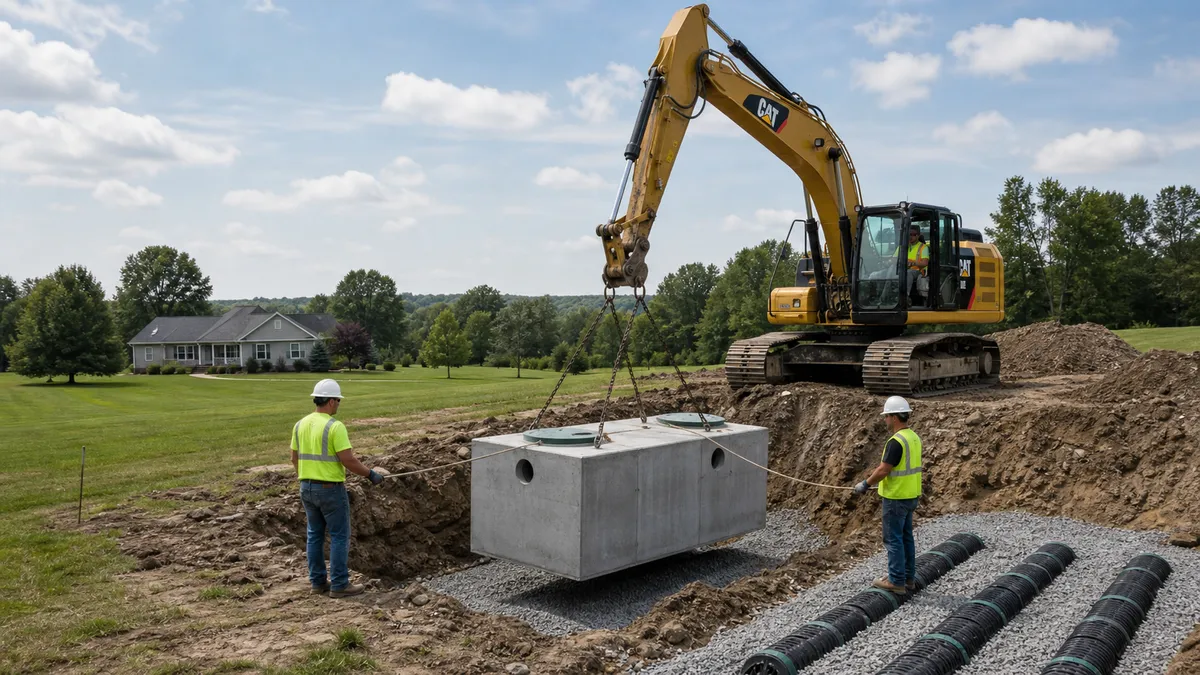
- Build. Rock excavation, imported fill and sand, dosing tank and field.
- Certify. PE construction check before backfill where required.
What it costs
| Item | Typical published figure | Where the number comes from |
|---|---|---|
| Perc test plus deep hole | $400 to $800 | Backwell perc test page |
| Engineered design, when required | $1,500 to $3,500 | Backwell perc test page |
| Pressure distribution system | $13,000 to $19,000 | Backwell system types page |
| Engineered mound | $22,000 to $28,000 | Backwell system types page |
| Aerobic treatment unit system | $15,000 to $24,000 | Backwell system types page |
| Onondaga County sewage plan review, under 1,000 gpd | $310 application; $186 redesigned project; $62 amended project | Onondaga County Local Law 11 of 2025, effective January 1, 2026 |
| Cayuga County plan review | $150 new system; $100 conventional trench repair; $150 other repair types | Cayuga County Health Department forms |
Installed ranges are typical Central New York figures Backwell publishes on its septic system types page. They are ranges, not a quote. Your number comes back in writing after we see the address and the test results.
Backwell's installation page also notes extensive rock excavation beyond the allowance is priced separately at $125 per cubic yard.
What the health department checks
- Depth to rock or hardpan in each deep hole, and whether the rock is solid or fractured.
- Any visible cracks, sinkholes or outcrops near the field.
- Fill source percs, sand gradation for mounds, and settling for raised systems.
- Pressure network design for mounds.
- Table 2 distances, measured from the toe of the fill.
Central New York specifics
Farmington soils are shallow, well drained soils over bedrock at 10 to 20 inches, found in New York and established as a series in Ontario County. On them a conventional field is out from the start. The fragipan soils of the Appalachian Plateau hills, like Volusia and Erie, are not on rock, but their dense pan 10 to 22 inches down behaves the same way for septic design.
Lake watersheds add their own rock rules. The Skaneateles Lake rules and the Otisco Lake rules both let approval be denied where rapid percolation shows up, such as in rock fissures.
Plan review: Onondaga County Bureau of Public Health Engineering (421 Montgomery Street, Syracuse), Cayuga County Health Department (8 Dill Street, Auburn), Oswego County Health Department.
Timeline
Deep holes and percs can run any time the ground is not frozen. A raised system on settled fill waits six months including a freeze and thaw, unless granular fill is compacted in shallow lifts. A mound has no settling wait. County review time varies; Cayuga County lists up to 4 to 6 weeks.
Costs. Scope. Questions.
What a septic design over shallow bedrock costs in Central New York.
A conventional trench field needs 4 feet of useable soil above bedrock, keeping 2 feet between the trench bottom and the rock. Shallow trenches work with 2 to 4 feet. A raised system works with 1 to 2 feet of good original soil, and a mound needs bedrock at least 2 feet down.
Rock can be removed, but the system then sits in disturbed or imported material that has to be stabilized and tested. The state handbook calls for contacting the health department before any site modification, and fill must settle or be compacted to spec.
Not for septic. The handbook says fractured or channeled rock under shallow soil can carry effluent so fast that groundwater and streams get contaminated. No system is allowed where fractured bedrock is at grade or within 2 feet of original grade.
For design purposes it acts like a boundary. The handbook lists fragipan with clay, shale and cemented limestone as dense layers that restrict downward flow, and the 2 foot separation is measured to it.
Not for a new home. Appendix 75-A.10 bars holding tanks for new construction except temporary use, and says they are not acceptable long term on year-round homes. The handbook allows one to correct a failing system only when no other option exists.
Backwell publishes typical Central New York installed ranges of $13,000 to $19,000 for pressure distribution and $22,000 to $28,000 for an engineered mound. Heavy rock excavation beyond the allowance is priced separately. Send the address for a written number.
Sources
- 10 NYCRR Appendix 75-A.4, Soil and site appraisal, Table 2 separation distances (NYS DOH)
- 10 NYCRR Appendix 75-A.8, Conventional subsurface treatment systems (NYS DOH)
- 10 NYCRR Appendix 75-A.9, Alternative systems: raised systems, mounds, sand filters (NYS DOH)
- 10 NYCRR Appendix 75-A.10, Other systems: holding tanks, non-waterborne systems (NYS DOH)
- NYS DOH Residential Onsite Wastewater Treatment Systems Design Handbook, 2012 edition (posted by Onondaga County Health Department)
- NYS DOH fact sheet: Need for Licensed Design Professionals, Residential Onsite Wastewater Treatment Systems
- 10 NYCRR Section 131.1, City of Syracuse Skaneateles Lake watershed rules and regulations
- 10 NYCRR Section 131.50, Onondaga County Water Authority (Otisco Lake) watershed rules
- Onondaga County Health Department, Septic Systems and Public Sewers
- Cayuga County Health Department, Application to Install a New Septic System (rev 1/7/2025)
- Oswego County septic system replacement grant application
- USDA NRCS Official Soil Series Description: Farmington
- USDA NRCS Official Soil Series Description: Volusia
- USDA NRCS Official Soil Series Description: Erie
- Backwell, Septic system types and published Central New York price ranges
- Backwell, Perc test and site evaluation price table
Rules and fees change. Everything above was checked against the linked documents in October 2026. Designs are prepared and stamped by a New York licensed Professional Engineer (PE); Backwell coordinates the design, the health department submittal and the install.