Septic Engineer in Onondaga, NY
The northern third of the Town of Onondaga is in the county sewer district. The rest is 2 acre lots on wells and septic, on soils the town calls severely limited.
Fees. Process. Answers.
Septic design for Onondaga, NY, from soil test to county approval.
The town master plan says the northern third of the town is within the county Consolidated Sanitary District and public sewers are available in significant portions of it. Most of the southern part of the town is on septic.
The master plan says zoning requires 2 acre lots where public water and public sewer are not available, and 20,000 square feet per dwelling where both are provided.
The town plan warns that soils rated only slightly limited can have rapid permeability that threatens ponds, streams and lakes, and that pollution through rock fractures is a concern. Appendix 75-A treats soil faster than 1 minute per inch as unsuitable unless modified.
The Onondaga County Health Department, Bureau of Public Health Engineering. Town of Onondaga Building and Codes issues the building permit.
Designs are prepared and stamped by a New York licensed Professional Engineer (PE). Backwell coordinates testing, design, approvals and the install.
Use the form. Estimate in 1 hour.
Septic engineer in Onondaga, NY: what it is and who needs one
The Town of Onondaga, south and west of Syracuse, splits in two for septic purposes. The town master plan says the northern third is inside the county sewer district. Most of the land outside it has soils with severe limitations for septic absorption fields. A septic engineer there tests the soil, designs to Appendix 75-A, and gets approval from the Onondaga County Health Department.
Backwell coordinates testing, design, the submittal and the install. Designs are prepared and stamped by a New York licensed Professional Engineer (PE).
The town's own description of its sewer
The Town of Onondaga Master Plan (2007, updated 2017) says the northern third of the town is within the county Consolidated Sanitary District, public sewers are available in significant portions of it, and the town controls the sewer districts inside the county boundary. Some areas have sewer without public water and some the reverse. The plan also says topography and environmental problems raise the cost of extending water and sewer into the southern half.
Zoning follows that line: 20,000 square feet per dwelling where public water and sewer are both provided, and 2 acre lots where neither is available, a rule that dates to a 1994 revision. Southern hamlets such as Navarino and South Onondaga are the kind of places where that 2 acre rule and a septic design apply.
Soils in Onondaga and the system they point to
Honeoye till covers nearly 30 percent of the town. Mohawk and Manheim soils formed in dark shale till, Palmyra gravel on the Onondaga Creek valley floor, Aurora soils over shale and Benson soils over limestone make up much of the rest.
| Soil series | Share of land | What it is (USDA) | What it usually means for the design |
|---|---|---|---|
| Honeoye | 29% | very deep, well drained loamy glacial till | Often deep enough for a conventional trench field. The perc rate and the 6 foot test pit still decide it. |
| Mohawk | 13% | very deep, well drained till high in dark shale | Good depth in most pits. Perc rate sets trench length. |
| Palmyra | 10% | very deep, well drained gravelly outwash over stratified sand and gravel | Drains well, sometimes too well. Soil faster than 1 minute per inch is not suitable as is under 75-A. |
| Aurora | 6% | moderately deep, moderately well drained till with bedrock at 20 to 40 inches | Rock and seasonal water both inside 4 feet. Shallow trench or raised bed. |
| Benson | 6% | shallow soil with limestone or calcareous shale at 10 to 20 inches | Rock this close to the surface rules out conventional trenches and a mound (mounds need 2 feet to rock). A raised bed needs at least 1 foot of usable native soil. |
| Lima | 5% | very deep, moderately well drained till strongly influenced by limestone; the till can be dense | Dense till under the subsoil can perch water in spring. Trench depth follows the mottling in the pit. |
USDA septic absorption field ratings, the Town of Onondaga boundary: very limited 79 percent, somewhat limited 21 percent of rated land. Leading limits: shallow seasonal water, fast seepage in the bottom layer, depth to bedrock.
About 79 percent of the town's rated land is very limited for a conventional field, and the leading reason is shallow seasonal water by a wide margin, then seepage, depth to bedrock and slope. The master plan raises a point worth repeating: soils rated only slightly limited can have rapid permeability that becomes a contamination hazard for nearby ponds, streams and lakes, and pollution through rock fractures is a significant concern. Palmyra gravel in the valley is the fast case. The design has to slow effluent down where perc is very rapid, and 75-A says soil faster than 1 minute per inch is not suitable as is.
Onondaga Creek, floodplains and wetlands
The master plan lists flood hazard areas along Onondaga Creek from Pumpkin Hollow to South Onondaga, along Harbor Brook, and in parts of Nedrow, and notes that septic tanks can be breached during floods. Wetlands follow the West Branch of Onondaga Creek around South Onondaga and the Pumpkin Hollow area. Fields stay 100 feet from those creeks and wetlands, above the 100 year flood level, and out of the area below the 10 year flood level entirely.
The county design guidelines list part of the Town of Onondaga inside the Otisco Lake watershed. Lots there follow the Otisco watershed rules: no seepage unit within 50 feet of the lake or a watercourse, and a county application form with the plans.
How a septic design in Onondaga works
- Send the address. Use the form. Estimate in 1 hour.
- Confirm sewer or septic. If a public sewer can serve the lot, you do not need a septic design.
- Perc holes and a deep test pit. At least two staked perc holes in the design area (30 inches deep for a conventional system) and a test pit logged to 6 feet for mottling, water and rock.
- Stamped design. A scaled plan with the tax map number, nearby wells, elevations and system details. Designs are prepared and stamped by a New York licensed Professional Engineer (PE).
- County submittal. Plan and fee go to the Bureau of Public Health Engineering, 421 Montgomery Street, Syracuse: 3 plan copies outside the lake watersheds. Once approved, a copy goes to the town.
- Town building permit. Town of Onondaga Building and Codes, 5020 Ball Road, Syracuse. The office lists Onondaga County Plumbing Control at (315) 435-6614 for plumbing.
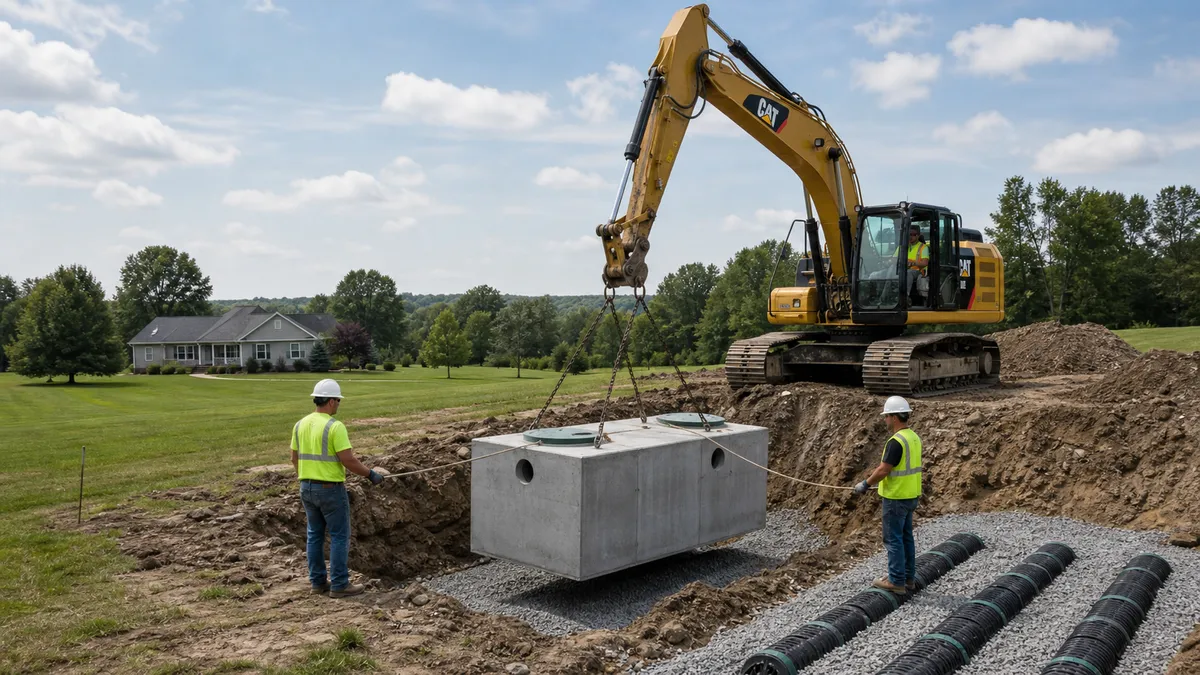
- Install and inspection. County inspection on 24 hours notice. Inside plumbing is done by a plumber licensed through Onondaga County Plumbing Control, and fill systems get the engineer's fill certification first.
What it costs
The county fee schedule sets the health department side for a lot under 1,000 gallons per day: $310 full application, $186 redesigned project, $62 amended project or revised plan review, $93 site investigation, $62 repair inspection. The fee is paid with the plans and covers the county's review and construction inspection. Testing, design and install are priced in writing.
What the health department checks
The county reviews the plan against New York's Appendix 75-A and its own design guidelines. In the Town of Onondaga the checks that most often decide the plan are seasonal water depth, the flood elevation along Onondaga Creek, and the 2 acre lot rule for lots without public utilities.
- Flow and tank. 110 gallons per day per bedroom for new construction. Tank size follows the bedroom count.
- Usable soil. Conventional: 4 feet over rock, clay or high water, with water 2 feet below the trench bottom. Shallow trench: 2 to 4 feet. Raised bed: 1 to 2 feet, water 1 foot down. Mound: water 1 foot down, rock 2 feet down, native perc faster than 120 minutes per inch, slope under 12 percent.
- Separations. Field, raised bed or mound: 100 feet to wells (200 if upgrade in the drainage path), 100 feet to water and wetlands, 20 to the house, 10 to the lot line, measured from the toe of any fill. Tank: 50 feet to wells and water.
- Site limits. No field over 15 percent slope or below the 10 year flood level, system above the 100 year flood level, no soil faster than 1 minute per inch unless modified, and 50 percent expansion area where possible.
Common Onondaga problems and how the design handles them
Valley gravel that percs too fast
The problem: Palmyra outwash can perc faster than 1 minute per inch, and the town plan warns about contamination through rapid soils and rock fractures.
How the design handles it: The PE designs to slow effluent down, using fill blending or a design matched to the fast soil, so it gets treatment before reaching groundwater.
House site in the Onondaga Creek floodplain
The problem: The master plan maps flood hazard areas along the creek and warns tanks can be breached in floods.
How the design handles it: The field and tank go above the 100 year flood level with elevations on the plan, often with a pump to reach higher ground.
Two acre lot that looks big enough
The problem: Two acres can still be tight once the 100 foot well distances, the 50 percent replacement area and the creek setback are drawn.
How the design handles it: A feasibility test and scaled layout show whether the lot works before you buy or build.
Timeline
The Town of Onondaga's top soil limit is seasonal water, so spring testing gives the best read. Lots in the Otisco watershed corner need the county watershed application with the plan. Raised beds add the county's fill certification step.
Sources
Soil shares and ratings come from the USDA NRCS soil survey (SSURGO) for Onondaga County, summarized for the Town of Onondaga boundary. Regulations and fees as published by the agencies below; they can change.
- Onondaga County Health Department, Septic Systems (Bureau of Public Health Engineering)
- Onondaga County Environmental Health fee schedule
- Onondaga County Design Guidelines for Individual Sewage Systems
- Onondaga County Health Department Fill Certification Form
- NYS DOH 10 NYCRR Appendix 75-A, Wastewater Treatment Standards, Residential Onsite Systems
- NYS DOH fact sheet: Need for Licensed Design Professionals, Residential OWTS
- Onondaga County WEP, Consolidated Sanitary District service area
- Onondaga County WEP Plumbing Control
- 10 NYCRR Section 131.50, Onondaga County Water Authority (Otisco Lake) watershed rules
- USDA NRCS Web Soil Survey, Onondaga County (NY067)
- USDA NRCS Soil Data Access (SSURGO), septic tank absorption field ratings
- Town of Onondaga Master Plan (2017 update)
- Town of Onondaga Building and Codes
- Onondaga, New York
- USDA Official Series Description: Honeoye
- USDA Official Series Description: Mohawk
- USDA Official Series Description: Palmyra
- USDA Official Series Description: Aurora
- USDA Official Series Description: Benson
- USDA Official Series Description: Lima
More septic design in Onondaga County.
Tell us about the Onondaga lot.
Send the address. Estimate in 1 hour.
Free Written Estimate
Estimate in 1 hour.