Septic Engineering Process Step by Step
From the first soil test to the county's final sign-off: who tests, who designs, who approves, who inspects, and how long each step takes in Central New York.
Test. Design. Approve.
The order of a septic project and who handles each part.
Site and soil testing (deep hole and perc tests), a design prepared by a licensed design professional, plan review and approval by the county health department or other agency with jurisdiction, construction to the approved plan, inspection before backfill, and a final certification. Several Central New York counties add watershed reviews or tie the approval to the town building permit.
It depends on the county. Onondaga, Oswego, Cayuga and Cortland county health departments review residential septic plans. In Madison County the health department reviews alternative systems and the town code officer permits ordinary ones. Oneida County's program page describes approving alternative systems for individual homes. Skaneateles plans also go to the City of Syracuse and Otisco plans to the Onondaga County Water Authority.
Cayuga County says approval may take up to 4 to 6 weeks. Madison County asks for alternative system plans at least 30 days before construction. Cortland County permits are valid for 12 months once issued. Testing season adds time: perc tests cannot be run in frozen ground.
Onondaga County asks for about 24 hours notice before required inspections, and its repair form requires an inspection before the work is covered. Cortland County says no part of a system may be covered until a New York licensed PE inspects it. Cayuga County does not inspect before backfill; the design professional verifies construction and submits a certificate of construction letter.
It is the final sign-off that the system was built to the approved plan. Cortland County issues a certificate of completion after receiving a letter from a New York licensed PE noting completion according to the permit, and the PE has 15 days after completion to verify it in writing. Cayuga County notifies the town code officer after the certificates of construction are filed so a certificate of occupancy can be issued.
Often not. Cayuga County sends a memo to the town code officer after accepting the septic plan so the town can then consider the building permit. For raised systems, Onondaga County's design guidelines say release of the building permit will not be authorized until the fill is in place and certified by the design professional.
The licensed design professional performs or oversees the site evaluation and soil tests, designs the system, and in many counties certifies the construction. The county or watershed agency reviews and approves the plan and may witness tests or inspect. The installer builds to the approved plan. Backwell coordinates the testing, the PE design, the submittal and the install.
NYS DOH Fact Sheet #1 recommends that when no regulatory agency is responsible for inspecting a finished system, a written certificate of compliance be submitted by a New York licensed professional engineer or architect before occupancy.
The septic engineering process, start to finish
Getting a septic system approved in Central New York runs through the same basic steps everywhere: test the soil, have a licensed design professional draw the plan, get it approved by the agency with jurisdiction, build it to the plan, have it inspected before it is covered, and file the final certification. What changes from county to county is who reviews, who witnesses, who inspects, and how the approval ties to your town building permit.
Below is the full sequence with who does each step, followed by the county by county differences and the timeline.
Step by step
- Send the address. Use the form on this page. You get a written estimate in 1 hour covering testing, the stamped design, the submittal and the install.
- Desk screen. Soil survey, flood level, slope, wells, surface water, wetlands and watershed rules are checked against Appendix 75-A. The NYS DOH handbook says septic location should be part of the first site layout, and that the house and well should not be started until the system is located and designed. See lot septic feasibility.
- Soil testing. At least one deep test hole at least 6 feet deep in or next to the field area, and at least two perc tests (Appendix 75-A). Backwell digs. The design professional is responsible for the results. A county or watershed inspector witnesses where required. Perc tests cannot be run in frozen ground or when rain fills the hole. See deep hole test and perc test.
- Design. A New York licensed PE sizes the system: daily flow at 110 gallons per day per bedroom for new construction, tank size from Table 3, absorption area from the perc rate, the system type from soil depth, Table 2 setbacks, and a 50 percent reserve area where possible. The plan is stamped.
- Submittal. Backwell files the plan, application and fee with the county health department or the town, plus any watershed agency.
- Review and approval. The agency reviews the plan, may visit the site, and issues an approval letter or permit. Approved plans are often copied to the town.
- Building permit. The town code officer issues the building permit once the septic approval is in hand where the town or county ties them together.
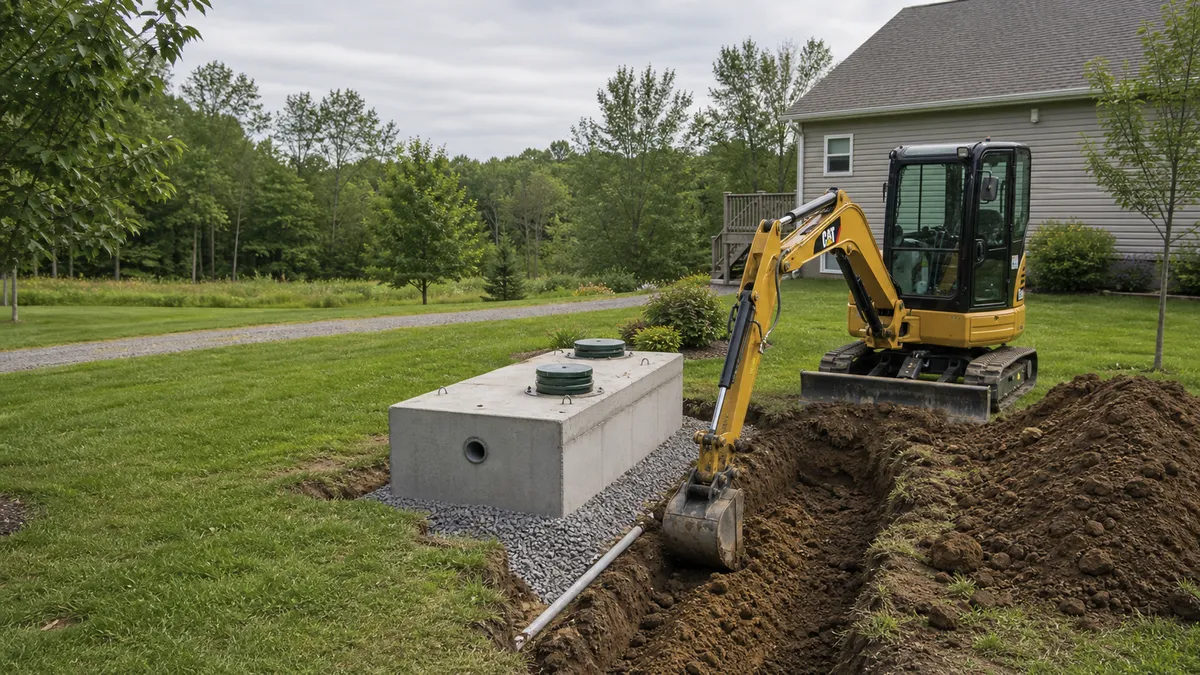
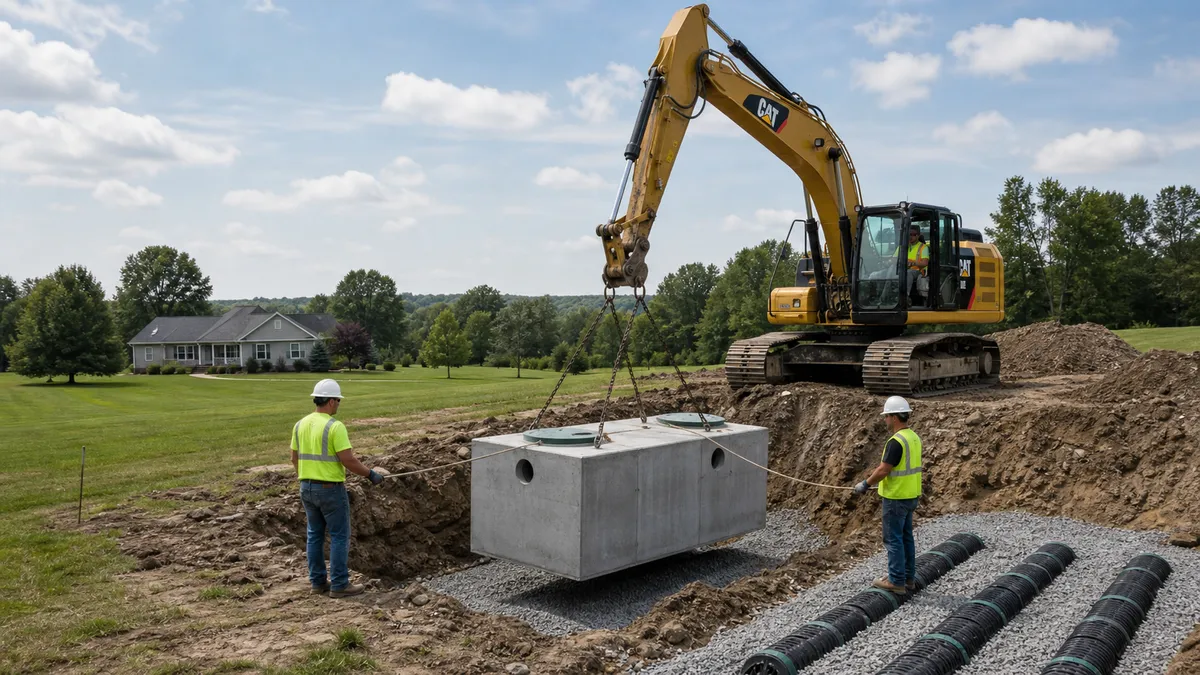
- Construction. The system is built to the approved plan. For raised systems and mounds the fill is placed and tested first under the design professional's oversight.
- Inspection before backfill. The county, the town or the PE inspects the open system, depending on the county.
- Final certification. The PE certifies the construction, the county issues its completion document where it has one, and the town can issue the certificate of occupancy.
Who does what
| Party | Role |
|---|---|
| Owner | Signs the application, pays agency fees, keeps the approved plan and final certification with the property records. |
| Licensed design professional (PE) | Under NYS DOH Fact Sheet #1, performs or oversees the site evaluation and soil tests, prepares the stamped plan, and in many counties verifies construction. Part 75 says plans shall be prepared directly by or under the supervision of a design professional. |
| County health department or town | Reviews and approves the plan, may witness tests or inspect the site, issues the permit or approval letter, and in some counties issues a certificate of completion. |
| Watershed agency | Skaneateles: City of Syracuse reviews plans and witnesses soil work. Otisco: Onondaga County Water Authority reviews plans. |
| Installer (Backwell) | Digs test pits, builds the system to the approved plan, calls for inspections, and coordinates the PE design and the submittal. |
How each county handles review, inspection and final approval
Onondaga County (Bureau of Public Health Engineering, Office of Environmental Health, John H. Mulroy Civic Center, 421 Montgomery St., Syracuse). Plan review is $310 for systems under 1,000 gallons per day (Local Law 11 of 2025). The design professional is responsible for the site evaluation and soil testing. The county wants about 24 hours notice before required inspections. Inside plumbing on new installs must be done by a plumber licensed through the County Plumbing Control Section. For raised systems, the county will not authorize release of the building permit until the fill is in place and the design professional certifies its placement and perc results. For mounds, formal approval comes once the owner's construction schedule shows the work can be done during dry soil conditions. In the Skaneateles and Otisco watersheds, the owner also completes an Application for Permit to Construct a Waste Disposal System, and the plans go to the City of Syracuse or the Onondaga County Water Authority for review before the county's final approval.
Cayuga County (8 Dill St., Auburn). New system review is $150 and approval may take up to 4 to 6 weeks. The design professional must perform the perc test and deep test hole before preparing plans, and a county inspector visits to confirm wetlands, watercourses, wells and perc holes. After the plan is accepted, the county sends a memo to the town code enforcement officer so the town can consider the building permit. The county does not inspect before backfill. The design professional verifies construction before backfill and submits a certificate of construction letter, the contractor files a certificate too, and the county then notifies the town so a certificate of occupancy can be issued. In the Skaneateles watershed the owner also contacts the City of Syracuse watershed inspector before backfill.
Cortland County (60 Central Ave., Cortland). The engineer conducts the soil tests, designs the system and inspects the install. The sewage disposal permit is $200 and is valid for 12 months. No part of the system may be covered until a New York licensed PE inspects it, and the PE verifies construction in writing within 15 days of completion. The county issues a certificate of completion after the PE's completion letter. For fill systems, the fill must be inspected and allowed to settle 45 days before trenching.
Oswego County (Environmental Health Division, 70 Bunner St., Oswego). New residential systems must be designed by a licensed professional engineer or architect. Design engineers submit four sets of plans, and plan review is $125 in 2026. A copy of the approval letter goes to the owner and to the town or city code enforcement officer.
Madison County (Madison County Public Health, 138 N. Court St., Building 5, Wampsville). The county reviews and approves alternative system designs and construction, observes percolation and deep hole tests, and asks for at least 2 copies of an engineer's design at least 30 days before construction, with a $125 review and inspection fee. Ordinary systems are permitted by the town. In the Town of Madison, for example, the code enforcement officer issues the septic permit, visually inspects every system before it is covered, and asks for 72 hours notice before backfill.
Oneida County (Environmental Health, 185 Genesee St., Utica). The county's sewage program page describes approving alternative treatment systems for individual homes and giving technical help to towns and engineers. Its plan review schedule lists $500 for an individual sewage system and $150 for a site survey.
Where no agency inspects a finished system, NYS DOH Fact Sheet #1 recommends a written certificate of compliance from a New York licensed PE or architect before occupancy.
Timeline
| Stage | What sets the time |
|---|---|
| Estimate | 1 hour after you send the address |
| Soil testing | Frozen ground stops perc tests. Perc presoak starts the day before the test. Skaneateles watershed soil work should fall between about March 15 and June 30. |
| Design | Starts when the pit log and perc results are in |
| Plan review | Cayuga: up to 4 to 6 weeks. Madison alternative systems: submit 30 days before construction. Watershed reviews add a second agency. |
| Permit life | Cortland: 12 months |
| Fill systems | Cortland: fill settles 45 days before trenching. Onondaga raised systems: building permit waits for fill certification. |
| Final | Cortland: PE letter within 15 days of completion, then certificate of completion |
Where projects stall, and the fix
Testing in the wrong season. A dry-season pit can miss the spring water table, and some agencies ask for wet-season observation. Plan the soil work early. See high water table.
Plan sent back. Missing setbacks, flood elevations or soil logs are common reasons. Onondaga County, for example, wants the soil profile to 6 feet and the flood elevation documented on the plan. See health department rejected.
Building permit waiting on septic. Start the septic work before the house plans are final, especially for raised systems in Onondaga County.
Bedrooms added later. An addition that raises the bedroom count needs a new evaluation. See bedroom addition.
Costs for each stage are on the septic engineer cost page. Replacement-specific steps are on septic replacement design.
Designs are prepared and stamped by a New York licensed Professional Engineer (PE). Backwell coordinates the design, the health department submittal, and the install.
Sources
- NYS DOH, Residential Onsite Wastewater Treatment Systems Design Handbook (includes Appendix 75-A and Fact Sheet #1)
- NYS DOH, 10 NYCRR Appendix 75-A, Wastewater Treatment Standards: Residential Onsite Systems
- Onondaga County Health Department, Septic Systems (Bureau of Public Health Engineering)
- Onondaga County Health Department, Design Guidelines for Individual Sewage Systems
- Onondaga County Local Law 11 of 2025, Health Department fees (effective 1/1/2026)
- Onondaga County, Application for Repair of Sewage Disposal System
- 10 NYCRR 131.1, Skaneateles Lake watershed rules and regulations
- 10 NYCRR 131.50, Otisco Lake watershed rules and regulations
- Cayuga County Health Department, Instructions for New Construction
- Cayuga County, Application to Install a New Septic System (rev. 1/7/2025)
- Cortland County Health Department, Sewage Systems
- Cortland County Sanitary Code (April 1, 2026)
- Cortland County Health Department, Fee Schedule effective April 1, 2026
- Oswego County Health Department, Water Supply Protection
- Oswego County Health Department, Septic Plan Review
- Oswego County Health Department, 2026 Plan Review Fee Schedule
- Madison County Public Health, Water and Septic: Individual Systems
- Madison County, Alternative Household Wastewater Treatment System Application
- Town of Madison, building and septic fee schedule
- Town of Madison, building permit application
- Oneida County Health Department, Public Water Supply and Sewage Program
- Oneida County Health Department, Plan Review Fee Schedule (rev. 3/2022)