Septic Engineer in Cicero, NY
West Cicero is sewered. East of I-81 the Cicero Swamp and the Oneida Lake shore make septic design a real engineering job. Testing, PE stamped plans and the county submittal.
Fees. Process. Answers.
Septic design for Cicero, NY, from soil test to county approval.
Cicero's 2025 comprehensive plan says the west side is well served by public sewer, while sewer is more limited on the east side because of lower density and the Cicero Swamp. Northern Route 11 has limited lines, and the land between Schuyler Road and I-481 is outside the sewer district.
The USDA rates about 98 percent of Cicero's rated land very limited for conventional fields, mostly from slow silty soil, ponding and shallow seasonal water. Raised beds and mounds build the needed separation above the water table in fill.
Appendix 75-A requires 100 feet between an absorption field, raised bed or mound and a lake, stream or wetland, measured from the toe of fill on fill systems. The system must also sit above the 100 year flood level under county guidelines.
The town says new dwelling reviews can take 2 to 6 weeks. The septic plan approval from the Onondaga County Health Department is a separate step.
Designs are prepared and stamped by a New York licensed Professional Engineer (PE). Backwell coordinates testing, design, approvals and the install.
Send the address and the job through the form. Estimate in 1 hour.
Septic engineer in Cicero, NY: what it is and who needs one
Cicero covers about 48.5 square miles between Oneida Lake on the north and Chittenango Creek on the east. A septic engineer here tests the soil, designs to Appendix 75-A, and gets the plan approved by the Onondaga County Health Department. In Cicero, more than almost anywhere in the county, that design is shaped by water: the Cicero Swamp, lake plain silts and a high spring water table.
Backwell coordinates testing, design, the submittal and the install. Designs are prepared and stamped by a New York licensed Professional Engineer (PE).
What the town plan says about Cicero sewer
Cicero's 2025 comprehensive plan, Vision Cicero, lays it out plainly. The west side of town is well served by public sewer, with town sewers on residential streets and county sewers along the larger roads. Sewer service is more limited on the east side because of lower density and the Cicero Swamp. Along northern Route 11, sewer runs north from Route 31 only as far as the MACC on Meltzer Court, and in the industrial area the land between Schuyler Road and I-481 is outside the public sewer district.
Flow from the sewered parts goes to the county's Brewerton plant on Guy Young Road (fed by the Lakeshore and Orangeport trunk sewers) and to the Oak Orchard plant in Clay. Cicero is in the county Consolidated Sanitary District, but WEP says that alone does not mean a property can connect. That leaves much of the east side of town on private septic systems.
Soils in Cicero and the system they point to
Cicero is flat lake plain. Niagara silt, somewhat poorly drained and formed in lake sediment, covers nearly 30 percent of the town by itself. Collamer silt adds another 16 percent. Carlisle and Palms muck fill the swamp and the low spots.
| Soil series | Share of land | What it is (USDA) | What it usually means for the design |
|---|---|---|---|
| Niagara | 29% | very deep, somewhat poorly drained silty lake sediments | High seasonal water and slow perc. Raised beds and mounds are common here. |
| Collamer | 16% | very deep, moderately well drained silty lake sediments | Slow perc and spring wetness. Long trenches, shallow trenches or a raised bed. |
| Carlisle | 12% | very poorly drained organic muck in depressions | Muck is not usable soil for an absorption field. The field has to go on a different part of the lot. |
| Palms | 6% | very poorly drained muck 16 to 51 inches thick over mineral soil | Organic layer is not usable. The field needs a different spot. |
| Hilton | 5% | very deep, moderately well drained till | Seasonal wetness in the lower subsoil. Shallow trench layouts come up often. |
| Canandaigua | 3% | very deep, poorly and very poorly drained silty lake sediments | Wet most of the spring. Often not usable for a field. |
USDA septic absorption field ratings, the Town of Cicero boundary: very limited 98 percent, somewhat limited 2 percent of rated land. Leading limits: slow water movement, ponding, shallow seasonal water.
About 98 percent of Cicero's rated land is very limited for a conventional field. Slow water movement is the top reason by a wide margin, then ponding and shallow seasonal water. The town plan backs that up from a different angle: federal and state wetlands are concentrated in the south, center and southeast, and 86 percent of the town's open space is restricted wetland. On most unsewered Cicero lots, the realistic designs are a raised bed or a mound, and the test pit decides which. Mounds need native soil faster than 120 minutes per inch. Raised beds need 1 to 2 feet of soil faster than 60 minutes per inch. Both need the seasonal high water at least 1 foot below the surface.
Oneida Lake shore, floodplain and the Cicero Swamp
The roughly 5,000 acre Cicero Swamp Wildlife Management Area in the southeast is the county's largest WMA. Lots near it, and near other DEC wetlands, have to hold the 100 foot septic setback from wetlands, and the county guidelines note a DEC permit may be needed for work in a regulated wetland's 100 foot adjacent area.
Along Oneida Lake, Cicero has a floodplain zone for the lake and its tributaries and a flood hazard mitigation ordinance, and the plan proposes a Waterfront Overlay along the south shore from Short Point and Lower South Bay to Maple Bay and Chittenango Creek, about half a mile inland. Septic fields stay 100 feet from the lake and above the 100 year flood level. The town also notes that new dwelling permit reviews can take 2 to 6 weeks, and that large projects may need DEC or county planning review.
How a septic design in Cicero works
- Send the address. Use the form. Estimate in 1 hour.
- Confirm sewer or septic. If a public sewer can serve the lot, you do not need a septic design.
- Perc holes and a deep test pit. At least two staked perc holes in the design area (30 inches deep for a conventional system) and a test pit logged to 6 feet for mottling, water and rock.
- Stamped design. A scaled plan with the tax map number, nearby wells, elevations and system details. Designs are prepared and stamped by a New York licensed Professional Engineer (PE).
- County submittal. Plan and fee go to the Bureau of Public Health Engineering, 421 Montgomery Street, Syracuse: 3 plan copies outside the lake watersheds. Once approved, a copy goes to the town.
- Town building permit. Town of Cicero Zoning and Planning, Code Enforcement, at Town Hall, 8236 Brewerton Road. Permits last 12 months, or 6 months if work does not start.
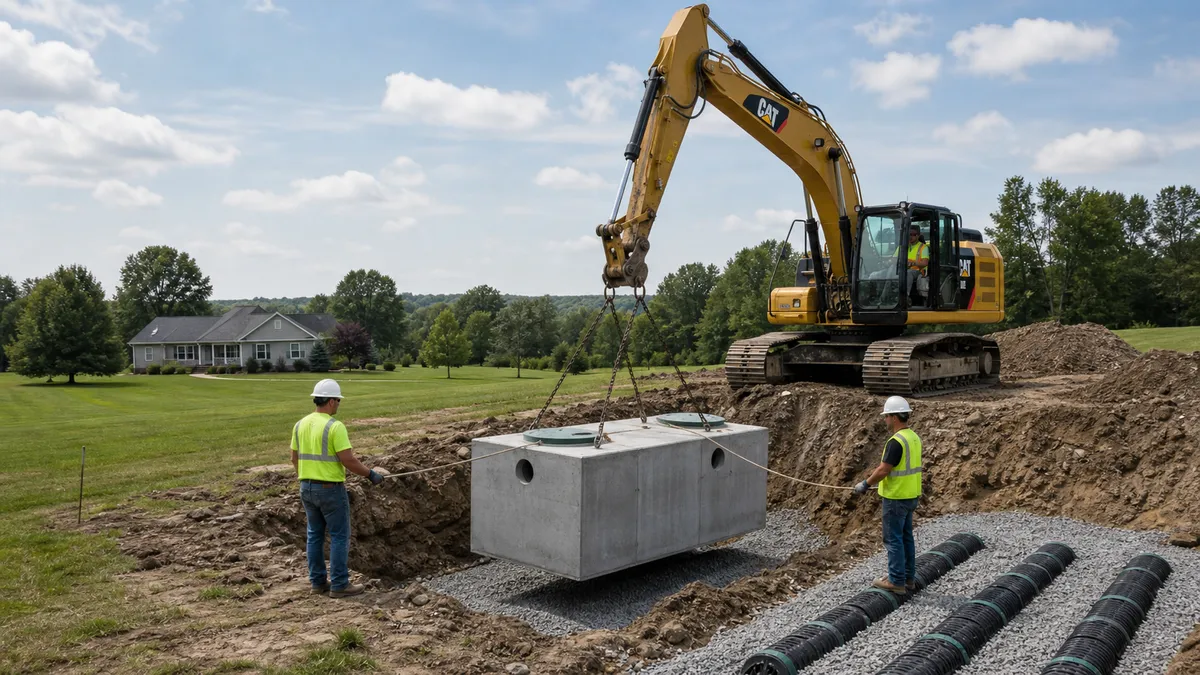
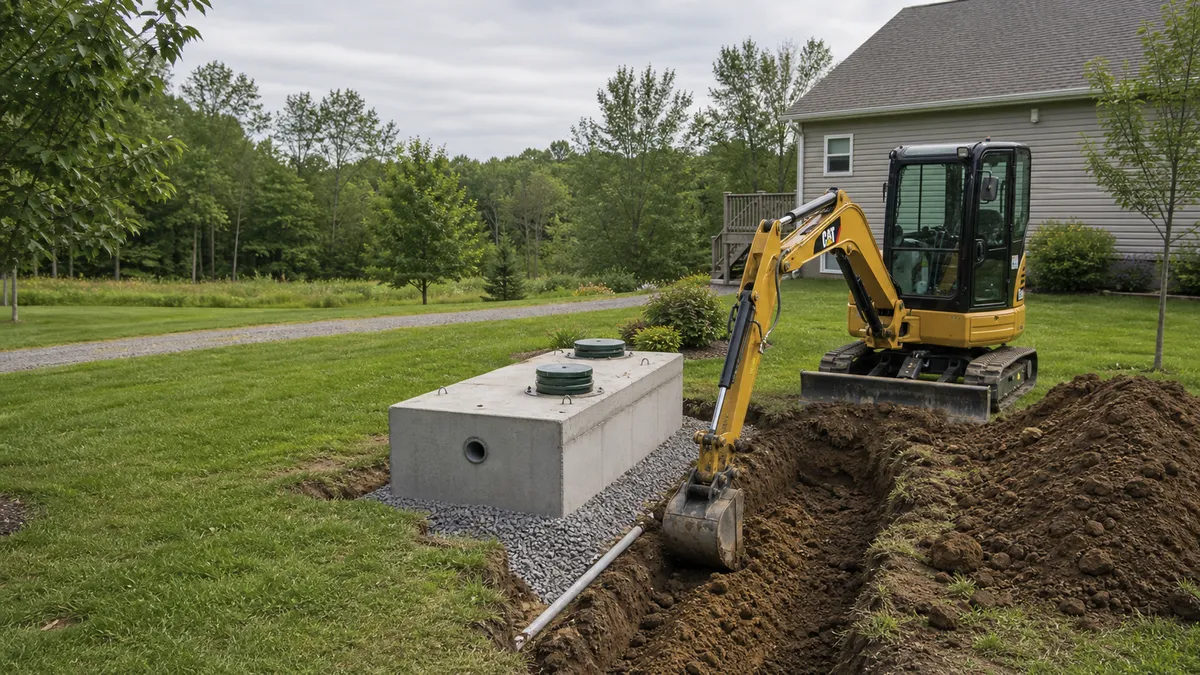
- Install and inspection. County inspection on 24 hours notice. Inside plumbing is done by a plumber licensed through Onondaga County Plumbing Control, and fill systems get the engineer's fill certification first.
What it costs
The county fee schedule sets the health department side for a lot under 1,000 gallons per day: $310 full application, $186 redesigned project, $62 amended project or revised plan review, $93 site investigation, $62 repair inspection. The fee is paid with the plans and covers the county's review and construction inspection. Testing, design and install are priced in writing.
What the health department checks
The county reviews the plan against New York's Appendix 75-A and its own design guidelines. In Cicero the design almost always turns on the 2 foot separation to seasonal high water, the 100 foot wetland and lake setbacks, and keeping the fill toe 10 feet off the property line.
- Flow and tank. 110 gallons per day per bedroom for new construction. Tank size follows the bedroom count.
- Usable soil. Conventional: 4 feet over rock, clay or high water, with water 2 feet below the trench bottom. Shallow trench: 2 to 4 feet. Raised bed: 1 to 2 feet, water 1 foot down. Mound: water 1 foot down, rock 2 feet down, native perc faster than 120 minutes per inch, slope under 12 percent.
- Separations. Field, raised bed or mound: 100 feet to wells (200 if upgrade in the drainage path), 100 feet to water and wetlands, 20 to the house, 10 to the lot line, measured from the toe of any fill. Tank: 50 feet to wells and water.
- Site limits. No field over 15 percent slope or below the 10 year flood level, system above the 100 year flood level, no soil faster than 1 minute per inch unless modified, and 50 percent expansion area where possible.
Common Cicero problems and how the design handles them
Water in the pit at 18 inches
The problem: Niagara silt holds spring water close to the surface. The county wants 2 feet of separation from the bottom of the system to the highest groundwater.
How the design handles it: If water is at least 1 foot down, a raised bed or mound builds the separation in fill. If it is shallower than 1 foot, the PE looks for a better spot or a different approach before anyone spends money on fill.
Lot backs up to the swamp
The problem: Wetlands set a 100 foot septic setback, and organic muck soil is not usable for a field.
How the design handles it: The PE maps the wetland edge, the mineral soil and the well, then fits the field in what is left. On tight lots, pressure dosed trenches or enhanced treatment can shrink the footprint.
Oneida Lake camp going year round
The problem: Older lake camps were often built with small tanks and fields close to the water and below today's setbacks.
How the design handles it: The PE checks the lot against 100 feet to the lake and the flood elevation, then designs a system that fits year round flow.
Timeline
Plan Cicero work around the water table. Spring pits show the truth, and mottling is used to set the high water line in other seasons. Add the town's 2 to 6 week dwelling review to the county approval. Mounds get formal approval once there is a construction schedule for dry conditions. Raised beds wait on settled, certified fill, which means 6 months through a freeze and thaw for native fill, or compaction in 6 inch lifts for imported sand.
Sources
Soil shares and ratings come from the USDA NRCS soil survey (SSURGO) for Onondaga County, summarized for the Town of Cicero boundary. Regulations and fees as published by the agencies below; they can change.
- Onondaga County Health Department, Septic Systems (Bureau of Public Health Engineering)
- Onondaga County Environmental Health fee schedule
- Onondaga County Design Guidelines for Individual Sewage Systems
- Onondaga County Health Department Fill Certification Form
- NYS DOH 10 NYCRR Appendix 75-A, Wastewater Treatment Standards, Residential Onsite Systems
- NYS DOH fact sheet: Need for Licensed Design Professionals, Residential OWTS
- Onondaga County WEP, Consolidated Sanitary District service area
- Onondaga County WEP Plumbing Control
- Onondaga County WEP, Brewerton WPCP
- Onondaga County WEP, Oak Orchard WWTP
- USDA NRCS Web Soil Survey, Onondaga County (NY067)
- USDA NRCS Soil Data Access (SSURGO), septic tank absorption field ratings
- Vision Cicero, Town of Cicero Comprehensive Plan (2025)
- Town of Cicero Zoning and Planning
- Town of Cicero officials
- USDA Official Series Description: Niagara
- USDA Official Series Description: Collamer
- USDA Official Series Description: Carlisle
- USDA Official Series Description: Palms
- USDA Official Series Description: Hilton
- USDA Official Series Description: Canandaigua
More septic design in Onondaga County.
Tell us about the Cicero lot.
Send the address. Estimate in 1 hour.
Free Written Estimate
Estimate in 1 hour.