High Water Table Septic Design in Central NY
Wet spring soil is the most common reason a CNY lot cannot take a standard leach field. Here is what the state measures and the designs that lift the field out of the water.
The short answer
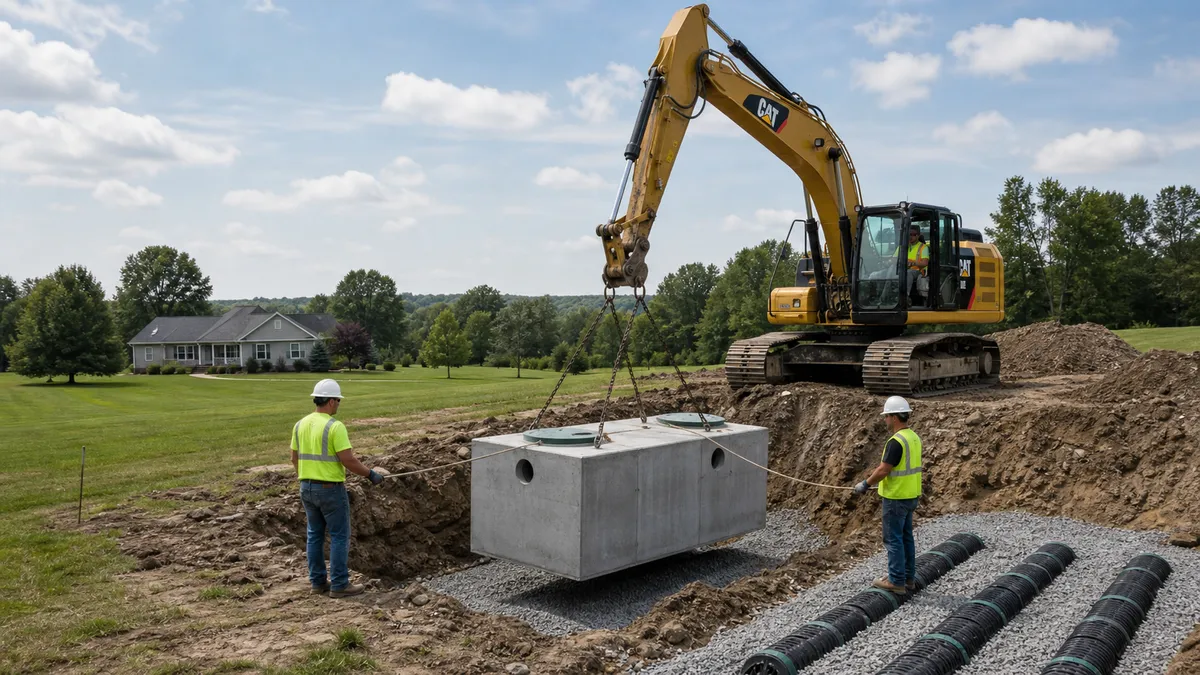
New York requires at least 2 feet of unsaturated soil between the bottom of a leach trench and the highest seasonal groundwater, and a conventional field needs 4 feet of useable soil above that water. When spring water sits higher than that, the fix is to raise the field: shallow trenches with fill, a raised system, or a sand mound, often with a curtain drain upslope.
The answer depends on how high the water gets in a wet spring, not what you see in August.
How to tell you have a high water table
- Standing water or soft ground in the yard in April and May that dries out by summer.
- A sump pump that runs hard every spring.
- Gray soil with rust colored blotches (mottling) close to the surface when you dig.
- Cattails, certain ferns or purple loosestrife growing where the field would go. The state handbook names these as wet soil plants that help confirm a deep hole reading.
- An existing field that gurgles, smells or backs up in spring and behaves in late summer.
How the state measures it
Appendix 75-A.4 says the highest groundwater level has to be determined, including its depth and type: perched, apparent or artesian. The design handbook explains why mottling matters. Gray colors form where soil sits saturated and iron is chemically reduced. Yellowish brown colors form where soil is aerated. Soils with a seasonal high water table usually show mottling at the high water mark and below.
Spring rain and snowmelt normally push groundwater to its high between March 15 and June 30. A dry spring can hide it, so mottling always has to be checked. In some soils mottling does not show, and the only accurate way is to watch a monitoring well or open hole during that spring window.
The deep hole for a trench system should be at least 6 feet deep, and preferably 4 feet below the planned trench bottom, inside or right next to the proposed field.
What New York rules say
| Situation | Rule |
|---|---|
| Conventional trenches | 4 feet of useable soil above groundwater; 2 feet between trench bottom and high groundwater (75-A.4, 75-A.8) |
| Shallow trenches | At least 2 but less than 4 feet of useable soil and separation; 2 feet kept under every trench; fill no more than 30 inches above original grade |
| Raised system | Maximum high groundwater at least 1 foot below original ground; fill percing 5 to 30 min/in builds back 2 feet of separation; dosing or pressure distribution required unless local conditions are met |
| Mound | Maximum high groundwater at least 1 foot below original ground; slope 12% or less; pressure distribution required |
| Seepage pit | 3 feet between pit bottom and high groundwater; not allowed where trenches would work |
| Flood zone | Areas below the 10 year flood level are unacceptable for onsite systems |
| Plastic tanks | Fiberglass and polyethylene tanks cannot go where groundwater can rise to the tank bottom |
If water stands less than 1 foot below the surface in the wet season, neither a raised system nor a mound qualifies on its own. That is when groundwater control or a different spot on the lot comes into play.
Curtain drains: when they help and when they do not
A curtain drain is a gravel trench with perforated pipe placed upslope of the field to catch shallow groundwater moving downhill and send it out to daylight. The state handbook sets the rules:
- On sites of 5 percent slope or more, the collection drain should be at least 15 feet upslope of the field.
- On flatter ground the gap grows 5 feet for each 1 percent less slope, and under 1 percent it should be 100 feet. The handbook says the method will not be effective on flat sites.
- The drain outlet must be at least 20 feet from the field.
- Downslope curtain or footing drains in the path of the field should stay 100 feet away, or 50 feet under certain soil conditions, so effluent does not short circuit to the outlet.
- The drain has to prove it works during the wet season before the field goes in when the slope is under 5 percent, the soil percs slower than 30 minutes per inch, or the drain does not reach the layer causing the water.
For raised systems, Appendix 75-A.9 adds that curtain drains go upslope and at least 20 feet from the toe of the fill.
Which design solves it
Water at 3 to 4 feet: shallow trenches with matching fill can work.
Water at 1 to 2 feet with decent native soil: raised bed septic design with select fill and a 20 foot minimum taper.
Water at 1 to 2 feet, slow native soil: mound septic design. Mound fill must perc 5 to 30 minutes per inch and meet grain size limits.
Any of the above: pressure distribution spreads effluent evenly in thin soil.
Tight lot near water: enhanced treatment cleans effluent before the field. The handbook warns limits like high water tables still have to be accounted for.
How it works with Backwell
- Send the address. Estimate in 1 hour.
- Deep hole in the right season. A deep hole soil test reads mottling; in some soils the PE wants a spring observation.
- Design. Plans are prepared and stamped by a New York licensed Professional Engineer (PE), sized to the wettest reading.
- Submittal. Backwell files with the county health department and any watershed office.
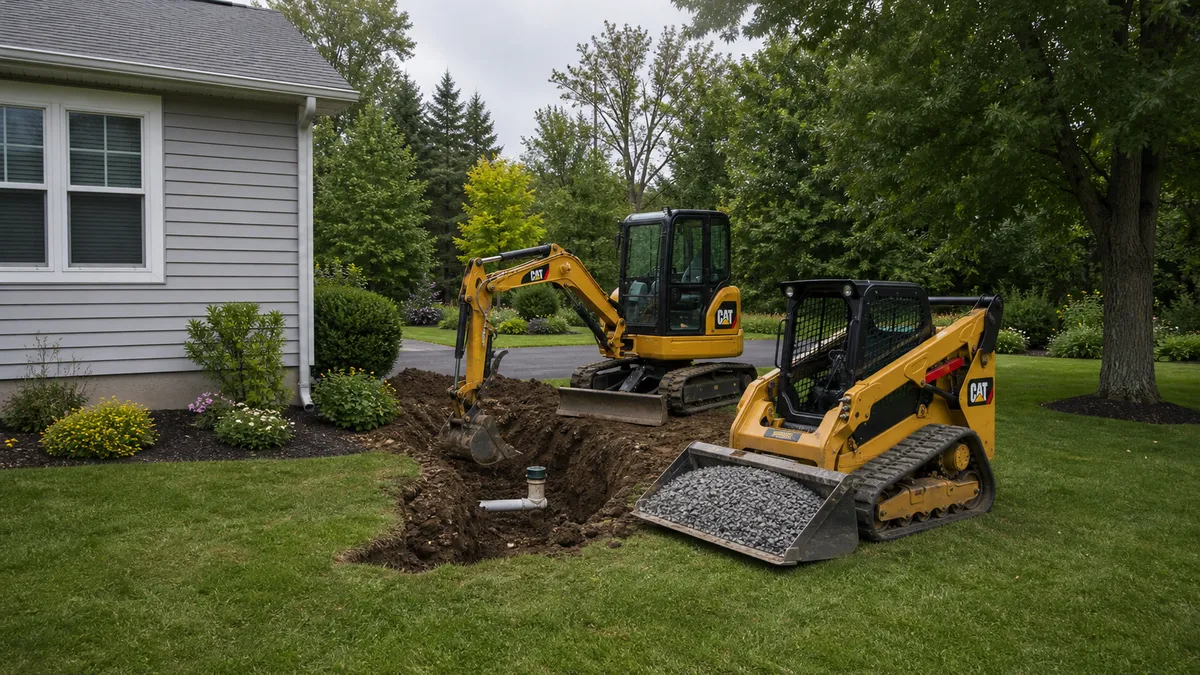
- Build. No heavy equipment in the basal area; fill placed from upslope; topsoil and seed.
- Certify. PE construction check before backfill where required.
What it costs
| Item | Typical published figure | Where the number comes from |
|---|---|---|
| Perc test plus deep hole | $400 to $800 | Backwell perc test page |
| Engineered design, when required | $1,500 to $3,500 | Backwell perc test page |
| Pressure distribution system | $13,000 to $19,000 | Backwell system types page |
| Engineered mound | $22,000 to $28,000 | Backwell system types page |
| Aerobic treatment unit system | $15,000 to $24,000 | Backwell system types page |
| Onondaga County sewage plan review, under 1,000 gpd | $310 application; $186 redesigned project; $62 amended project | Onondaga County Local Law 11 of 2025, effective January 1, 2026 |
| Cayuga County plan review | $150 new system; $100 conventional trench repair; $150 other repair types | Cayuga County Health Department forms |
Installed ranges are typical Central New York figures Backwell publishes on its septic system types page. They are ranges, not a quote. Your number comes back in writing after we see the address and the test results.
What the health department checks
- Mottling depth and any free water in the deep hole, with the date it was dug.
- Whether the design keeps 2 feet of separation in the wettest month.
- Fill source percs and settling for raised systems.
- Curtain drain location, outlet and separation.
- Table 2 distances measured from the toe of any fill.
Central New York soils with seasonal high water
Canandaigua soils are very deep, poorly and very poorly drained silty lake sediments on lowland lake plains and in depressions. USDA notes much of it is drained for crops. Lamson soils, first described in Onondaga County, are poorly and very poorly drained soils on low, flat glacial lake plains, found on the Erie, Oneida and Ontario lake plains. Neither is a candidate for an in ground field.
Covert sand is moderately well drained, but USDA puts its apparent seasonal high water table 2.0 to 3.5 feet below the surface between September and May. On Covert sand a conventional field with 4 feet of useable soil usually does not fit, while shallow trenches or a raised system often do. Windsor sands are excessively drained with very high conductivity, so the risk there is effluent moving too fast, not water standing.
On the hills, Mardin soils carry a seasonal water table 14 to 24 inches down, above a dense fragipan that starts 14 to 26 inches down. Shallow water sitting on a tight layer like that is the kind of condition a curtain drain on a slope is built to intercept.
Plan review sits with the county: Onondaga County's Bureau of Public Health Engineering, the Cayuga County Health Department at 8 Dill Street in Auburn, and the Oswego County Health Department.
Timeline
If the deep hole is dug outside March 15 to June 30, the PE reads mottling; if that is unclear, expect to wait for spring. Raised system fill must settle six months with a freeze and thaw unless it is granular and compacted in lifts. Mounds use sand and need no settling. Cayuga County lists up to 4 to 6 weeks for plan approval.
Costs. Scope. Questions.
What a high water table septic design costs in Central New York.
A conventional trench needs 4 feet of useable soil above seasonal high groundwater and 2 feet between the trench bottom and the water. If the water comes within 1 foot of the surface in the wet season, even a raised system or mound does not qualify without groundwater control.
The state handbook says groundwater normally peaks between March 15 and June 30. Outside that window the engineer reads soil mottling. Where mottling is not visible, the only accurate method is watching a hole or monitoring well during the spring high water period.
Sometimes. A curtain drain works on sloped ground where water moves sideways on a tight layer. The state handbook says it will not be effective on flat sites, and in some cases the drain has to prove it lowers the water before the field can be built.
Both need groundwater at least 1 foot below the original surface. A raised system needs 1 to 2 feet of original soil that percs faster than 60 minutes per inch and settled fill. A mound can sit on slower native soil, uses sand fill with no settling period, and requires pressure distribution and a slope of 12 percent or less.
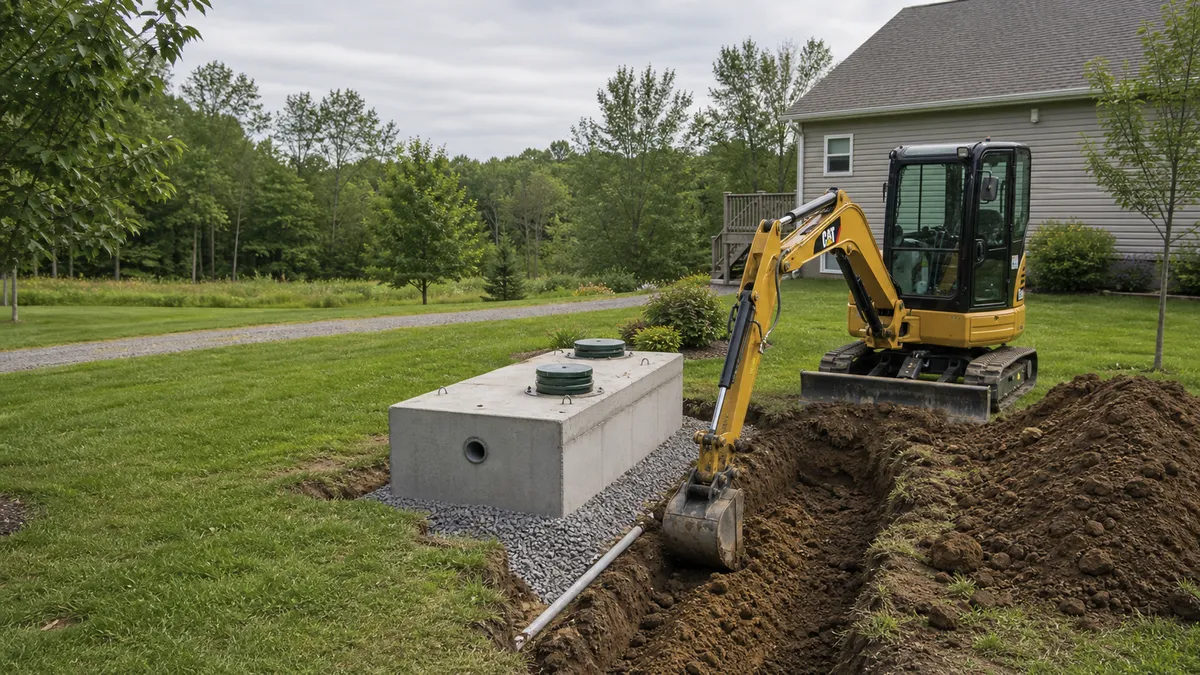
Not where groundwater can rise to the bottom of the tank. Appendix 75-A.6 bars fiberglass and polyethylene tanks in that condition, so a concrete tank is the usual choice on high water sites.
Backwell publishes typical Central New York installed ranges of $13,000 to $19,000 for pressure distribution and $22,000 to $28,000 for an engineered mound. Design by a PE runs $1,500 to $3,500 when required. Send the address for a written price.
Sources
- 10 NYCRR Appendix 75-A.4, Soil and site appraisal, Table 2 separation distances (NYS DOH)
- 10 NYCRR Appendix 75-A.6, Septic tanks and enhanced treatment units (NYS DOH)
- 10 NYCRR Appendix 75-A.8, Conventional subsurface treatment systems (NYS DOH)
- 10 NYCRR Appendix 75-A.9, Alternative systems: raised systems, mounds, sand filters (NYS DOH)
- 10 NYCRR Appendix 75-A.7, Distribution devices, pressure distribution and dosing (NYS DOH)
- NYS DOH Residential Onsite Wastewater Treatment Systems Design Handbook, 2012 edition (posted by Onondaga County Health Department)
- NYS DOH fact sheet: Need for Licensed Design Professionals, Residential Onsite Wastewater Treatment Systems
- Onondaga County Health Department, Septic Systems and Public Sewers
- Cayuga County Health Department, Application to Install a New Septic System (rev 1/7/2025)
- Oswego County septic system replacement grant application
- USDA NRCS Official Soil Series Description: Canandaigua
- USDA NRCS Official Soil Series Description: Lamson
- USDA NRCS Official Soil Series Description: Covert
- USDA NRCS Official Soil Series Description: Windsor
- USDA NRCS Official Soil Series Description: Mardin
- Onondaga County Local Law No. 11 of 2025, Health Department fees (effective January 1, 2026)
- Backwell, Septic system types and published Central New York price ranges
- Backwell, Perc test and site evaluation price table
Rules and fees change. Everything above was checked against the linked documents in October 2026. Designs are prepared and stamped by a New York licensed Professional Engineer (PE); Backwell coordinates the design, the health department submittal and the install.