Septic Engineer in Elbridge, NY
Two villages, Jordan and Elbridge, and a lot of rural town between them and Cross Lake. Testing, PE stamped designs and the county submittal.
Fees. Process. Answers.
Septic design for Elbridge, NY, from soil test to county approval.
Yes. The Town of Elbridge codes page says modifications to existing septic systems, including additions that increase bedrooms or encroach on any part of the existing system, must be approved by the Onondaga County Health Department.
The Town of Elbridge is not in the county Consolidated Sanitary District. The Village of Jordan runs its own sewer system. Most rural town properties are on septic.
Appendix 75-A says soils with percolation faster than 1 minute per inch are not suitable for absorption systems unless the site is modified, because effluent passes through without enough treatment. Elbridge has a lot of gravel outwash.
The Onondaga County Health Department, Bureau of Public Health Engineering. The Town of Elbridge issues the building permit.
Designs are prepared and stamped by a New York licensed Professional Engineer (PE).
Use the form. Estimate in 1 hour.
Septic engineer in Elbridge, NY: what it is and who needs one
The Town of Elbridge runs from Cross Lake and the Seneca River on the north to Skaneateles Junction on the south, with the villages of Jordan and Elbridge along Routes 31 and 5. Outside the villages, homes are on private systems. A septic engineer tests the soil, designs to Appendix 75-A, and gets approval from the Onondaga County Health Department.
Backwell coordinates testing, design, the submittal and the install. Designs are prepared and stamped by a New York licensed Professional Engineer (PE).
Where Elbridge has sewer
The Town of Elbridge is not in the county Consolidated Sanitary District. The Village of Jordan has its own sewer system, with village sewer rates and a treatment operator on staff. For properties outside the villages, including the hamlets of Skaneateles Junction (also called Hartlot), Peru, Halfway, Laird Corners and Memphis, plan on septic.
The town's codes page is direct about it: all new septic system designs and modifications to existing systems, including additions that increase the number of bedrooms or encroach on any component of the existing system, must be approved by the Onondaga County Health Department, Division of Environmental Health.
Soils in Elbridge and the system they point to
Elbridge has a varied map. Ontario and Honeoye till on the drumlins, Palmyra and Wampsville gravel on the outwash along Skaneateles Creek and Route 5, Camillus soils over shale, Madrid till, and Carlisle muck in the low spots toward Cross Lake.
| Soil series | Share of land | What it is (USDA) | What it usually means for the design |
|---|---|---|---|
| Ontario | 16% | deep or very deep, well drained loamy till on drumlins and till plains | Usually workable for conventional or shallow trenches. Drumlin slopes can push past the 15 percent limit. |
| Palmyra | 12% | very deep, well drained gravelly outwash over stratified sand and gravel | Drains well, sometimes too well. Soil faster than 1 minute per inch is not suitable as is under 75-A. |
| Honeoye | 10% | very deep, well drained loamy glacial till | Often deep enough for a conventional trench field. The perc rate and the 6 foot test pit still decide it. |
| Camillus | 7% | moderately deep, well drained soil over weathered calcareous shale | Shale shows up inside the 4 feet a conventional field needs, which points to shallow trench or raised designs. |
| Madrid | 7% | very deep, well drained loamy till, moderate to moderately slow in the substratum | Good depth. A slow substratum can stretch trench length. |
| Wampsville | 5% | very deep, well drained outwash with reddish shale | Usually good depth. Gravelly layers can perc fast. |
USDA septic absorption field ratings, the Town of Elbridge boundary: very limited 82 percent, somewhat limited 18 percent of rated land. Leading limits: fast seepage in the bottom layer, shallow seasonal water, slow water movement.
About 82 percent of the town's rated land is very limited for a conventional field. Seepage in the bottom layer leads the reasons, which is the fast gravel, ahead of seasonal water, slow water movement and depth to bedrock. That makes Elbridge a town of two problems. On Palmyra and Wampsville gravel, effluent can move too fast, and 75-A treats soil faster than 1 minute per inch as unsuitable unless modified. On the Carlisle muck and wet ground toward Cross Lake, the soil is not usable at all. Ontario and Honeoye drumlins in between are the best bets for a conventional or shallow trench field.
Cross Lake, the Seneca River and Skaneateles Creek
Part of Cross Lake, with South Bay, is in the northeast corner of the town, and the Erie Canal and Seneca River form part of the north border. Fields stay 100 feet from the lake, river, creeks and wetlands, and above the 100 year flood level. The Seneca River from the Cross Lake outlet to Klein Island is on the county septic replacement grant list for properties within 250 feet with failing or substandard systems.
Elbridge also registers and inspects rental units, every 24 months for single family and long term rentals and annually for multi family and short term rentals, which can bring an old septic system to light.
How a septic design in Elbridge works
- Send the address. Use the form. Estimate in 1 hour.
- Confirm sewer or septic. If a public sewer can serve the lot, you do not need a septic design.
- Perc holes and a deep test pit. At least two staked perc holes in the design area (30 inches deep for a conventional system) and a test pit logged to 6 feet for mottling, water and rock.
- Stamped design. A scaled plan with the tax map number, nearby wells, elevations and system details. Designs are prepared and stamped by a New York licensed Professional Engineer (PE).
- County submittal. Plan and fee go to the Bureau of Public Health Engineering, 421 Montgomery Street, Syracuse: 3 plan copies outside the lake watersheds. Once approved, a copy goes to the town.
- Town building permit. Town of Elbridge Building, Codes and Zoning, 5 Route 31, Jordan, 315-689-9031 extension 6.
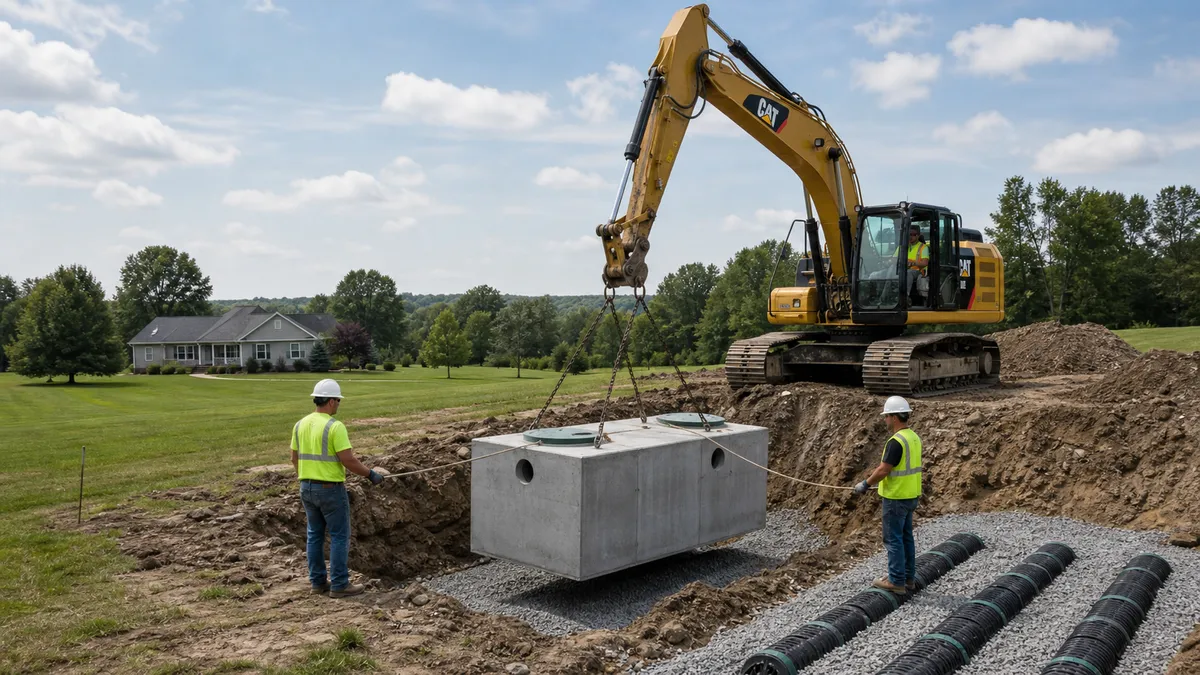
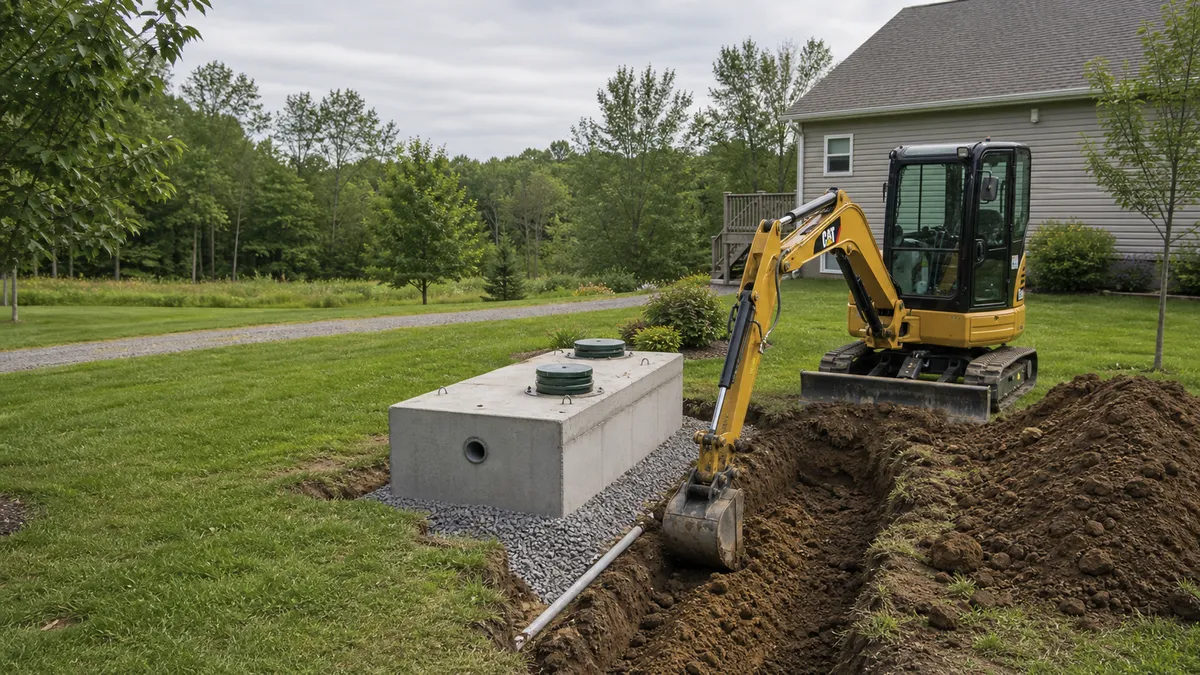
- Install and inspection. County inspection on 24 hours notice. Inside plumbing is done by a plumber licensed through Onondaga County Plumbing Control, and fill systems get the engineer's fill certification first.
What it costs
The county fee schedule sets the health department side for a lot under 1,000 gallons per day: $310 full application, $186 redesigned project, $62 amended project or revised plan review, $93 site investigation, $62 repair inspection. The fee is paid with the plans and covers the county's review and construction inspection. Testing, design and install are priced in writing.
What the health department checks
The county reviews the plan against New York's Appendix 75-A and its own design guidelines. In Elbridge the checks that decide most designs are fast gravel perc rates, the Cross Lake and river setbacks, and the bedroom count against the existing system on additions.
- Flow and tank. 110 gallons per day per bedroom for new construction. Tank size follows the bedroom count.
- Usable soil. Conventional: 4 feet over rock, clay or high water, with water 2 feet below the trench bottom. Shallow trench: 2 to 4 feet. Raised bed: 1 to 2 feet, water 1 foot down. Mound: water 1 foot down, rock 2 feet down, native perc faster than 120 minutes per inch, slope under 12 percent.
- Separations. Field, raised bed or mound: 100 feet to wells (200 if upgrade in the drainage path), 100 feet to water and wetlands, 20 to the house, 10 to the lot line, measured from the toe of any fill. Tank: 50 feet to wells and water.
- Site limits. No field over 15 percent slope or below the 10 year flood level, system above the 100 year flood level, no soil faster than 1 minute per inch unless modified, and 50 percent expansion area where possible.
Common Elbridge problems and how the design handles them
Gravel that percs in seconds
The problem: Palmyra and Wampsville outwash can be faster than 1 minute per inch, which 75-A says is not suitable unless modified.
How the design handles it: The PE designs to slow the effluent, for example by blending with less permeable soil across the field area as 75-A allows, or by pressure dosing a smaller area.
Adding a bedroom on septic
The problem: The town says additions that increase bedrooms need county Health Department approval.
How the design handles it: The PE evaluates the existing tank and field against the new bedroom count and designs the upgrade if needed.
Lot toward Cross Lake with muck
The problem: Carlisle muck is not usable for a field, and wetlands carry a 100 foot setback.
How the design handles it: Test pits find the mineral soil, and the field goes there.
Timeline
Gravel lots can be tested most of the year. Lots toward Cross Lake and the river should be tested in spring. A bedroom addition evaluation belongs before the building permit.
Sources
Soil shares and ratings come from the USDA NRCS soil survey (SSURGO) for Onondaga County, summarized for the Town of Elbridge boundary. Regulations and fees as published by the agencies below; they can change.
- Onondaga County Health Department, Septic Systems (Bureau of Public Health Engineering)
- Onondaga County Environmental Health fee schedule
- Onondaga County Design Guidelines for Individual Sewage Systems
- Onondaga County Health Department Fill Certification Form
- NYS DOH 10 NYCRR Appendix 75-A, Wastewater Treatment Standards, Residential Onsite Systems
- NYS DOH fact sheet: Need for Licensed Design Professionals, Residential OWTS
- Onondaga County WEP, Consolidated Sanitary District service area
- Onondaga County WEP Plumbing Control
- Onondaga County Septic System Replacement Funding Program
- USDA NRCS Web Soil Survey, Onondaga County (NY067)
- USDA NRCS Soil Data Access (SSURGO), septic tank absorption field ratings
- Town of Elbridge Building, Codes and Zoning
- Village of Jordan Public Works
- Elbridge, New York
- USDA Official Series Description: Ontario
- USDA Official Series Description: Palmyra
- USDA Official Series Description: Honeoye
- USDA Official Series Description: Camillus
- USDA Official Series Description: Madrid
- USDA Official Series Description: Wampsville
More septic design in Onondaga County.
Tell us about the Elbridge lot.
Send the address. Estimate in 1 hour.
Free Written Estimate
Estimate in 1 hour.