Failed Perc Test? Septic Engineer in Central NY
A failed perc test is a design problem, not always a dead lot. Find out what failed, what New York allows next, and what the fix costs.
The short answer
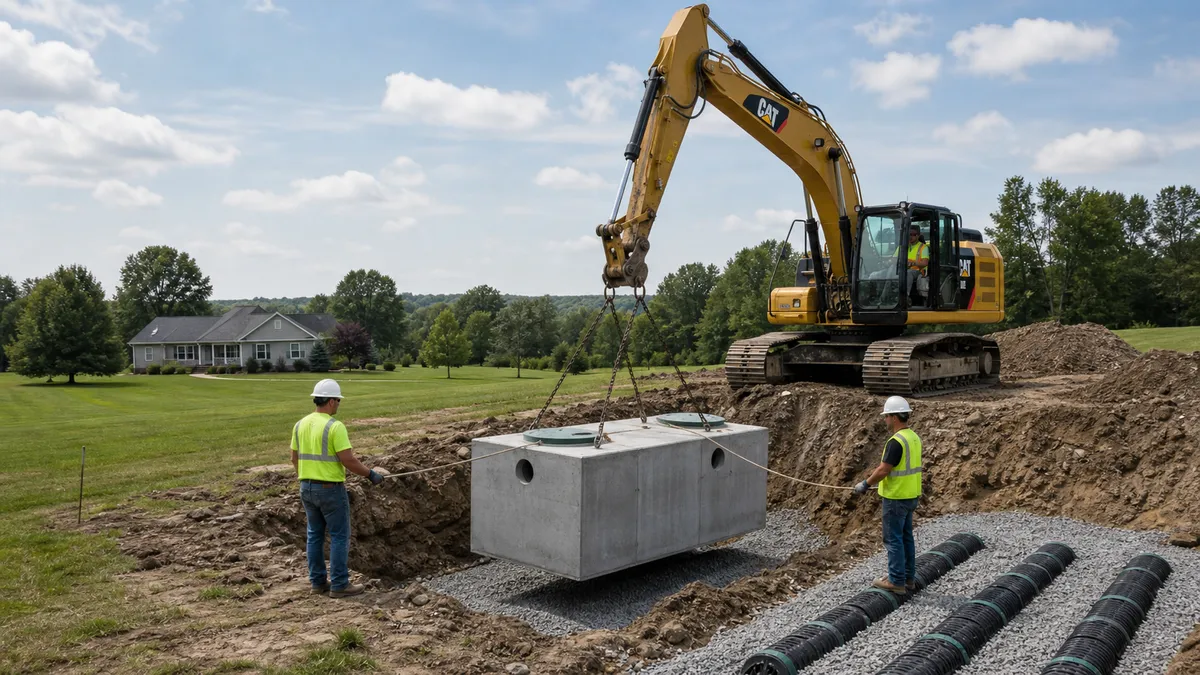
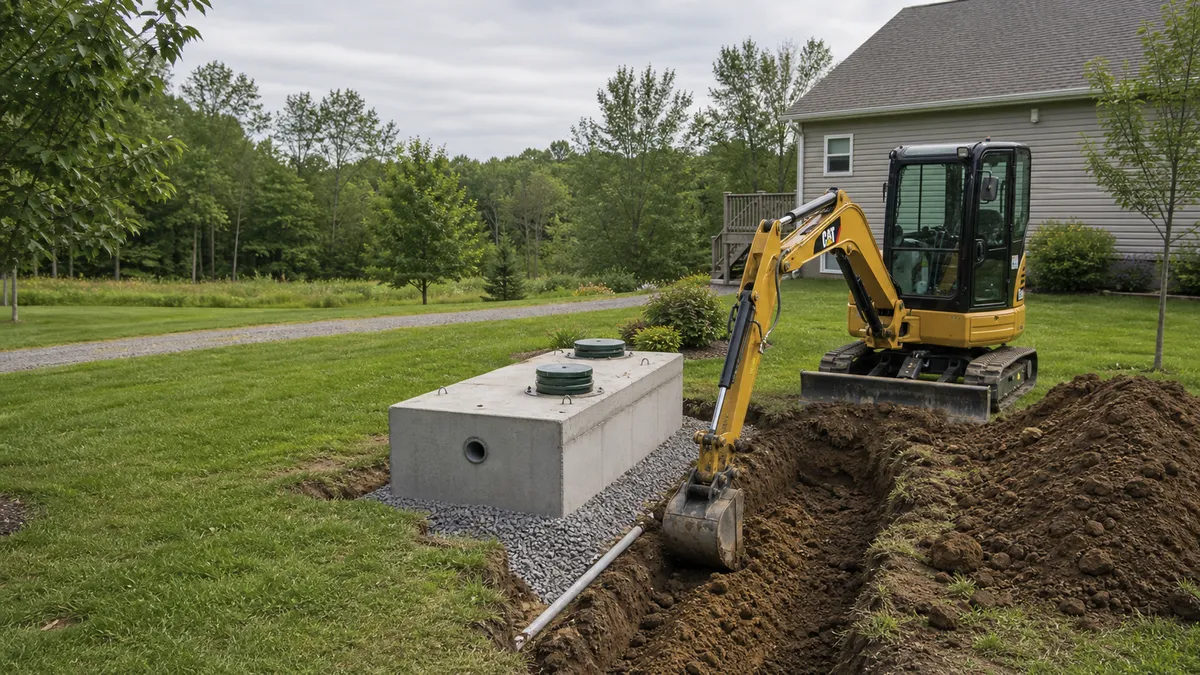
A perc test fails in New York when the soil drains slower than 60 minutes per inch, faster than 1 minute per inch, or when the test hole shows water, rock or a tight layer too close to the surface. In most of those cases a licensed engineer can still design a septic system that meets state rules: a cut and fill system, a raised system, a mound, or a pressure dosed field.
The first job is to find out exactly why the test failed. "Failed" on a form can mean four different things, and each one points to a different design.
What a perc test actually measures
The New York State Department of Health design handbook spells out the test. A hole about 12 inches across is dug by hand to the depth of the future trench bottom, usually 24 to 30 inches below final grade. The hole is pre-soaked for at least four hours, starting the day before, so clay in the soil swells the way it will once the system is running. On test day the hole is filled to 6 inches and the tester times how long the water takes to drop from 6 inches to 5 inches. The run is repeated at least three times until two readings match. The slowest stable reading is the design rate.
At least two perc tests are required at each proposed system, with the slowest one used for design. One more test should go in the reserve area. Tests can be run any time the ground is not frozen and rain is not adding water to the hole.
Appendix 75-A defines useable soil as soil that percs between 1 and 60 minutes per inch. That range is the whole game for a standard trench system.
Four ways a perc test fails, and what each one means
1. Too slow: slower than 60 minutes per inch
Silty clay, clay loam and dense glacial till hold water. Above 60 minutes per inch the soil is not "useable" for a conventional trench. But a slow surface layer is not always the whole story. If better soil sits underneath, the state rules allow a cut and fill system or deep trenches. If the native soil percs faster than 120 minutes per inch, a mound can be sized on it. See our page on septic on clay soil.
2. Too fast: faster than 1 minute per inch
Clean sand and gravel can pass effluent to groundwater before it is treated. Appendix 75-A.4 says these soils are unsuitable unless the site is modified by blending in a less permeable soil. The handbook describes a special cut and fill: all soil within 2 feet of the trenches is removed and replaced with soil that percs 5 to 60 minutes per inch, with 5 to 10 preferred.
3. Water in the hole
If the deep hole fills with water, or the walls show gray and rust mottling close to the surface, the perc rate may be fine but the separation to seasonal high groundwater is not. That is a high water table problem, solved with shallow trenches, a raised system or a mound.
4. Rock or a hardpan
Bedrock, a fragipan or a clay layer inside 4 feet stops a conventional field. That is covered on our shallow bedrock page.
What New York rules allow after a failed test
| Design | Key site limits in Appendix 75-A |
|---|---|
| Conventional trenches | 4 feet of useable soil (1 to 60 min/in) above rock and groundwater, 2 feet of separation under the trench bottom, trenches 18 to 30 inches deep |
| Shallow trenches | At least 2 but less than 4 feet of useable soil; trench bottom no higher than original grade; up to 30 inches of fill |
| Cut and fill | Soil slower than 60 min/in over useable soil, with at least 3 feet of useable soil under the tight layer; tight soil dug out and replaced |
| Deep absorption trenches | 3 to 5 feet of impermeable soil over at least 4 feet of useable soil |
| Raised system | At least 1 foot but not more than 2 feet of original soil faster than 60 min/in; high groundwater at least 1 foot down; slope 15% or less; fill that percs 5 to 30 min/in |
| Mound | Native soil faster than 120 min/in; groundwater at least 1 foot down; bedrock at least 2 feet down; slope 12% or less; pressure distribution required |
The mound line matters most to people who "failed." A soil that percs 61 to 120 minutes per inch is not useable for trenches, but Appendix 75-A.9 sizes a mound's basal area on it at 0.2 gallons per day per square foot. That is often the path for a lot that failed on slow soil.
Why a slow perc makes the field so big
Table 4A in Appendix 75-A sets trench length by perc rate and flow. New homes are designed at 110 gallons per day per bedroom, so a 3 bedroom house is 330 gallons per day. At that flow the required 2 foot wide trench length is:
- 1 to 5 minutes per inch: 138 feet of trench
- 21 to 30 minutes per inch: 275 feet
- 46 to 60 minutes per inch: 367 feet
Trenches must sit at least 4 feet apart with undisturbed soil between them, and the regs want a 50 percent reserve area set aside whenever possible. On a slow soil the field plus reserve can outgrow the lot, which is why designers move to mounds or pressure distribution. Dosing is required once total trench length reaches 500 feet.
Which design solves it
Slow topsoil over better soil: conventional design using cut and fill or deep trenches.
Slow soil with only 1 to 2 feet of workable ground: raised bed septic design with select fill, dosed or pressure fed.
Soil between 61 and 120 minutes per inch, or shallow water: mound septic design.
Marginal soil where even distribution matters: pressure distribution septic design. Appendix 75-A.7 recommends dosing or pressure distribution for all systems.
Tight lot that cannot fit the long field: enhanced treatment design. An NSF Standard 40 Class I unit can earn a 33 percent trench length reduction, but only where a management entity or a local code or watershed rule requires the unit to be serviced.
How it works with Backwell
- Send the address and the failed test sheet. Use the form below. Estimate in 1 hour.
- Find the real limit. A new deep hole soil test at least 6 feet deep and fresh perc holes show whether the problem is rate, water, rock or a tight layer.
- Pick the design. The PE matches the site to trenches, cut and fill, raised, mound or enhanced treatment.
- Stamped plans. Designs are prepared and stamped by a New York licensed Professional Engineer (PE).
- Health department submittal. Backwell files the plans and answers review comments.
- Install and certify. Backwell builds the approved system and the PE checks it before backfill where the county requires it.
What it costs
| Item | Typical published figure | Where the number comes from |
|---|---|---|
| Perc test plus deep hole | $400 to $800 | Backwell perc test page |
| Engineered design, when required | $1,500 to $3,500 | Backwell perc test page |
| Pressure distribution system | $13,000 to $19,000 | Backwell system types page |
| Engineered mound | $22,000 to $28,000 | Backwell system types page |
| Aerobic treatment unit system | $15,000 to $24,000 | Backwell system types page |
| Onondaga County sewage plan review, under 1,000 gpd | $310 application; $186 redesigned project; $62 amended project | Onondaga County Local Law 11 of 2025, effective January 1, 2026 |
| Cayuga County plan review | $150 new system; $100 conventional trench repair; $150 other repair types | Cayuga County Health Department forms |
Installed ranges are typical Central New York figures Backwell publishes on its septic system types page. They are ranges, not a quote. Your number comes back in writing after we see the address and the test results.
What the health department checks
- That the perc results match the soil seen in the deep hole. If they do not, more tests are required and the most restrictive result is used.
- Depth to seasonal high groundwater, bedrock and any tight layer, including mottling in the hole walls.
- Field length against Table 4A, plus the reserve area.
- Table 2 distances: 100 feet from the field to a well, 100 feet to a stream, lake or wetland, 20 feet to the house, 10 feet to the property line.
- For raised systems, fill percs both at the borrow pit and after placement. The slower number is used.
Central New York specifics
In Onondaga County, the Health Department's Bureau of Public Health Engineering reviews plans for individual sewage disposal systems from the John H. Mulroy Civic Center, 421 Montgomery Street, Syracuse. In Cayuga County, new system plans must be prepared by a Professional Engineer or Registered Architect, carry a $150 review fee, and the county says approval can take up to 4 to 6 weeks. In Oswego County, the county health department approves replacements and the county's grant paperwork says they must be designed by a licensed engineer.
The soils that fail most often here are the red clayey lake soils like Odessa and Schoharie on the Erie-Ontario plain, and the fragipan till soils like Volusia, Erie and Langford on the Appalachian Plateau hills. USDA describes the Volusia fragipan starting just 10 to 22 inches down. A perc hole that sits right on that pan reads slow even when the topsoil looks good.
Timeline
A retest can happen any time the ground is not frozen. If groundwater is the issue, the handbook puts the normal high water period at March 15 to June 30, and some sites need observation in that window. A raised system built on most fill must settle for six months, including one freeze and thaw, unless the fill is granular sand or sandy loam compacted in shallow lifts. A mound uses sand fill and needs no settling period.
Costs. Scope. Questions.
What it costs to get a septic permit after a failed perc test.
Often, yes. A failed perc only rules out a conventional trench field. Depending on why it failed, New York Appendix 75-A allows cut and fill systems, deep trenches, raised systems or mounds. A mound can be sized on native soil that percs as slow as 120 minutes per inch.
Useable soil under Appendix 75-A percs between 1 and 60 minutes per inch. Slower than 60 is too tight for a conventional field. Faster than 1 minute per inch is too fast and has to be blended or replaced with slower soil.
Yes, and it is worth doing. The rules require at least two perc tests in the proposed field and the slowest one governs, so moving the field to better ground on the same lot is a normal fix. The results also have to match the soil seen in the deep hole.
No. If the slow layer sits on top of better soil, a cut and fill or deep trench system may work for less. A raised system works where there is 1 to 2 feet of decent original soil. The deep hole tells the engineer which one fits.
A New York licensed design professional. The State Health Department fact sheet says new residential systems and any raised system, mound or sand filter must be designed by a licensed engineer or architect. Backwell coordinates the design, the submittal and the install.
Backwell publishes typical Central New York installed ranges of $13,000 to $19,000 for pressure distribution and $22,000 to $28,000 for an engineered mound. A perc test plus deep hole runs $400 to $800 and engineered design $1,500 to $3,500. Send the address for a written number.
The state design handbook says people trained in the test should run it, including design professionals, surveyors, sanitarians, soil scientists, geologists, technicians and system installers. The design professional is responsible for the results used in the design.
Sources
- 10 NYCRR Appendix 75-A.1, Introduction and definitions (NYS DOH)
- 10 NYCRR Appendix 75-A.3, Sewage flows (NYS DOH)
- 10 NYCRR Appendix 75-A.4, Soil and site appraisal, Table 2 separation distances (NYS DOH)
- 10 NYCRR Appendix 75-A.7, Distribution devices, pressure distribution and dosing (NYS DOH)
- 10 NYCRR Appendix 75-A.8, Conventional subsurface treatment systems (NYS DOH)
- 10 NYCRR Appendix 75-A.9, Alternative systems: raised systems, mounds, sand filters (NYS DOH)
- 10 NYCRR Appendix 75-A.6, Septic tanks and enhanced treatment units (NYS DOH)
- NYS DOH Residential Onsite Wastewater Treatment Systems Design Handbook, 2012 edition (posted by Onondaga County Health Department)
- NYS DOH fact sheet: Need for Licensed Design Professionals, Residential Onsite Wastewater Treatment Systems
- Onondaga County Health Department, Septic Systems and Public Sewers
- Onondaga County Local Law No. 11 of 2025, Health Department fees (effective January 1, 2026)
- Cayuga County Health Department, Application to Install a New Septic System (rev 1/7/2025)
- Cayuga County Health Department, Instructions for Repair/Replacement of an Existing Septic System
- Oswego County septic system replacement grant application
- USDA NRCS Official Soil Series Description: Volusia
- USDA NRCS Official Soil Series Description: Odessa
- Backwell, Septic system types and published Central New York price ranges
- Backwell, Perc test and site evaluation price table
Rules and fees change. Everything above was checked against the linked documents in October 2026. Designs are prepared and stamped by a New York licensed Professional Engineer (PE); Backwell coordinates the design, the health department submittal and the install.