Septic Engineer in West Monroe, NY
Toad Harbor, the Oneida Lake shore and the farm roads inland. West Monroe has a town sewer system for part of town; everyone else needs a septic design that Oswego County approves.
Soil. Design. Permit.
What a septic design and install in West Monroe includes.
The town maintains a sewer system for part of town through its Sewer Department at 46 County Route 11. Homes without a main at the road are on private septic.
No. Appendix 75-A prohibits absorption systems under driveways, buildings, above ground pools or other heavily loaded areas.
100 feet from the mean high water mark for the field, 50 feet for the tank.
Oswego County has proposed a regional interceptor that would include parts of West Monroe. Until a main is built and the house connects, septic rules apply.
The Oswego County Health Department, Environmental Health Division, 70 Bunner St., Oswego. The design engineer submits four sets of plans and the review fee. The county engineer returns three sets with an approval or rejection letter and copies the letter to the owner and the Town of West Monroe code enforcement officer.
The county fee schedule effective January 1, 2026 lists $125 for an individual onsite system and $250 for a commercial system, which the county applies to businesses and rentals.
Septic design in West Monroe: the short answer
West Monroe sits on the north shore of Oneida Lake between Constantia and Hastings. The town maintains a sewer system for part of its area, and the rest of the town is on private septic. If yours is private, a new home or a failed field requires a PE stamped design reviewed by the Oswego County Health Department.
Short answer: near the lake the sandy soil holds seasonal water and lots are tight; inland, more room and drier ground. The field always has to stay 100 feet from the lake.
Sewer or septic in West Monroe
The Town of West Monroe Sewer Department at 46 County Route 11 maintains the town sewers and asks residents not to drain sump pumps into the system. Oswego County's proposed Southern Oswego County Regional Interceptor would include parts of West Monroe in a county sewer district feeding the Fulton plant.
If your street does not have a town sewer main, you are on septic, and a planned county interceptor does not change that until the line is built and you connect.
How a septic design works in West Monroe
- Send the address and a few photos. Use the form below. Estimate in 1 hour.
- Confirm the lot needs septic. Ask the town sewer department if your road has a main. No main, septic design.
- Deep hole and perc tests. At least one test hole six feet deep at the leaching area and at least two perc tests per system, per Appendix 75-A. Lakeside pits often show wet sand high in the profile; inland pits vary from dry sand to firm till.
- Design and stamp. Designs are prepared and stamped by a New York licensed Professional Engineer (PE), sized at a minimum of 110 gallons per day per bedroom for a new house.
- Oswego County plan review. Four sets of plans and the plan review fee go to the Oswego County Health Department, Environmental Health Division, 70 Bunner St., Oswego. The department engineer sends three sets back with a letter of approval or rejection, and a copy of that letter goes to you and to the Town of West Monroe code enforcement officer.
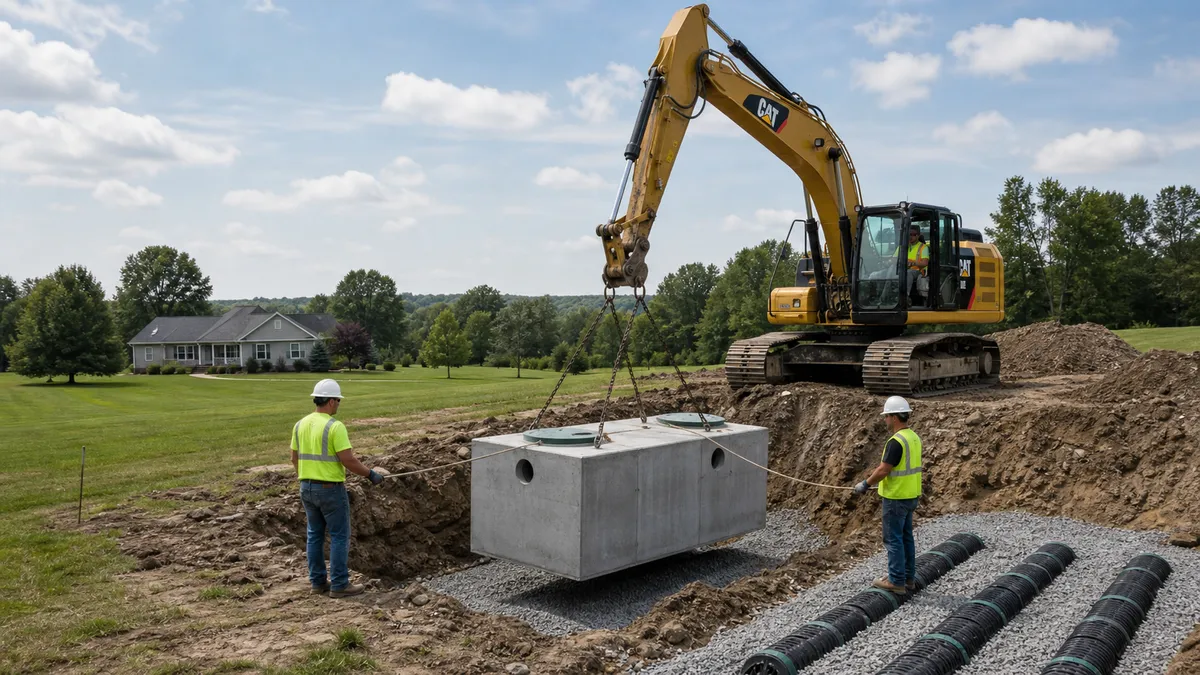
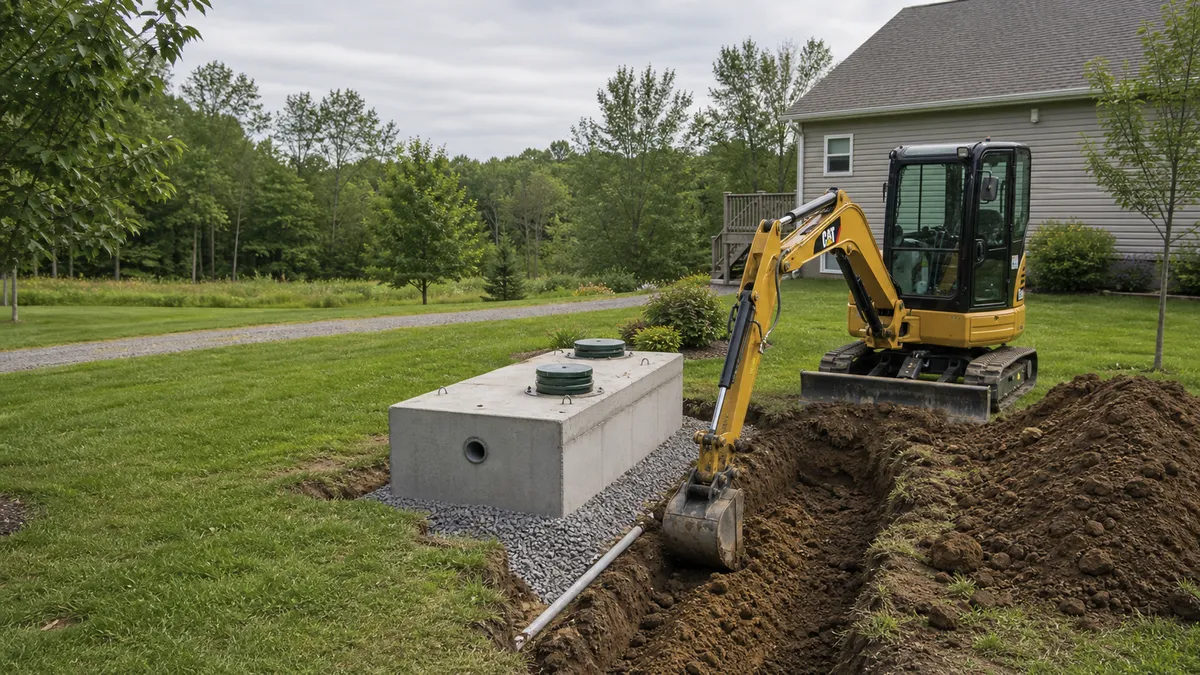
- Building permit and install. With the approval letter in hand, the building permit is pulled through the Town of West Monroe code enforcement office. Backwell coordinates the excavation, tank, distribution box and absorption area and builds them to the approved plan.
- Final paperwork. For an alternative system such as a raised bed, mound or sand filter, state rule 10 NYCRR 75.5 has a design professional supervise construction and certify to the health department that it matches the approved plans.
Soils and seasonal water around West Monroe
West Monroe lies on the same Glacial Lake Iroquois sand plain as its neighbors along the north shore. The well drained Colonie and moderately well drained Elnora sands occur on rises; poorly drained Sun and Stockholm soils occupy the low, level spots. Stockholm's perched water table sits at 0 to 12 inches.
Somewhat poorly drained Scriba fine sandy loam with a fragipan 12 to 18 inches down shows up where firm till underlies the sand. For a septic design that pan is a boundary condition just like groundwater: the trench bottom needs 2 feet of separation from it.
What the health department checks
Oswego County reviews septic plans itself, at its Environmental Health Division in Oswego. The state sets the floor in Appendix 75-A; a local health department may adopt stricter standards, but not looser ones without a state waiver. On a lot in West Monroe the review comes down to a handful of measured items:
- 100 feet from an absorption field, raised bed or mound to a stream, lake, watercourse or wetland, measured to the mean high water mark, and 50 feet from the tank.
- Conventional trench field: at least 4 feet of useable soil above rock, tight soil and the high seasonal groundwater, with the highest groundwater at least 2 feet below the trench bottom.
- Raised system: 1 to 2 feet of original soil faster than 60 minutes per inch, high groundwater at least 1 foot below the surface, fill that percs between 5 and 30 minutes per inch, and a taper no steeper than 1 on 3 with at least 20 feet of taper.
- 100 feet from an absorption field to a well or suction line, 200 feet if the field sits upgrade and in the drainage path to the well, and 50 feet from the septic tank to a well.
Common West Monroe site problems and the design fix
Small lake lot with a driveway in the way
No absorption field can go under a driveway or other heavy loading. On a narrow Oneida Lake lot the PE fits the tank, field and driveway together, often by moving the driveway or pumping to a field up the hill.
Seasonal water near the lake
Stockholm and Sun soils can hold water within a foot of the surface. That points to a raised bed or mound with pressure dosing.
Camp to year round
A seasonal camp system is rarely sized for a full time household. The design uses at least 110 gallons per day per bedroom for new construction.
What it costs
Published county fees, effective January 1, 2026: $125 for the Oswego County Health Department to review plans for one home and $250 for a commercial system, a category the county applies to businesses and rentals. Selling a house? The county lists a 4 day septic dye test with written results at $230.
Design and install are priced together in writing for your lot. Lake lots in West Monroe often need a pump and fill; inland sand lots often do not.
Grant money: Oswego County runs the state Septic System Replacement Fund. Its application says eligible projects can be reimbursed up to 50 percent with a $10,000 maximum, design costs at 50 percent up to $3,000, and every replacement must be county approved, engineer designed and covered by a local building permit. The state priority waters for Oswego County are the central and eastern Lake Ontario shoreline and the upper Little Sandy Creek and its tributaries.
Timeline
Spring testing, stamped design, Oswego County review with the $125 fee and copy to the town code officer, building permit, install.
If a raised bed uses finer fill, six months of settling through a freeze and thaw cycle. The written price includes the schedule.
Sources
- Oswego County Health Department: Septic Plan Review
- Oswego County Health Department: Water Supply Protection and Septic Plan Review
- Oswego County Health Department: Plan Review Fee Schedule, effective 1/1/2026
- Oswego County Health Department: Fee Schedule for Environmental Health Services, 1/1/2026
- Oswego County Community Development, Tourism and Planning: Septic System Replacement Grant Application
- NYS EFC: Septic System Replacement Fund Priority Waterbody List
- 10 NYCRR Appendix 75-A.4: Soil and site appraisal (Table 2 separation distances)
- 10 NYCRR Appendix 75-A.8: Conventional subsurface treatment systems
- 10 NYCRR Appendix 75-A.9: Alternative systems (raised, mound, sand filter)
- 10 NYCRR Appendix 75-A.3: Sewage flows
- 10 NYCRR Section 75.5: Minimum standards, design professional, alternative system approval
- Town of West Monroe: Sewer Department
- NYSDEC ENB: Southern Oswego County Regional Interceptor Sewer
- USDA NRCS Official Series Description: Colonie
- USDA NRCS Official Series Description: Elnora
- USDA NRCS Official Series Description: Stockholm
- USDA NRCS Official Series Description: Scriba
Rules and fees as published by the agencies above when this page was written; they can change. The approved plan for your lot controls.
More in Oswego County.
Nearby towns
Septic engineer in ConstantiaSeptic engineer in HastingsSeptic engineer in Central SquareSeptic engineer in ParishDesign services
Lakefront septicSmall lot setbacksSeasonal camp to year roundRaised bed septic designMound septic designTell us about the West Monroe property.
Send the address. Estimate in 1 hour.
Free Written Estimate
Estimate in 1 hour.