Septic Engineer in Parish, NY
Parish sits where the lake plain starts climbing toward Tug Hill. Hardpan, wet swales and heavy precipitation shape every septic design here. We test, coordinate a PE stamped design, submit and build.
Soil. Design. Permit.
What a septic design and install in Parish includes.
Yes, the village operates a wastewater treatment plant. Homes in the Town of Parish outside the village are on private septic systems.
Scriba and Ira soils have fragipans close to the surface, and the Tug Hill side gets very high precipitation. Together they leave little useable soil for conventional trenches.
The field has to be 100 feet from a wetland under Appendix 75-A, and peat soils are not useable for treatment.
Often. Appendix 75-A allows curtain drains upslope of a raised system to intercept groundwater, set at least 20 feet from the toe of the fill.
The Oswego County Health Department, Environmental Health Division, 70 Bunner St., Oswego. The design engineer submits four sets of plans and the review fee. The county engineer returns three sets with an approval or rejection letter and copies the letter to the owner and the Village or Town of Parish code enforcement officer.
The county fee schedule effective January 1, 2026 lists $125 for an individual onsite system and $250 for a commercial system, which the county applies to businesses and rentals.
Septic design in Parish: the short answer
The Village of Parish has a wastewater treatment plant; the farms and back roads around it do not. Outside the village, a new home, a camp conversion or a failed field calls for a PE stamped septic design approved by the Oswego County Health Department.
Short answer for Parish: fine sandy loams with hardpan, wet swales with peat, and rising ground to the east with very high annual precipitation. Raised beds are common, and the design has to handle a lot of water.
Sewer or septic in Parish
The village operates a wastewater treatment plant and has held quarterly plant meetings and a 2021 bond hearing for plant improvements. Homes on village mains do not need septic designs. Outside the village, in the Town of Parish, homes are on private systems.
How a septic design works in Parish
- Send the address and a few photos. Use the form below. Estimate in 1 hour.
- Confirm the lot needs septic. Village of Parish main in the road means sewer. Anywhere else in the town, plan on septic.
- Deep hole and perc tests. At least one test hole six feet deep at the leaching area and at least two perc tests per system, per Appendix 75-A. Expect a firm layer in the fine sandy loams and wet, organic soil in the swales.
- Design and stamp. Designs are prepared and stamped by a New York licensed Professional Engineer (PE), sized at a minimum of 110 gallons per day per bedroom for a new house.
- Oswego County plan review. Four sets of plans and the plan review fee go to the Oswego County Health Department, Environmental Health Division, 70 Bunner St., Oswego. The department engineer sends three sets back with a letter of approval or rejection, and a copy of that letter goes to you and to the Village or Town of Parish code enforcement officer.
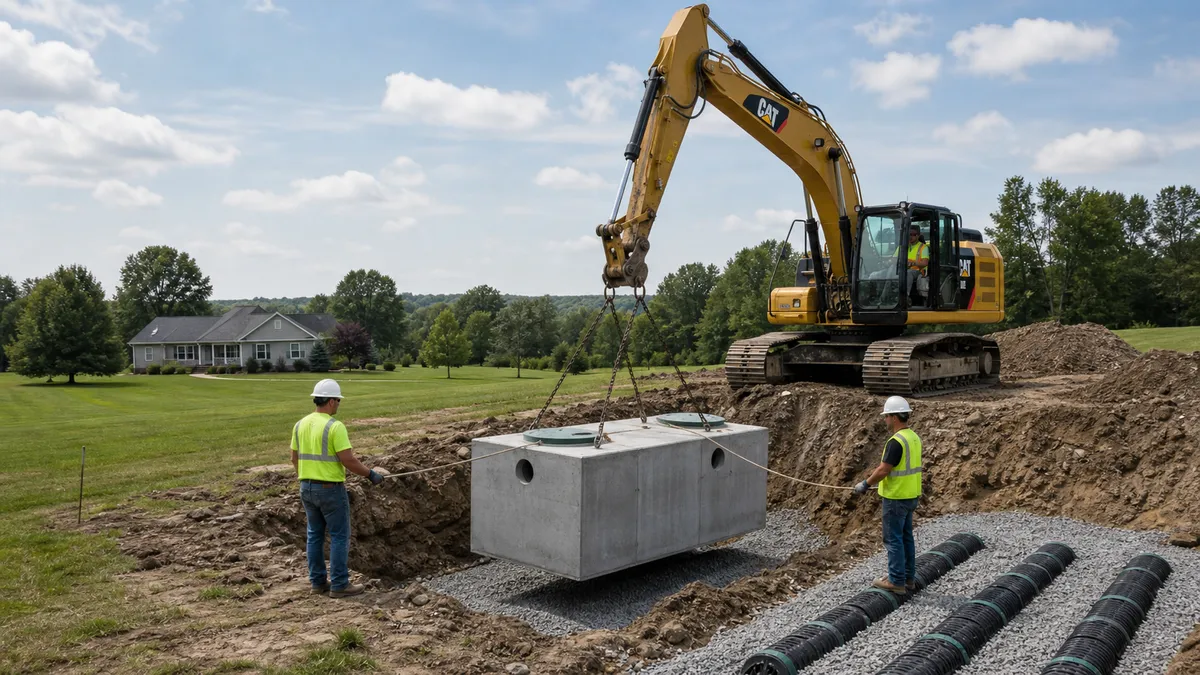
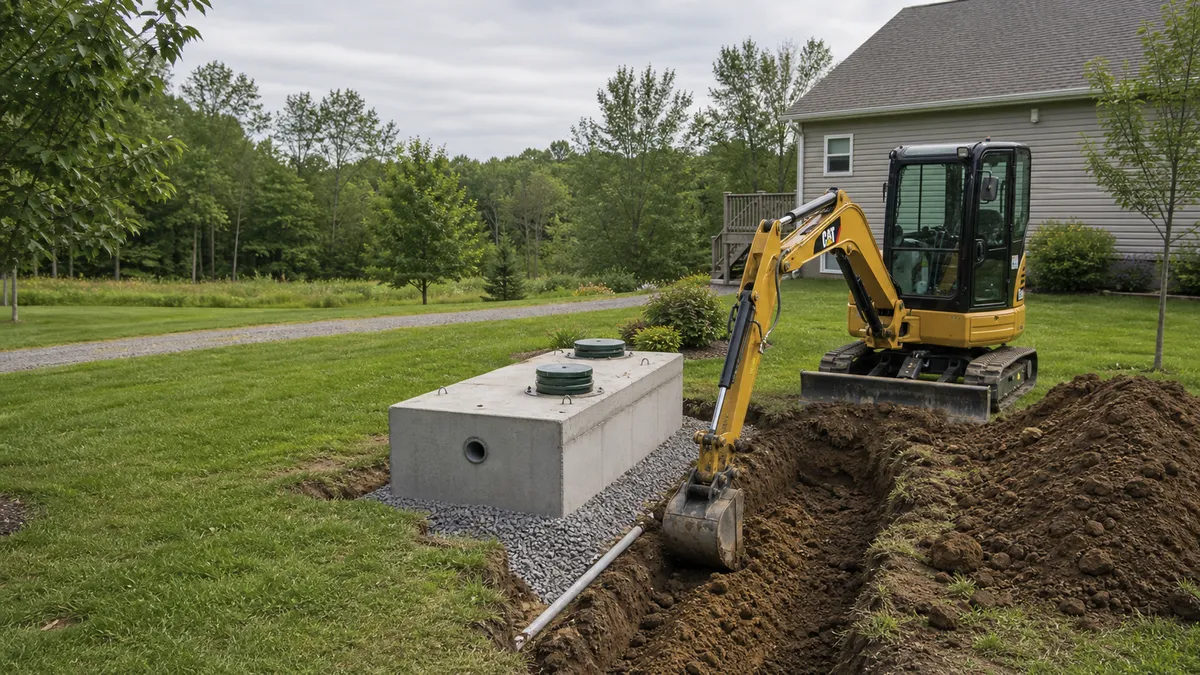
- Building permit and install. With the approval letter in hand, the building permit is pulled through the Parish code enforcement office. Backwell coordinates the excavation, tank, distribution box and absorption area and builds them to the approved plan.
- Final paperwork. For an alternative system such as a raised bed, mound or sand filter, state rule 10 NYCRR 75.5 has a design professional supervise construction and certify to the health department that it matches the approved plans.
Soils and seasonal water around Parish
Parish lies on the lake plain transitioning into the Tug Hill foothills. Scriba and Ira fine sandy loams cover much of the upland. Scriba is somewhat poorly drained with the top of its fragipan 12 to 18 inches down; Ira is moderately well drained with very slow permeability in its pan. Both limit trench depth.
On the rising ground to the east are Worth and Empeyville channery silt loams, Tug Hill soils with fragipans. The USDA puts the Worth fragipan 46 to 97 centimeters down (about 18 to 38 inches) and lists mean annual precipitation of about 1,476 millimeters, roughly 58 inches, in its range. Greenwood mucky peat fills the wetland swales and is not useable soil.
What the health department checks
Oswego County reviews septic plans itself, at its Environmental Health Division in Oswego. The state sets the floor in Appendix 75-A; a local health department may adopt stricter standards, but not looser ones without a state waiver. On a lot in Parish the review comes down to a handful of measured items:
- Conventional trench field: at least 4 feet of useable soil above rock, tight soil and the high seasonal groundwater, with the highest groundwater at least 2 feet below the trench bottom.
- Shallow trenches: at least 2 feet but under 4 feet of useable soil, 2 feet of separation under every trench, and no more than 30 inches of matching fill over original grade.
- Raised system: 1 to 2 feet of original soil faster than 60 minutes per inch, high groundwater at least 1 foot below the surface, fill that percs between 5 and 30 minutes per inch, and a taper no steeper than 1 on 3 with at least 20 feet of taper.
- 100 feet from an absorption field, raised bed or mound to a stream, lake, watercourse or wetland, measured to the mean high water mark, and 50 feet from the tank.
Common Parish site problems and the design fix
Fragipan within 18 inches
On Scriba ground the pan perches water early. Less than 2 feet of useable soil rules out shallow trenches, so the PE designs a raised system with dosing, a curtain drain upslope at least 20 feet from the fill toe, and surface water diverted away.
Peat swale on the property
Greenwood peat cannot treat effluent and a field cannot sit within 100 feet of a wetland. The design places the field on mineral soil on the high side of the lot.
So much water the field floods
Tug Hill soils like Worth are described in areas averaging close to 58 inches of precipitation a year, so surface water control is part of the design: diversion ditches on sloping sites, roof and footing drains kept out of the system, and the field mounded to shed water.
What it costs
Published county fees, effective January 1, 2026: $125 for the Oswego County Health Department to review plans for one home and $250 for a commercial system, a category the county applies to businesses and rentals. Selling a house? The county lists a 4 day septic dye test with written results at $230.
Design and install are priced together in writing for your lot. Most Parish designs outside the village need imported fill and a pump chamber; a dry upland lot is the exception.
Grant money: Oswego County runs the state Septic System Replacement Fund. Its application says eligible projects can be reimbursed up to 50 percent with a $10,000 maximum, design costs at 50 percent up to $3,000, and every replacement must be county approved, engineer designed and covered by a local building permit. The state priority waters for Oswego County are the central and eastern Lake Ontario shoreline and the upper Little Sandy Creek and its tributaries.
Timeline
Testing in spring shows the perched water. Stamped design to Oswego County with the $125 fee, approval copied to the Parish code officer, then the building permit and install.
Fill for a raised bed that is not clean sand or sandy loam must settle six months through a freeze and thaw cycle. The schedule comes with the written price.
Sources
- Oswego County Health Department: Septic Plan Review
- Oswego County Health Department: Water Supply Protection and Septic Plan Review
- Oswego County Health Department: Plan Review Fee Schedule, effective 1/1/2026
- Oswego County Health Department: Fee Schedule for Environmental Health Services, 1/1/2026
- Oswego County Community Development, Tourism and Planning: Septic System Replacement Grant Application
- NYS EFC: Septic System Replacement Fund Priority Waterbody List
- 10 NYCRR Appendix 75-A.4: Soil and site appraisal (Table 2 separation distances)
- 10 NYCRR Appendix 75-A.8: Conventional subsurface treatment systems
- 10 NYCRR Appendix 75-A.9: Alternative systems (raised, mound, sand filter)
- 10 NYCRR Appendix 75-A.3: Sewage flows
- 10 NYCRR Section 75.5: Minimum standards, design professional, alternative system approval
- Village of Parish: sewer and wastewater treatment plant notices
- USDA NRCS Official Series Description: Scriba
- USDA NRCS Official Series Description: Ira
- USDA NRCS Official Series Description: Worth
- USDA NRCS Official Series Description: Empeyville
Rules and fees as published by the agencies above when this page was written; they can change. The approved plan for your lot controls.
More in Oswego County.
Nearby towns
Septic engineer in Central SquareSeptic engineer in MexicoSeptic engineer in WilliamstownSeptic engineer in ConstantiaDesign services
Raised bed septic designHigh water tableWet yard or wetlandMound septic designYard drainage designTell us about the Parish property.
Send the address. Estimate in 1 hour.
Free Written Estimate
Estimate in 1 hour.