Septic Holding Tank Design in Central New York
When New York allows a holding tank, how big it has to be, and what has to be ruled out first. A PE-stamped plan, the county submittal, and the install.
Allowed. Sized. Pumped.
What New York allows for holding tanks and how they are built.
Only temporarily. Appendix 75-A does not permit holding tanks for new home construction except where the home is occupied while the septic system is under construction. The state handbook adds weather delays as a reason for temporary use, and says the ban applies whether the home is full-time or part-time.
Only as a last resort. The state handbook says holding tanks are meant to correct an existing failing system when no other alternative exists, and permanent use due to extreme hardship may need approval from the code enforcement officer or health department.
Five days of design flow or 1,000 gallons, whichever is greater. At 110 gallons per day per bedroom, a 3-bedroom house needs at least 1,650 gallons and a 4-bedroom house at least 2,200 gallons.
Yes. The state handbook says every holding tank shall have an audible and visual alarm in a conspicuous place to show when a pump-out is needed.
Not for a new camp. The handbook says holding tanks are not used for new residential construction regardless of full-time or part-time occupancy. An existing camp with a failing system may qualify only when no other alternative exists.
A NYSDEC-permitted septage waste transporter. The state handbook says the owner should have a service contract with one.
Onondaga County lists $186 for commercial holding tanks and $310 for a full individual system application under 1,000 gallons per day. Oswego County lists $125 and Oneida County $500 for an individual system.
Holding tanks in New York, the short answer
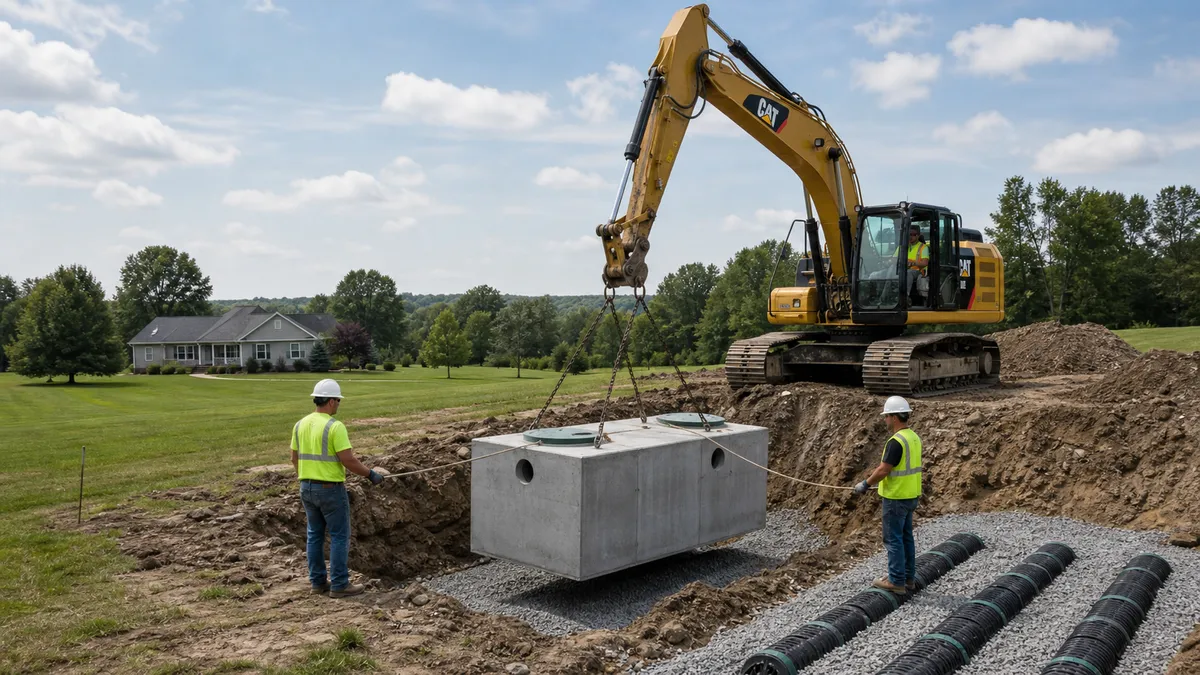
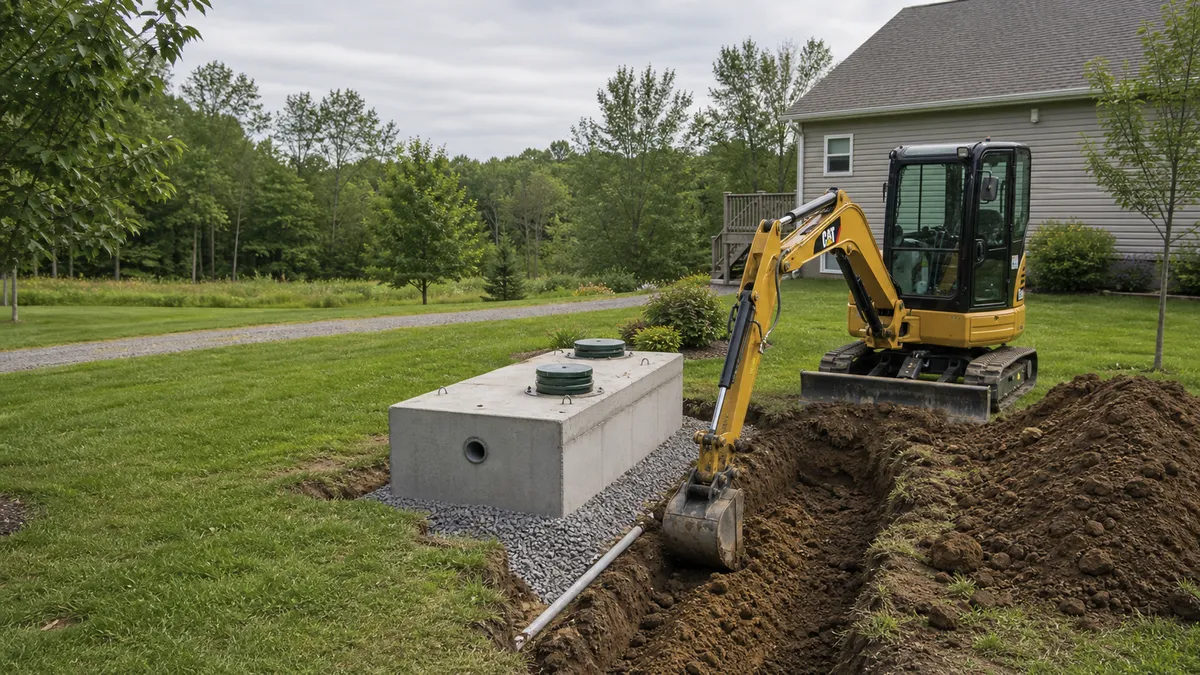
A holding tank is a watertight tank with an inlet and no outlet. Everything the house sends to it stays there until a septage hauler pumps it out. New York allows them in narrow cases: not for a new home, except as a stopgap while the real septic system is being built, and as a last resort when an existing system has failed and nothing else will work. Designs are prepared and stamped by a New York licensed Professional Engineer (PE). Backwell coordinates the design, the county submittal, and the install, and the first question on every holding tank job is whether a real system can go in instead.
What the state rules say
10 NYCRR Appendix 75-A, section 75-A.10(a), is short and direct:
- Holding tanks are not permitted for new home construction, except where the home is allowed to be occupied while the sewage treatment system is under construction.
- Tank size is based on five days of design flow or 1,000 gallons, whichever is greater.
- The tank meets the same construction standards as a septic tank, except it has no outlet.
- Holding tanks are not acceptable for long-term use on year-round residences.
The NYS design handbook fills in the gaps:
- The new-construction ban applies regardless of full-time or part-time occupancy. A new seasonal camp is not an exception.
- Temporary use is allowed while the system is under construction or when installation is delayed by weather, such as freezing temperatures or excessive rain.
- Beyond those cases, holding tanks are only meant to correct an existing failing system when no other alternative exists.
- They are not acceptable long term at year-round homes because of high maintenance costs and the constant attention they need.
- If one is considered as permanent because of extreme hardship in replacing a failed system with no other option, approval may be required by the local code enforcement officer, the local health department, or another agency with jurisdiction.
When a holding tank is the right call
Put those rules together and there are three realistic situations in Central New York:
- Occupancy before the septic is finished. A new home is ready, but the field cannot be built yet, often because a raised system's fill is still settling through its 6-month, freeze-thaw period, or the ground is frozen or soaked. A holding tank can carry the house until the approved system is built.
- A failed system on a lot with no room left. An older house on a tiny or waterfront lot where the tests show no conventional, shallow, raised, mound, or enhanced treatment design can meet the standards, even with a waiver. Here the holding tank is the fix of last resort.
- Non-flush toilets that make reduced-volume waste. Appendix 75-A allows the reduced-volume waste from recirculating toilets to go to a larger holding tank, but never to a subsurface system.
Before settling on a holding tank for a failed system, the design should rule out the alternatives on paper: enhanced treatment units for small lots, mounds for wet or shallow soil, and shallow trenches for 2 to 4 feet of soil. Those are permanent; a holding tank is a pumping bill that never ends.
Sizing a holding tank
The size rule is five days of design flow or 1,000 gallons, whichever is greater. At the 110 gallons per day per bedroom used for new construction:
| Bedrooms | Design flow | Five days of flow | Minimum holding tank |
|---|---|---|---|
| 1 | 110 gpd | 550 gal | 1,000 gal |
| 2 | 220 gpd | 1,100 gal | 1,100 gal |
| 3 | 330 gpd | 1,650 gal | 1,650 gal |
| 4 | 440 gpd | 2,200 gal | 2,200 gal |
| 5 | 550 gpd | 2,750 gal | 2,750 gal |
Computed from Appendix 75-A. Older houses with pre-1994 or pre-1980 fixtures carry higher design flows (130 or 150 gpd per bedroom), which makes the tank bigger. The tank size is a minimum; the real pumping interval depends on how much water the house actually uses, which is why the handbook pushes water-saving fixtures in any home on a holding tank.
How the tank is built
Because a holding tank meets septic tank standards, these Appendix 75-A rules apply to it:
- Watertight, built of durable material not subject to corrosion, decay, frost damage, or cracking, and able to support at least 300 pounds per square foot once installed.
- Concrete at a minimum of 2,500 psi at 28 days (3,000 psi recommended), walls at least 3 inches thick unless a thin-wall design is certified by a New York licensed PE, and joints below the liquid level tested for watertightness before backfill.
- Fiberglass and polyethylene tanks cannot be installed where groundwater can rise to the tank bottom.
- Set on at least 3 inches of sand or pea gravel.
- Driveways and other structures cannot go over the tank unless it is specially designed and reinforced for the load.
The handbook adds items specific to holding tanks:
- Access to grade for pumping and cleanup, with a watertight, lockable cover.
- Venting through the house vent stack may be needed to avoid odors.
- An alarm, audible and visual, in a conspicuous place to signal when a pump-out is needed.
- A service contract with a NYSDEC-permitted septage waste transporter.
- A solenoid valve on the water service line, upstream of all fixtures, should be considered to prevent overflows.
Where it goes on the lot
Appendix 75-A Table 2 does not list holding tanks on a line of their own. The septic tank line, 50 feet from a well or suction line and from a stream, lake, watercourse, or wetland, and 10 feet from the house and the property line, is the closest match, and the county reviewer applies the distances it requires. The practical layout question is truck access: the cover has to be reachable by a pump truck hose in every season, without crossing the well area or a future field location.
What the county health department checks
A holding tank plan still goes through the county. Onondaga County's fee schedule lists a $186 review fee for commercial holding tanks, alongside its $310 full application fee for individual systems under 1,000 gallons per day. Oswego County's published plan review fee for an individual system is $125, and Oneida County's is $500. We did not find a separate published holding tank policy on the Oswego or Oneida County health department pages we reviewed, so the state rule in Appendix 75-A and the county's plan review are what govern there. Expect the reviewer to ask why a subsurface system will not work, and to see the sizing, the alarm, the access, and the hauler arrangement on the plan.
Seasonal camps and holding tanks
Camp owners often ask whether a holding tank is the easy answer for part-time use. For a new camp, the handbook says no: the ban on holding tanks for new residential construction applies regardless of full-time or part-time occupancy. For an existing camp with a failing system, a holding tank is possible only when no other alternative exists. If the plan is to use the camp year-round, Appendix 75-A says holding tanks are not acceptable for long-term use on year-round residences. See seasonal camp to year-round.
Non-flush options that pair with a tank
Appendix 75-A also covers non-waterborne systems for places where water is scarce or the owner wants to save it. Composting toilets must carry an NSF Standard 41 label and a warranty of at least five years. Recirculating toilet waste can go to a holding tank. In every case the greywater from sinks, showers, and laundry still needs a real treatment system, designed at 75 gallons per day per bedroom. The handbook adds that greywater should not be used for irrigation.
Timeline and cost
A holding tank installs quickly once it is approved, which is why it works as a bridge while a raised system's fill settles or the ground thaws. The long-term cost is the pumping, and the state handbook names high maintenance cost as the reason holding tanks are not accepted long term at year-round homes. The design and install come as one written price; pumping is between you and your hauler.
Related reading: septic failing or backing up, small lot setbacks, septic replacement, system types, and the septic engineer hub.
Sources
- NYS DOH, 10 NYCRR Appendix 75-A, Wastewater Treatment Standards, Residential Onsite Systems (compilation effective 3/16/2016)
- NYS DOH, Residential Onsite Wastewater Treatment Systems Design Handbook (2012), posted by Onondaga County
- Onondaga County Health Department, Fee Schedule
- Oswego County Health Department, Septic Plan Review
- Oneida County Health Department, Plan Review Fees (rev. 3/2022)
Regulatory figures on this page are taken from the documents listed. Rules change; the county health department reviewing the plan applies the version in force when the plan is submitted.
Other septic designs.
Tell us about the property.
Send the address. Estimate in 1 hour.
Free Written Estimate
Estimate in 1 hour.