Enhanced Treatment and Aerobic Septic Design in Central New York
NSF-listed aerobic and media treatment units for small lots, lakefront homes and failed fields. A PE-stamped design under NYS Appendix 75-A, the county submittal, the unit, and the install.
Treat. Filter. Disperse.
What an enhanced treatment unit changes in a New York septic design.
A pre-manufactured unit that treats wastewater beyond what a septic tank does, cutting BOD and suspended solids before the effluent reaches the leach field. Many are aerobic units that blow air into the wastewater. New York requires them to be listed as NSF Standard 40 Class I units or equivalent.
Not under the state standard. Appendix 75-A lists no reduced vertical separation for ETU effluent, and the state handbook says high water tables, bedrock, and clay must still be taken into account. A deviation on a specific site needs a specific waiver from the county health department.
Up to 33% shorter total trench length, but only for conventional or shallow trench systems, and only where the unit is under a Responsible Management Entity or a local code requires it to be serviced. The credit cannot be combined with the gravelless chamber reduction and does not apply in the New York City watershed.
NSF Standard 40 Class I units must meet effluent limits of 25 mg/l BOD and 25 mg/l TSS. Standard 245 units meet the same criteria and are also certified to reduce nitrogen by at least 50%.
Appendix 75-A sets a minimum rated daily capacity of 400 gallons or the design flow, whichever is greater. For a 4-bedroom house at 440 gallons per day, that means a unit rated for at least 440 gallons per day.
Yes. The state handbook says regular maintenance is imperative and that units should be maintained to the manufacturer's recommendations. They also need electric power for the blower or pumps.
They solve the same problem differently. Intermittent sand filters need at least 24 inches of specified sand, a downstream bed or mound, and an environmental assessment, and the state handbook says they belong on large lots. ETUs are compact and are most often used on small or sensitive lots.
What an enhanced treatment unit does
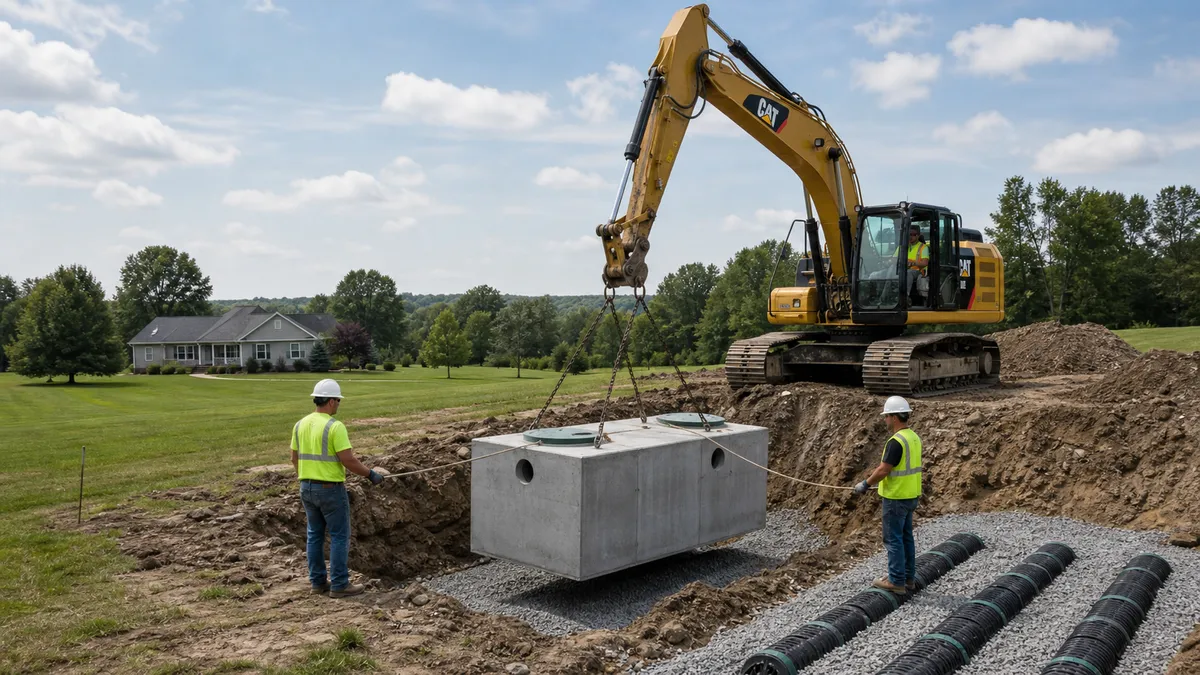
An enhanced treatment unit, or ETU, is a factory-built treatment tank that cleans septic effluent much more than a plain septic tank before it goes to the leach field. Most people call them aerobic units because many blow air into the wastewater to grow bacteria that break down the waste. New York regulations call them ETUs. They let a design fit a smaller field or protect a nearby lake or well, but they do not make bad soil good. Designs are prepared and stamped by a New York licensed Professional Engineer (PE). Backwell coordinates the design, the county submittal, the unit, and the install.
10 NYCRR Appendix 75-A defines enhanced treatment as the biological and physical treatment of wastewater to reduce biochemical oxygen demand (BOD) and total suspended solids (TSS) before the effluent reaches an absorption area. The state design handbook adds that ETUs also reduce pathogens, viruses, and other organic contaminants, and that lower BOD and TSS greatly reduce the chance of the field clogging.
Suspended growth and attached growth
The handbook describes two ways these units work:
- Suspended growth: air is mechanically mixed into the wastewater so aerobic bacteria multiply in the liquid. This is the classic aerobic treatment unit, and Appendix 75-A defines an aerobic treatment unit as one that decomposes wastewater by mechanical aeration.
- Attached growth (fixed film): the unit holds media with a large surface area where bacteria grow and treat the effluent as it passes.
Some units combine both. Either way, the handbook notes ETUs typically need electrical power for pumps, compressors, or other devices, and that regular maintenance is imperative for the effluent to stay at the quality the design depends on.
NSF Standard 40 and Standard 245
Appendix 75-A requires an ETU to carry a label showing compliance with NSF International Standard 40 for a Class I unit, or equivalent testing. The handbook explains what the listings mean:
- NSF Standard 40, Class I: the unit must meet effluent limits of 25 mg/l BOD and 25 mg/l TSS to be listed.
- NSF Standard 245: units are tested to the Standard 40 criteria and further certified to cut nitrogen discharge by at least 50%. The handbook discusses these nitrogen-reducing ETUs for sites where nutrients are a concern.
Two more state requirements apply to every unit: a minimum rated daily capacity of 400 gallons or the design flow, whichever is greater, and an effluent filter, either built into the product or a separate filter labeled to NSF Standard 46, on the outlet before the field.
What an ETU changes in the design, and what it does not
This is where most of the confusion lives, so here is exactly what Appendix 75-A allows.
It can shorten the trenches. A field receiving ETU effluent may be designed with a 33% reduction in total trench length, but only when one of two conditions is met: the ETU is under the jurisdiction of a Responsible Management Entity (an entity with the legal, financial, and technical capacity to manage the systems long term, such as a sewer district or utility), or a local sanitary code or watershed rule requires the unit to be maintained and serviced to the manufacturer's recommendations. As an example, a 3-bedroom field in soil percing 21 to 30 minutes per inch drops from 275 feet to about 184 feet.
Limits on that credit: it applies only to conventional and shallow trench systems, it cannot be stacked with the gravelless chamber reduction, and it does not apply in the New York City watershed.
It can shrink a raised system's base. A raised system receiving ETU effluent in an area meeting the same management conditions is sized at 0.3 gallons per day per square foot of basal area instead of 0.2. For a 3-bedroom house, that takes the minimum basal area from 1,650 to 1,100 square feet. See raised bed design.
It does not cut the vertical separation. Appendix 75-A lists no reduced separation to groundwater, bedrock, or tight soil for ETU effluent. Unless otherwise specified, the field after an ETU is designed the same way as for septic tank effluent. The handbook says it directly: ETU effluent still carries small amounts of biological contaminants and nutrients that need aerated soil for final treatment, so high water tables, bedrock, and clay must still be taken into account. Any deviation from the standard on a specific site goes through a specific waiver from the county health department, which has to show the design gives protection equivalent to the standard.
Where ETUs make sense
The handbook says ETUs are most often used to repair or replace failed systems where space is limited, or where better treatment is needed to protect surface water or water supplies. Typical cases in Central New York:
- Small lots where a full-length field will not fit between the house, the well, and the property lines. See small lot setbacks.
- Lakefront and stream-side homes, where the 100-foot setback to water is already tight. See lakefront septic.
- Failed fields where the replacement area is smaller than the original. See septic replacement design.
The handbook also notes that local restrictions may limit the use of ETUs for repairs or replacements, and that it recommends management entities or local codes with oversight wherever ETUs are used.
Intermittent sand filters: the other advanced treatment option
Appendix 75-A also lists the intermittent sand filter under alternative systems as another way to treat effluent before it reaches the soil. Effluent is dosed across at least 24 inches of specified sand, collected by underdrains, and then sent to an absorption bed or mound. Key numbers:
- Sand with an effective grain size of 0.25 to 1.0 mm (0.5 to 1.0 mm if the county does not require nitrification) and a uniformity coefficient of 4.0 or less.
- A maximum loading of 1.15 gallons per day per square foot.
- Collector pipe bottoms at least 2 feet above the maximum high groundwater.
- A two-compartment tank or two tanks ahead of the filter.
- Direct discharge of the filtered effluent to the ground surface or a water body is not allowed. It goes to a bed or mound sized at 1.2 gallons per day per square foot.
- An environmental assessment showing the sand filter is consistent with the area and causes no adverse impact.
The handbook says sand filters and their downstream systems should only be used on large lots. On a small or lakefront lot, an ETU is usually the more practical way to get advanced treatment.
Living with an ETU
An ETU is a machine, and the design assumes it is kept running. The handbook stresses regular maintenance to the manufacturer's recommendations, and the 33% trench credit depends on a management entity or local code that requires it. In practical terms that means a service arrangement for the unit, power to the blower or pumps, an alarm you will notice, and a septic tank or pretreatment chamber still pumped on schedule. Before a model is picked, the design checks that service for that product is available in the area, a point the handbook raises for any community using ETUs.
What the health department checks
For an ETU design, the county reviewer looks for the NSF Standard 40 Class I listing (or Standard 245 where nitrogen is the issue), the rated capacity, the effluent filter, and whether the site qualifies for the trench length credit. If the design leans on the 33% reduction, the plan has to show the management condition is met. Fields after the ETU still have to meet the usual depth to groundwater and rock, the Table 2 setbacks, and the reserve area. In Onondaga County, the Septic System Replacement Funding Program covers properties within 250 feet of priority waters such as Skaneateles Lake, Otisco Lake, and Jamesville Reservoir.
Timeline and cost
An ETU does not add a regulatory waiting period; the schedule follows the testing and the county review, plus the lead time to get the specific unit. On cost, the handbook says ETUs are generally much more expensive than a septic tank, and the national guide Building Advisor describes aerobic units as expensive to install and maintain. County plan review fees are published: $310 in Onondaga (full application under 1,000 gpd), $125 in Oswego, $500 in Oneida. You get one written price covering the unit, the field, and the install.
Related reading: conventional design, pressure distribution, septic replacement, and the septic engineer hub.
Sources
- NYS DOH, 10 NYCRR Appendix 75-A, Wastewater Treatment Standards, Residential Onsite Systems (compilation effective 3/16/2016)
- NYS DOH, Residential Onsite Wastewater Treatment Systems Design Handbook (2012), posted by Onondaga County
- Onondaga County Health Department, Septic System Replacement Funding Program
- Onondaga County Health Department, Fee Schedule
- Oswego County Health Department, Septic Plan Review
- Oneida County Health Department, Plan Review Fees (rev. 3/2022)
- Building Advisor, Alternative Septic Systems (national cost guide)
Regulatory figures on this page are taken from the documents listed. Rules change; the county health department reviewing the plan applies the version in force when the plan is submitted.
Other septic designs.
Tell us about the lot.
Send the address. Estimate in 1 hour.
Free Written Estimate
Estimate in 1 hour.