Septic Failing or Backing Up? Repair Design in Central NY
Sewage in the basement or wet spots over the field mean the system is failing. Some fixes are a pump truck and a baffle. Others need a new field and a stamped design. Here is how to tell which.
The short answer
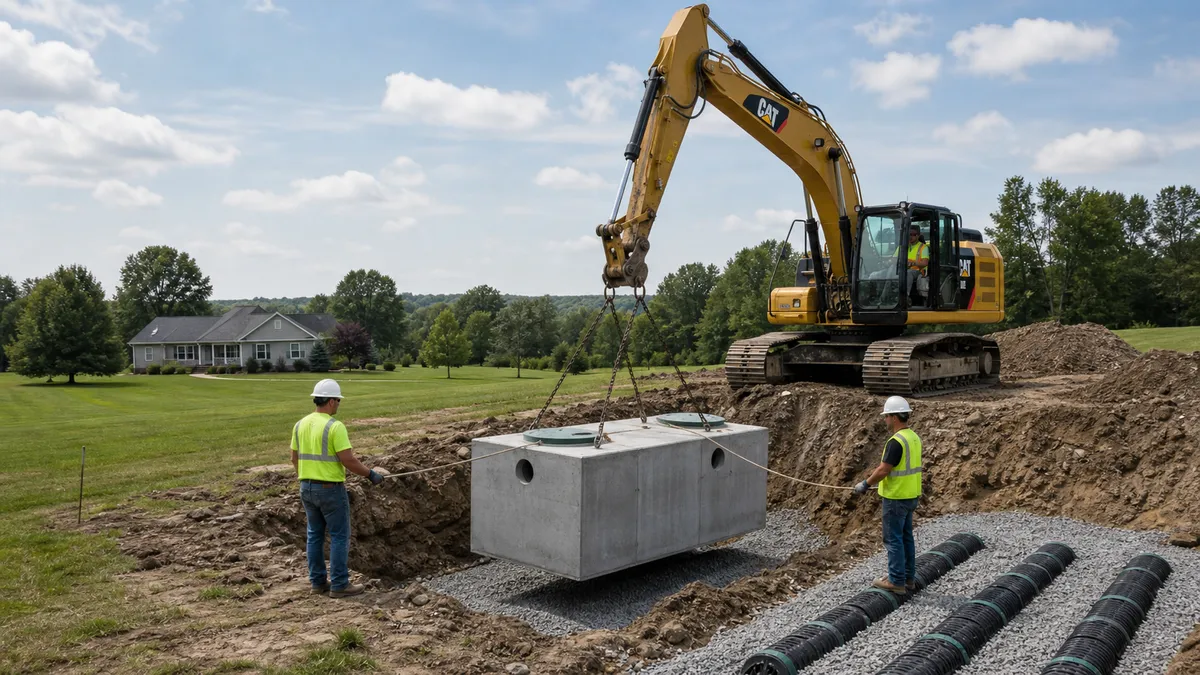
The New York State design handbook counts a system as failing when sewage backs up into the plumbing, untreated wastewater comes to the ground surface, or it reaches a stream, lake, well or spring. A full tank or a broken baffle can cause a backup with a sound field. A clogged or flooded field cannot be pumped back to health; it needs a new field, and when that field moves, grows or changes type, a licensed design professional has to design it.
Signs your septic is failing
- Toilets and drains slow or back up, worst after laundry or heavy use.
- Gurgling in the drains.
- Wet, spongy or bright green strips over the field, or effluent at the surface.
- Sewage odor in the yard.
- Problems in spring that go away by late summer, which points to groundwater.
- A bad well test or a dye test that shows up in a ditch or the lake.
Why systems fail
The state handbook lists the common causes:
- Siting and design: the seasonal high groundwater was missed, the soil was rated faster than it is, poor fill or compacted soil under the system.
- Construction: trenches not on contour or not level, uneven distribution, too much backfill so the field cannot breathe.
- Overloading: leaky fixtures, added bedrooms, more people than designed for, vacation rental use, a home business, hot tub draining, sump pump or water softener discharge.
- Maintenance: no pumping, so solids wash into the field.
- Age: the biomat at the soil surface builds up over time.
Roof, footing, garage, cellar and surface drainage are not allowed into the system under Appendix 75-A.3. Sump pumps tied into the house sewer are a common hidden overload.
First checks before you replace anything
- Pump and inspect the tank. The handbook says pump every two to three years, or sooner when sludge and scum fill a third of the liquid depth. Check the outlet baffle and look for cracks below the waterline. A tank that leaks below the liquid level and cannot be sealed must be replaced.
- Check the distribution box. A tipped box sends everything down one line.
- Find the extra water. Running toilets, softener backwash, sump pump, footing drains.
- Dig a look hole at the field. Standing effluent in the stone means the field itself has failed.
- Read the soil. A deep hole next to the field shows whether groundwater or a tight layer is the cause.
The handbook's failure table pairs causes with corrections: surface water diversion, curtain drains, bigger tank or field, dosing, an ETU, fixing plumbing, removing clear water discharges, making components watertight, or a full redesign and replacement.
When you need an engineer for the repair
The State Health Department fact sheet on licensed design professionals draws the line:
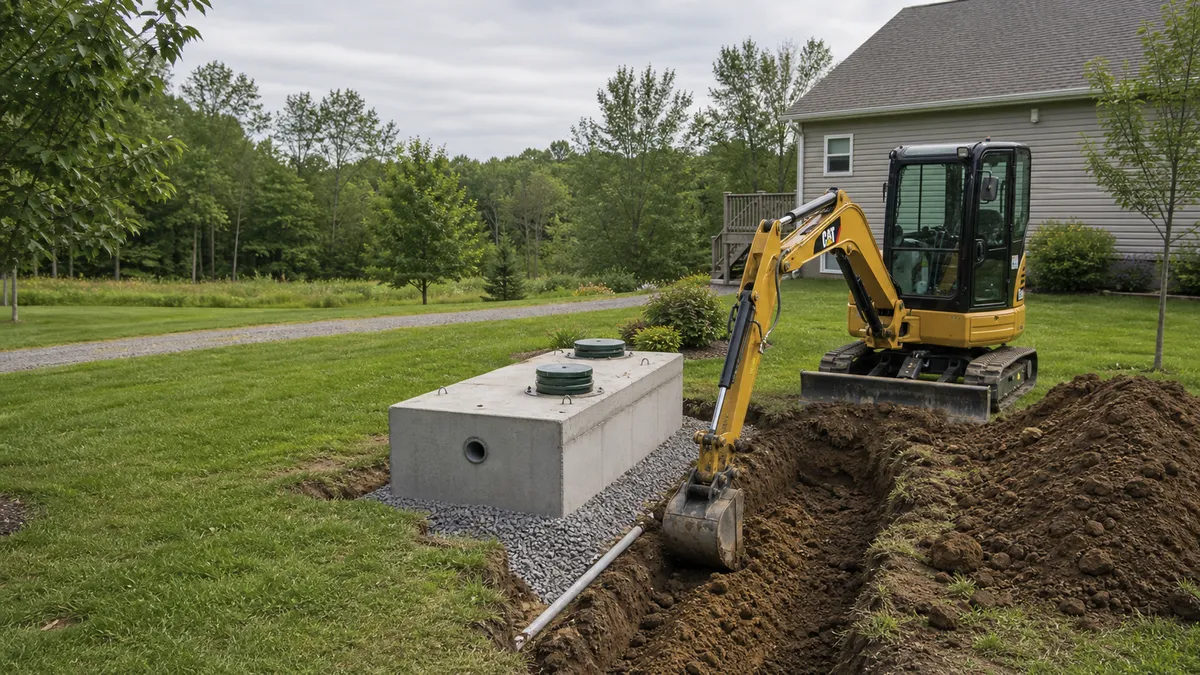
- Replacing components in kind, like a tank or a distribution box, may not need a design professional.
- Relocating or extending a field to ground not previously approved does.
- Installing a new field in the same location does.
- Using a raised system, mound, sand filter or other alternative or innovative design does.
County rules can be stricter. Onondaga County's repair form lets an owner propose a repair without a design professional only where there is no change in total use of the property, requires an inspection before covering, and the county can reject the form and require a formal plan. Cayuga County requires repair plans from a PE or Registered Architect inside the Owasco Lake and Little Sodus Bay watersheds and can require one on problem soils or next to water, and requires a design professional to inspect the work before backfill.
What New York rules say about the replacement
- A replacement field has to meet Appendix 75-A where it can: 4 feet of useable soil and 2 feet of separation for trenches, Table 2 distances of 100 feet to wells and water.
- When it cannot, raised systems, mounds and ETUs are the standard tools, and a specific waiver under Appendix 75-A.11 covers what is left.
- The handbook says specific waivers are not required for replacement systems unless the health department or a watershed has a replacement approval program.
- A holding tank may be used to correct a failing system only when no other alternative exists. It is not acceptable long term on a year-round home.
- On the Owasco and Otisco watersheds, when a system fails the whole system must be inspected and the site evaluated before redesign.
Which design solves it
Good soil, field simply worn out: conventional septic design in a new location, often the reserve area.
Groundwater was the cause: raised bed or mound.
Small lot, no room for a full new field: enhanced treatment, which the handbook calls an excellent option for repairing failing systems on small lots and difficult sites.
Uneven loading: pressure distribution.
Everything else ruled out: holding tank design.
The full replacement process is on our septic replacement design page and the existing septic replacement page.
What it costs
| Item | Typical published figure | Where the number comes from |
|---|---|---|
| Perc test plus deep hole | $400 to $800 | Backwell perc test page |
| Engineered design, when required | $1,500 to $3,500 | Backwell perc test page |
| Conventional gravity system | $8,000 to $13,000 | Backwell system types page |
| Pressure distribution system | $13,000 to $19,000 | Backwell system types page |
| Engineered mound | $22,000 to $28,000 | Backwell system types page |
| Aerobic treatment unit system | $15,000 to $24,000 | Backwell system types page |
| Onondaga County sewage plan review, under 1,000 gpd | $310 application; $186 redesigned project; $62 amended project | Onondaga County Local Law 11 of 2025, effective January 1, 2026 |
| Cayuga County plan review | $150 new system; $100 conventional trench repair; $150 other repair types | Cayuga County Health Department forms |
Installed ranges are typical Central New York figures Backwell publishes on its septic system types page. They are ranges, not a quote. Your number comes back in writing after we see the address and the test results.
Cayuga County charges no fee for a tank-only replacement. Grant money: the NYSDEC Septic System Replacement Fund covers systems in failure or reasonably likely to fail within 250 feet of listed waterbodies, up to 50 percent capped at $10,000, or 75 percent capped at $25,000 for eligible enhanced systems.
Central New York specifics
Onondaga County's Bureau of Public Health Engineering handles repair applications from 421 Montgomery Street, Syracuse. Its grant screen asks whether the property is within 250 feet of Skaneateles Lake or its tributaries, Otisco Lake, Jamesville Reservoir, Rush Creek or part of the Seneca River. In Cayuga County, every property transfer triggers a septic inspection and tank pumping, so many failures surface at sale; a passing inspection plus pumping proof gets a discharge permit. In Cayuga County, only contractors registered with the health department may be hired to repair septic systems, though owners may do their own work, and owners may dig to diagnose before getting approval.
Timeline
Pumping and diagnosis take days. A like-for-like tank swap can move fast. A new field needs testing, design and review; Cayuga County lists up to 4 to 6 weeks for plan approval. Raised fill must settle six months with a freeze and thaw unless granular fill is compacted in lifts, so a failing system in fall may need a mound or a temporary fix through winter.
Costs. Scope. Questions.
What fixing a failing septic system costs in Central New York.
Wet or green strips over the field, effluent at the surface, slow drains after heavy use, and standing liquid in the field stone when you dig a look hole. The state handbook counts backups into the house, wastewater on the ground surface, or contamination of water or wells as failure.
If the tank was full or the outlet was clogged, yes. If the field itself is saturated or clogged, pumping only buys a few days. The handbook says to pump every two to three years so solids never reach the field.
Not always. The State Health Department says like-for-like component repairs may not need one. A new field in the same spot, a relocated or extended field, or any raised system, mound or sand filter must be designed by a licensed design professional.
Extending a field onto ground that was not previously approved requires a licensed design professional under state guidance, plus health department approval. The cause of the failure has to be fixed too, or the new lines fail the same way.
Only as a last resort. The state handbook allows a holding tank to correct a failing system when no other alternative exists, and says it is not acceptable for long term use on a year-round home because of the pumping cost and attention it needs.
If the property is within 250 feet of a listed priority waterbody in a participating county, the NYSDEC Septic System Replacement Fund can reimburse up to 50 percent up to $10,000, or 75 percent up to $25,000 for eligible enhanced systems.
Backwell publishes typical installed ranges of $8,000 to $13,000 for a conventional gravity field, $13,000 to $19,000 for pressure distribution and $22,000 to $28,000 for an engineered mound. Send the address and photos for a written price.
Sources
- 10 NYCRR Appendix 75-A.3, Sewage flows (NYS DOH)
- 10 NYCRR Appendix 75-A.4, Soil and site appraisal, Table 2 separation distances (NYS DOH)
- 10 NYCRR Appendix 75-A.10, Other systems: holding tanks, non-waterborne systems (NYS DOH)
- 10 NYCRR Appendix 75-A.11, Specific waivers (NYS DOH)
- NYS DOH Residential Onsite Wastewater Treatment Systems Design Handbook, 2012 edition (posted by Onondaga County Health Department)
- NYS DOH fact sheet: Need for Licensed Design Professionals, Residential Onsite Wastewater Treatment Systems
- Onondaga County Health Department, Septic Systems and Public Sewers
- Onondaga County Health Department, Septic System Replacement Funding Program
- Cayuga County Health Department, Instructions for Repair/Replacement of an Existing Septic System
- Cayuga County Health Department, Septic System Installation and Inspection program
- 10 NYCRR Section 104.1, City of Auburn and Town of Owasco (Owasco Lake) watershed rules
- 10 NYCRR Section 131.50, Onondaga County Water Authority (Otisco Lake) watershed rules
- NYSDEC, State Septic System Replacement Fund outline and summary
- NYSDEC, State Septic System Replacement Fund participating counties and priority waterbodies
- Backwell, Septic system types and published Central New York price ranges
- Backwell, Perc test and site evaluation price table
Rules and fees change. Everything above was checked against the linked documents in October 2026. Designs are prepared and stamped by a New York licensed Professional Engineer (PE); Backwell coordinates the design, the health department submittal and the install.