Septic Engineer in Homer, NY
Homer sits on the Cortland-Homer-Preble aquifer. Valley lots drain fast, hill lots hit fragipan. Cortland County requires an engineer's design either way. We run the tests, coordinate the stamped plan and build it.
Fees. Process. Answers.
Septic design in the Town of Homer, in the valley and up the hills.
Yes. Cortland County requires an engineer design for all new construction and all replacement systems. Only a tank replacement by itself is exempt.
On primary aquifer lots with soils faster than 10 minutes per inch, the county requires a cut and fill system with fill slower than 10 minutes per inch, and its separation policy calls for 200 feet between well and septic in aquifer areas.
Mardin and Volusia soils have a dense fragipan inside two feet, and Mardin's seasonal water table typically sits 14 to 24 inches down. That leaves too little usable soil for a conventional field.
The Cortland County application says fill must be inspected and allowed to settle 45 days before trenching.
$200 for a sewage disposal permit under the fee schedule effective April 1, 2026.
The Cortland County Health Department, Environmental Health Division, 60 Central Avenue, Cortland, NY 13045, (607) 753-5035.
Send the address through the form. Estimate in 1 hour.
Homer in two sentences
On any Homer lot without public sewer, from the valley floor near the village to the hill roads toward East Homer, Cortland County requires an engineer's design for every new and replacement septic system. In Homer the design has to deal with either fast aquifer gravel or slow fragipan, sometimes on the same parcel.
Designs are prepared and stamped by a New York licensed Professional Engineer (PE). Backwell coordinates the design, the Cortland County submittal, and the install.
Valley floor: fast soil over a drinking water aquifer
USGS describes the Cortland-Homer-Preble aquifer system as both a NYSDEC Primary Aquifer and an EPA Sole Source Aquifer. The valley soils over it are Howard and Chenango gravelly loams, very deep and well to somewhat excessively drained outwash. Water moves through them quickly, which is why Cortland County's rules require a cut and fill system on primary aquifer lots with soils faster than 10 minutes per inch, using fill with a perc rate slower than 10 minutes per inch, and why the county's separation policy calls for 200 feet from well to septic in aquifer areas where perc rates are under 10 minutes per inch.
Appendix 75-A also lets a local health department require greater separation to bedrock where systems sit above drinking water aquifers, and lets it set density limits and minimum lot sizes. Cortland County's rules list 105,000 square feet for a lot without public water or sewer.
Hillsides: fragipan and perched water
Climbing out of the valley, the soils change to Mardin channery silt loam, moderately well drained with a dense fragipan starting 14 to 26 inches down and a seasonal water table typically 14 to 24 inches below the surface, and Volusia, somewhat poorly drained with a fragipan at 10 to 22 inches. Lordstown soils on the steeper ground are moderately deep to siltstone and sandstone bedrock.
Those numbers rule out a conventional field, which needs four feet of usable soil. With one to two feet of usable soil over the fragipan, a raised system is the usual design. Cortland County's rules call for fill with an in-place perc rate of 10 to 20 minutes per inch, approved before construction, and the county application says the fill must be inspected and allowed to settle 45 days before trenching. On sloped fill sites, the county wants diversion ditches at least 4 feet deep or the full depth of the fill so groundwater stays two feet below the trenches.
How it works in Homer
- Address and plan. Estimate in 1 hour.
- Soil tests. Perc and deep hole, conducted by the engineer, as the county requires.
- PE stamped design. Valley lot: cut and fill and well distances. Hill lot: raised system and diversion.
- Application. To the Cortland County Health Department, 60 Central Avenue, Cortland, with the $200 fee.
- Permit. The county reviews, approves and issues the installation permit.
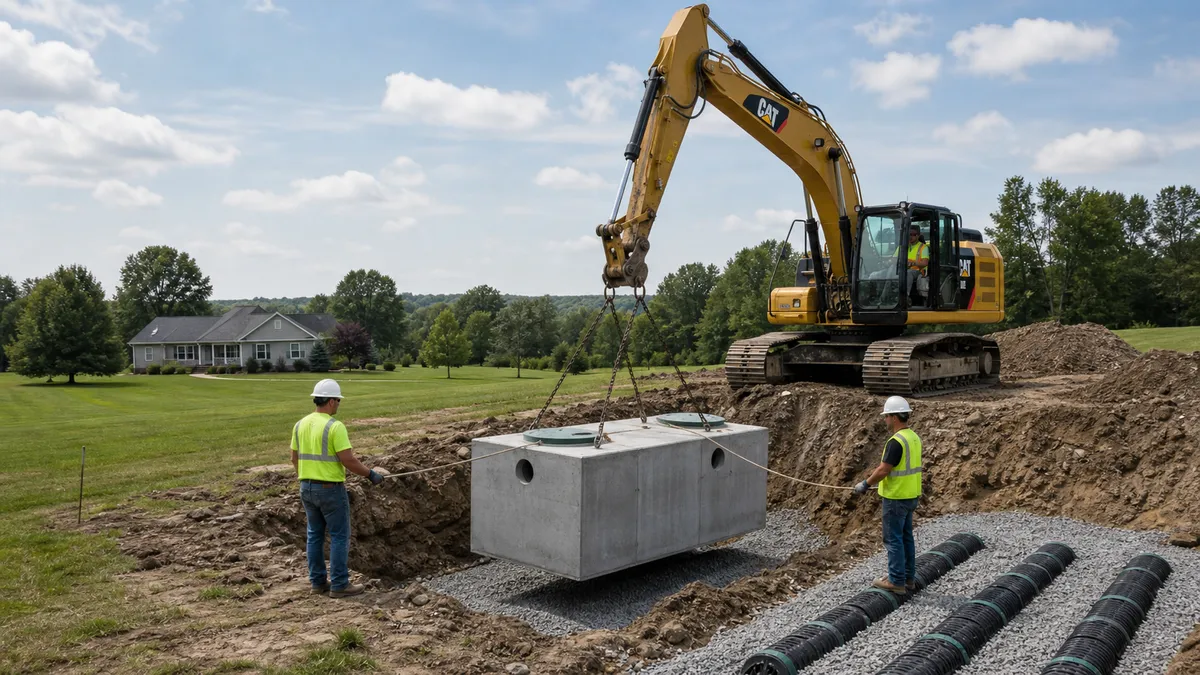
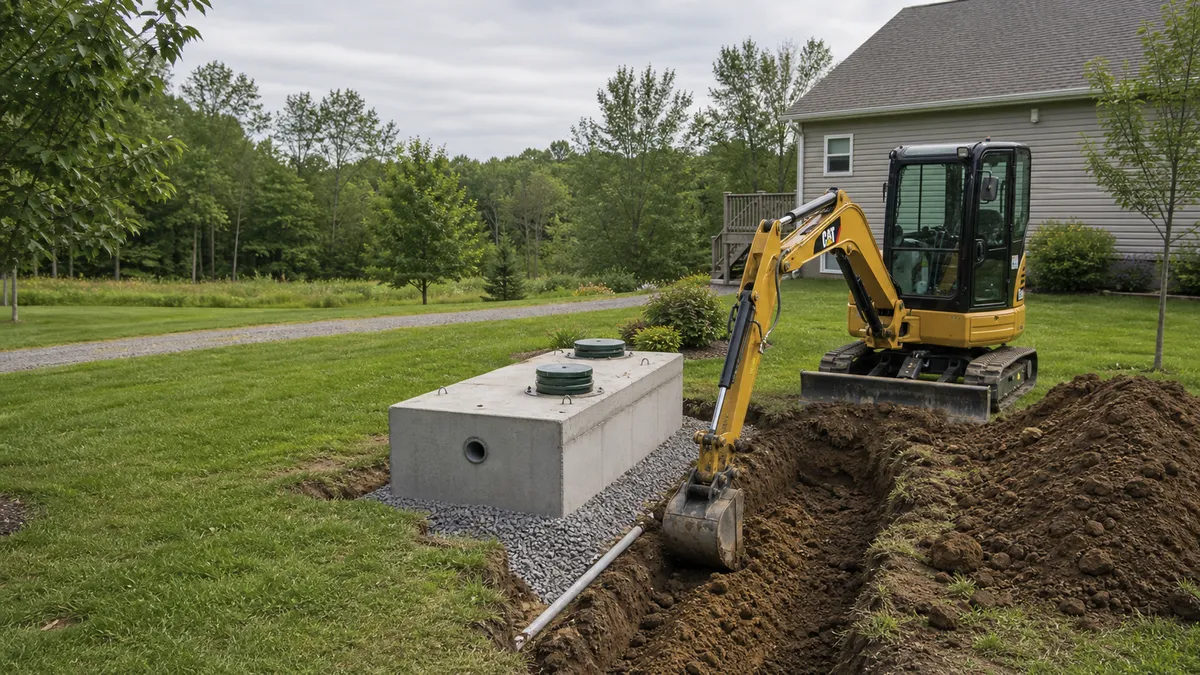
- Build, inspect, complete. Fill settles 45 days where used; the engineer inspects the install; the county issues the final completion.
What the county checks
- Every well on your lot and adjacent lots, with 200 feet where the aquifer policy applies.
- A 100 percent replacement area for the system, and a 20 foot radius replacement area for a well.
- Groundwater and rock each at least two feet below the trench bottoms.
- A site plan of sanitary facilities; changes without Health Department approval can lead to permit revocation.
Homer problems and fixes
New house near the village on gravel
Cut and fill field, longer well distance, and a lot big enough to fit both plus a full replacement area.
Camp on the hill going year-round
Fragipan at 18 inches means a raised system. Bedrooms set the tank and field size.
Shallow well next to the field
If aquifer water enters the well less than 50 feet down, well separation distances rise 50 percent. Deeper casing and grout can avoid it.
Timeline
Testing and design, county review and permit, then the install. Permits are valid 12 months; renewals are $65. Raised systems add the 45 day settling period before trenching.
Sources
- NYS DOH, 10 NYCRR Appendix 75-A, Wastewater Treatment Standards, Residential Onsite Systems
- Cortland County Health Department, Sewage Systems
- Cortland County Environmental Health Fee Schedule, effective April 1, 2026
- Cortland County Sanitary Code, April 1, 2026 (Article XV and Minimum Lot Size rules)
- Cortland County Health Department, Revised On-Site Well and Septic Separation Distances
- Cortland County Health Department, Application for Subsurface Sewage Treatment Permit
- USGS Fact Sheet 2003-0054, Cortland-Homer-Preble aquifer system (Primary Aquifer and Sole Source Aquifer)
- USDA NRCS Official Soil Series Description, Howard
- USDA NRCS Official Soil Series Description, Chenango
- USDA NRCS Official Soil Series Description, Mardin
- USDA NRCS Official Soil Series Description, Volusia
- USDA NRCS Official Soil Series Description, Lordstown
Rules and fees as published by each office on the date this page was written. They can change; the design is checked against the current versions at submittal.
More around Homer.
Nearby towns
Septic engineer in CortlandSeptic engineer in McGrawSeptic engineer in MarathonSeptic engineer in MoraviaDesign and site problems
Raised bed septic designClay soilCamp to year-roundHigh water tableSteep slope septicTell us about the Homer property.
Send the address. Estimate in 1 hour.
Free Written Estimate
Estimate in 1 hour.