Septic Engineer in Marathon, NY
A narrow river valley with steep sides. Village sewer in the middle, septic on the hills and up the side roads. We run the tests, coordinate the PE stamped design and do the install.
Fees. Process. Answers.
Septic design for the Town of Marathon and the Tioughnioga valley.
The Village of Marathon has a wastewater treatment plant, under an improvements project reviewed by the state in 2023. Homes outside the village system use septic systems permitted by Cortland County.
Not on slopes over 15 percent under Appendix 75-A. A raised system is limited to 15 percent and a mound to 12 percent. The design looks for the flattest workable ground on the lot.
Yes for new construction and replacements. Cortland County requires an engineer design for all of them; a tank replacement alone does not need one.
$200 for a sewage disposal permit and $65 for a tank replacement or repair in kind, per the April 1, 2026 fee schedule.
With one to two feet of usable soil over rock, Appendix 75-A allows a raised system in fill. A mound needs bedrock at least two feet down.
Cortland County Health Department, Environmental Health Division, 60 Central Avenue, Cortland, NY 13045, (607) 753-5035.
Send the address through the form. Estimate in 1 hour.
Marathon in two sentences
The Village of Marathon runs a wastewater treatment plant dating to about 1975, and the village has moved forward with a plant and pump station improvements project that went through state environmental review in 2023. Up the valley walls and along the side roads in the Town of Marathon, homes are on septic, and Cortland County requires an engineer's design for every new and replacement system.
Designs are prepared and stamped by a New York licensed Professional Engineer (PE). Backwell coordinates the design, the Cortland County submittal, and the install.
Slope is the first question in Marathon
Marathon's valley is narrow and the sides climb fast. Appendix 75-A says slopes greater than 15 percent are unacceptable for onsite systems, a raised system is limited to 15 percent, and a mound to 12 percent. On a steep lot the design job is finding a bench, a shoulder or a flatter corner that works, then fitting the tank and pump chamber where gravity or a pump can reach it. Trenches run parallel to the contours with bottoms as near level as possible, and adjacent trenches are separated by at least four feet of undisturbed soil.
Valley and hillside soils
The valley floor carries Chenango and Howard gravelly loams, very deep, well to somewhat excessively drained outwash. Lots there can take a field easily, but fast soil brings Cortland County's aquifer rules into play: a cut and fill system where soils on primary aquifer lots perk faster than 10 minutes per inch, and 200 feet from well to septic in aquifer areas. Ground near the river also has to sit above the 10 year flood level.
The valley walls are Lordstown soils, moderately deep to siltstone and sandstone bedrock, and Mardin soils, moderately well drained with a fragipan starting 14 to 26 inches down and a seasonal water table typically 14 to 24 inches deep. Rock or fragipan inside two feet usually means a raised system, and a mound needs bedrock at least two feet below the natural surface.
How it works in Marathon
- Address and plan. Estimate in 1 hour.
- Slope and flood check. Find workable ground below 15 percent and above the flood line.
- Soil tests. Perc and deep hole by the engineer.
- PE stamped design. Field on the contour, pump chamber if needed, separation distances.
- Application. Cortland County Health Department, 60 Central Avenue, Cortland, with the $200 fee.
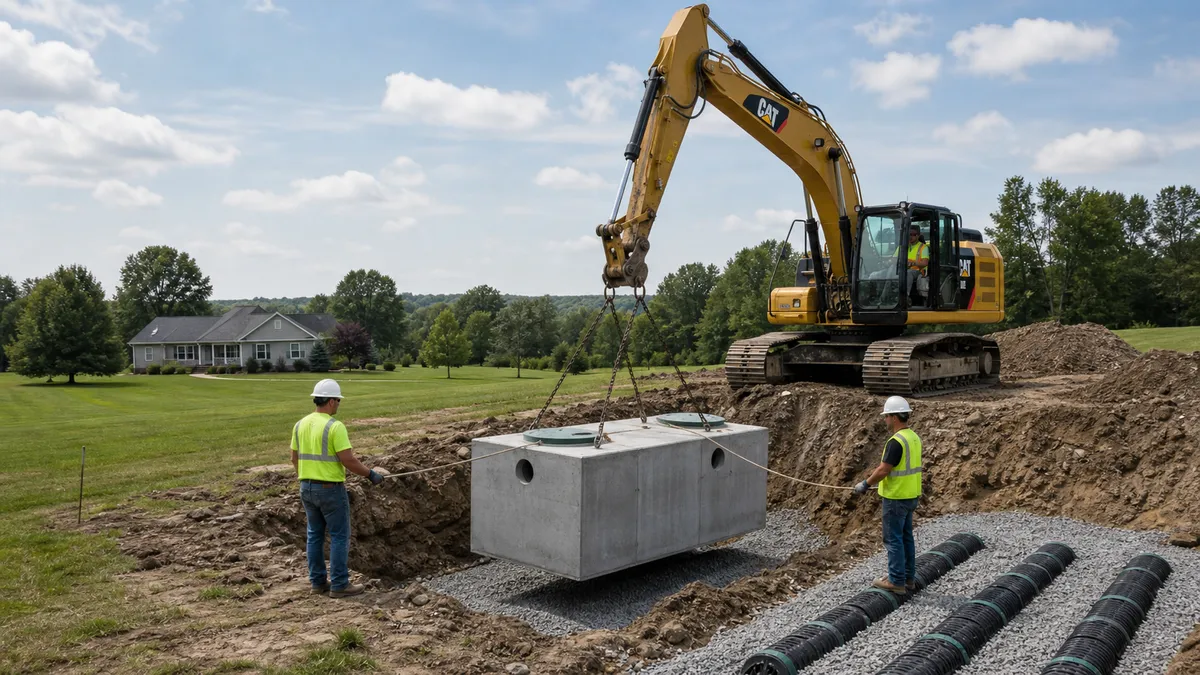
- Install and completion. Engineer inspection of the install, final measurements to the county, certificate of completion.
What the county checks
- Slope, flood elevation, usable soil depth and seasonal groundwater.
- Groundwater and rock each at least two feet below trench bottoms.
- Wells on your lot and adjacent lots, and a 100 percent replacement area for the septic system.
- Diversion ditches on sloped fill sites so runoff stays out of the fill.
Marathon problems and fixes
House on a 20 percent slope
The field moves to the flattest ground on the lot, even if it is uphill, with a pump and pressure distribution.
Rock at 18 inches on the hillside
A raised system in fill keeps two feet between the trench bottoms and the rock. A mound needs at least two feet to bedrock.
River lot on fast gravel
Aquifer rules: cut and fill with slower fill, and 200 feet to the well.
Timeline
Testing and design, county review and the installation permit, then the install. Permits run 12 months, renewable for $65. Steep lots take longer on site.
Sources
- NYS DOH, 10 NYCRR Appendix 75-A, Wastewater Treatment Standards, Residential Onsite Systems
- Cortland County Health Department, Sewage Systems
- Cortland County Environmental Health Fee Schedule, effective April 1, 2026
- Cortland County Sanitary Code, April 1, 2026 (Article XV and Minimum Lot Size rules)
- Cortland County Health Department, Revised On-Site Well and Septic Separation Distances
- Cortland County Health Department, Application for Subsurface Sewage Treatment Permit
- USGS Fact Sheet 2003-0054, Cortland-Homer-Preble aquifer system (Primary Aquifer and Sole Source Aquifer)
- NYSDEC Environmental Notice Bulletin, Village of Marathon Wastewater Treatment Plant and Pump Station Improvements
- Village of Marathon wastewater treatment improvements, financial disclosure and federal nexus (2025)
- USDA NRCS Official Soil Series Description, Chenango
- USDA NRCS Official Soil Series Description, Howard
- USDA NRCS Official Soil Series Description, Lordstown
- USDA NRCS Official Soil Series Description, Mardin
Rules and fees as published by each office on the date this page was written. They can change; the design is checked against the current versions at submittal.
More around Marathon.
Tell us about the Marathon property.
Send the address. Estimate in 1 hour.
Free Written Estimate
Estimate in 1 hour.