Septic on Clay Soil Design Options in Central NY
Clay holds water and smears when dug wet. Here is how New York rules treat clay, and the four designs that get a septic system working on it.
The short answer
Most clay percs slower than 60 minutes per inch, which makes it unusable for a standard leach field in New York. If clay is only on top, it can be cut out and replaced. If clay is a layer with good soil under it, deep trenches can punch through. If clay is all there is, a raised system or a mound puts the treatment in imported fill above it.
A mound can sit on native soil as slow as 120 minutes per inch. That one number rescues a lot of clay lots.
How to tell you have clay
The state handbook gives a hand test. Moist clay pressed between thumb and finger forms a long ribbon. Clay loam forms a thin ribbon that breaks easily. Silt loam will not ribbon smoothly and feels floury. Dry clay breaks into very hard clods and wet clay is plastic and sticky.
Other signs: puddles that sit for days after rain, cracks in the lawn in a dry August, and a perc hole that barely drops. The handbook pre-soaks perc holes for at least four hours so the clay swells first. A clay hole that was not pre-soaked will read faster than the soil really works.
What New York rules say about clay
| Rule | Source |
|---|---|
| Useable soil percs 1 to 60 minutes per inch | Appendix 75-A.1 |
| 4 feet of useable soil over clay for a conventional field | Appendix 75-A.4(c)(2) |
| Absorption beds are not allowed where the soil is silty loam, clay loam or clay | Appendix 75-A.8(g) |
| Cut and fill: soil slower than 60 min/in over useable soil, at least 3 feet of useable soil under it | Appendix 75-A.8(f) |
| Deep trenches: 3 to 5 feet of impermeable soil over at least 4 feet of useable soil | Appendix 75-A.8(d) |
| Raised system: 1 to 2 feet of original soil faster than 60 min/in above any impermeable layer | Appendix 75-A.9(b) |
| Mound: native soil faster than 120 min/in; 61 to 120 min/in sized at 0.2 gpd per square foot | Appendix 75-A.9(c) |
Four designs for clay, matched to the profile
Clay cap over good soil: cut and fill
The clay is dug out and replaced with soil that percs like the good layer underneath. The excavated and filled area extends at least 5 feet past the trenches in every direction. Original surface material cannot go back over the trenches, and the field is sized on whichever is slower, the fill or the native soil below. Built under conventional septic design.
Clay band 3 to 5 feet thick: deep absorption trenches
Trenches are dug at least 2 feet into the useable layer below, backfilled with coarse material up to 30 inches below grade, and a normal trench system is built on top. Sized on the perc of the lower soil.
Thin good soil over clay: raised system
With 1 to 2 feet of soil that percs faster than 60 over the clay, a raised bed adds fill that percs 5 to 30 minutes per inch to rebuild 2 feet of separation. The basal area is sized at 0.2 gallons per day per square foot, with a 20 foot minimum taper.
Slow clay at the surface: mound
A mound system uses sand fill with tight limits: percs 5 to 30 minutes per inch, less than 10 percent fines, at least 25 percent in the 0.5 to 2.0 mm range. Pressure distribution is required, plus a two compartment tank or two tanks in series and a dosing tank. The absorption area in the mound cannot be wider than 20 feet.
Building on clay: why the crew matters
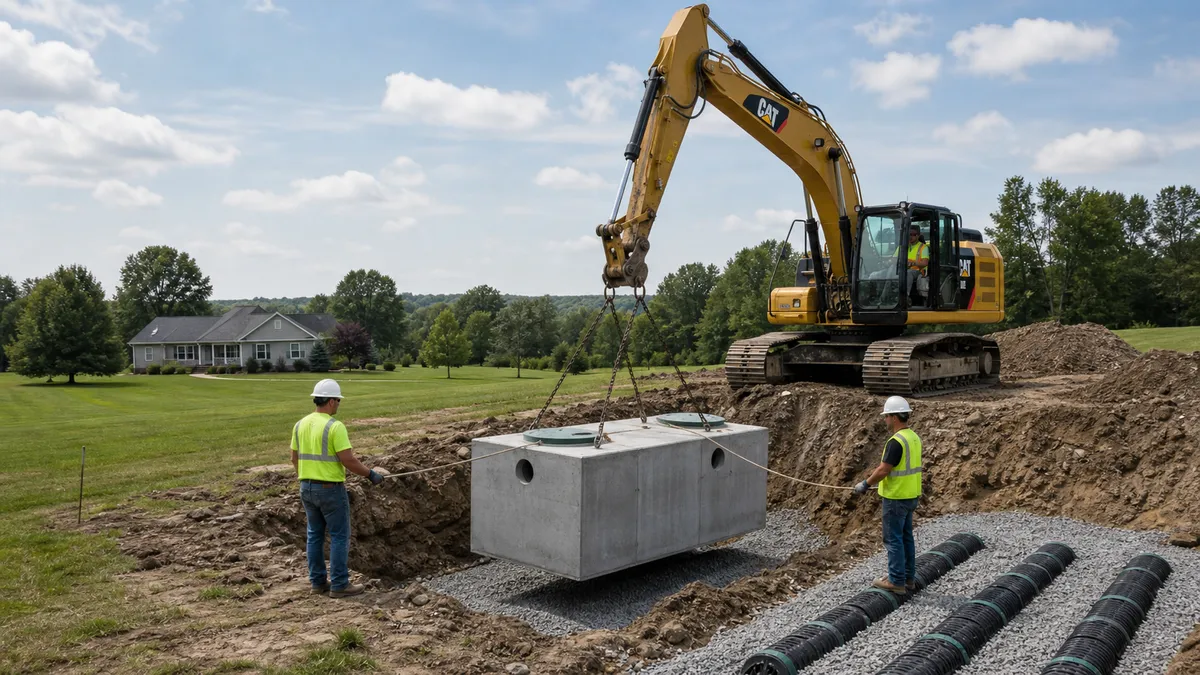
The handbook says smearing or compaction of trench walls and bottoms during excavation will severely restrict infiltration. Clay smears when dug wet. Trench walls are raked, heavy equipment stays off the field, and raised and mound areas are plowed with the furrow turned upslope instead of scraped. Fill for a raised system on clay must settle six months including a freeze and thaw, unless it is granular sand or sandy loam compacted in shallow lifts.
The handbook also lists poor fill and compacted soil under the system among common design and installation mistakes that cause failure.
How it works with Backwell
- Send the address. Estimate in 1 hour.
- Profile the clay. A deep hole shows how thick the clay is and what is under it. Perc tests run in each layer that matters.
- Choose the design. Cut and fill, deep trench, raised or mound.
- Stamped plans. Prepared and stamped by a New York licensed Professional Engineer (PE).
- Submittal. Backwell files with the county health department.
- Build in dry weather. Then PE construction check before backfill where required.
What it costs
| Item | Typical published figure | Where the number comes from |
|---|---|---|
| Perc test plus deep hole | $400 to $800 | Backwell perc test page |
| Engineered design, when required | $1,500 to $3,500 | Backwell perc test page |
| Pressure distribution system | $13,000 to $19,000 | Backwell system types page |
| Engineered mound | $22,000 to $28,000 | Backwell system types page |
| Conventional gravity system on good soil, for comparison | $8,000 to $13,000 | Backwell system types page |
| Onondaga County sewage plan review, under 1,000 gpd | $310 application; $186 redesigned project; $62 amended project | Onondaga County Local Law 11 of 2025, effective January 1, 2026 |
| Cayuga County plan review | $150 new system; $100 conventional trench repair; $150 other repair types | Cayuga County Health Department forms |
Installed ranges are typical Central New York figures Backwell publishes on its septic system types page. They are ranges, not a quote. Your number comes back in writing after we see the address and the test results.
What the health department checks
- That perc numbers match the soil texture logged in the deep hole.
- Thickness of the clay and the soil below it.
- Fill gradation and percs, at the borrow pit and after placement for raised systems.
- Mound hydraulic design, which Appendix 75-A.9 says the designer works out with the health unit having jurisdiction.
- No beds proposed in clay, clay loam or silty loam.
Clay soils in Central New York
Odessa soils are very deep, somewhat poorly drained soils in red clayey lake deposits, mainly on the Erie-Ontario plain and in the Mohawk Valley. Conductivity is low to moderately high in the upper soil and low to moderately low in the substratum. Schoharie soils are clayey lake sediments on the same plain, moderately well drained, with low to moderately high conductivity in the subsoil.
Niagara soils are somewhat poorly drained silty lake deposits on the Erie-Ontario plain, and Canandaigua soils are poorly drained silty lake sediments. Silty is not clay, but these often perc slow and carry seasonal wetness, so they get the same design attention.
On the glaciated Appalachian Plateau uplands of central New York, the tight layer is often a fragipan in loamy till, like Volusia and Langford, not true clay. The pan acts like a clay layer under the design rules.
Plan review: Onondaga County Bureau of Public Health Engineering; Cayuga County Health Department, where new system plans must come from a PE or Registered Architect with a $150 fee; Oswego County Health Department.
Timeline
Testing can run whenever the ground is not frozen, with groundwater checks best from March 15 to June 30. Clay work should wait for dry weather. Raised fill settling adds six months unless compacted granular fill is used. Mounds need no settling period.
Costs. Scope. Questions.
What a septic design on clay costs in Central New York.
Yes, with the right design. Clay that percs slower than 60 minutes per inch rules out a standard field, but New York allows cut and fill, deep trenches, raised systems and mounds. A mound can be built over native soil as slow as 120 minutes per inch.
It depends on the profile. Clay on top of good soil points to cut and fill. A clay band over good soil points to deep trenches. Clay at the surface with nothing better below usually means a mound with pressure distribution.
Appendix 75-A.8 does not allow a bed where the soil is silty loam, clay loam or clay, and limits beds to soils percing 1 to 30 minutes per inch on slopes of 8 percent or less. Trenches give more sidewall area for the water to leave.
Only as part of a designed system. The rules call for specific fill: 5 to 30 minutes per inch for raised systems and mounds, plus grain size limits for mound sand. Random sand mixed into clay can create layers that make the problem worse.
The state handbook lists smeared or compacted soil, poor fill, and overestimated soil permeability among the common causes. Clay smears when dug wet and seals the trench walls, so construction timing matters.
Backwell publishes typical Central New York installed ranges of $13,000 to $19,000 for pressure distribution and $22,000 to $28,000 for an engineered mound, against $8,000 to $13,000 for a gravity system on good soil. Send the address for a written price.
Sources
- 10 NYCRR Appendix 75-A.1, Introduction and definitions (NYS DOH)
- 10 NYCRR Appendix 75-A.4, Soil and site appraisal, Table 2 separation distances (NYS DOH)
- 10 NYCRR Appendix 75-A.8, Conventional subsurface treatment systems (NYS DOH)
- 10 NYCRR Appendix 75-A.9, Alternative systems: raised systems, mounds, sand filters (NYS DOH)
- NYS DOH Residential Onsite Wastewater Treatment Systems Design Handbook, 2012 edition (posted by Onondaga County Health Department)
- NYS DOH fact sheet: Need for Licensed Design Professionals, Residential Onsite Wastewater Treatment Systems
- Onondaga County Health Department, Septic Systems and Public Sewers
- Cayuga County Health Department, Application to Install a New Septic System (rev 1/7/2025)
- Oswego County septic system replacement grant application
- USDA NRCS Official Soil Series Description: Odessa
- USDA NRCS Official Soil Series Description: Schoharie
- USDA NRCS Official Soil Series Description: Niagara
- USDA NRCS Official Soil Series Description: Canandaigua
- USDA NRCS Official Soil Series Description: Volusia
- USDA NRCS Official Soil Series Description: Langford
- Backwell, Septic system types and published Central New York price ranges
- Backwell, Perc test and site evaluation price table
Rules and fees change. Everything above was checked against the linked documents in October 2026. Designs are prepared and stamped by a New York licensed Professional Engineer (PE); Backwell coordinates the design, the health department submittal and the install.