Septic Engineer in Annsville, NY
Soil tests and PE stamped septic plans for Taberg, Blossvale, Glenmore and the state forest roads of Annsville. Sand on one lot, fragipan till on the next.
Soils. Permits. Design.
County review fees and the three Annsville area waters on the county septic grant list.
We did not find a public sewer source for Annsville, so we treat parcels there as septic unless the town shows otherwise.
The town has fast draining Chenango and Windsor outwash next to Worth and Westbury till with a fragipan. The outwash usually takes a trench with careful distribution; the till often needs a raised bed or mound.
Fall Brook, East Branch Fish Creek and Rome Reservoir are on Oneida County's priority list. Properties within 250 feet can get back 50 percent of eligible repair or replacement costs, up to $10,000, through March 31, 2027.
Appendix 75-A requires at least one test hole at least 6 feet deep in or next to the proposed field, plus at least two percolation tests per system.
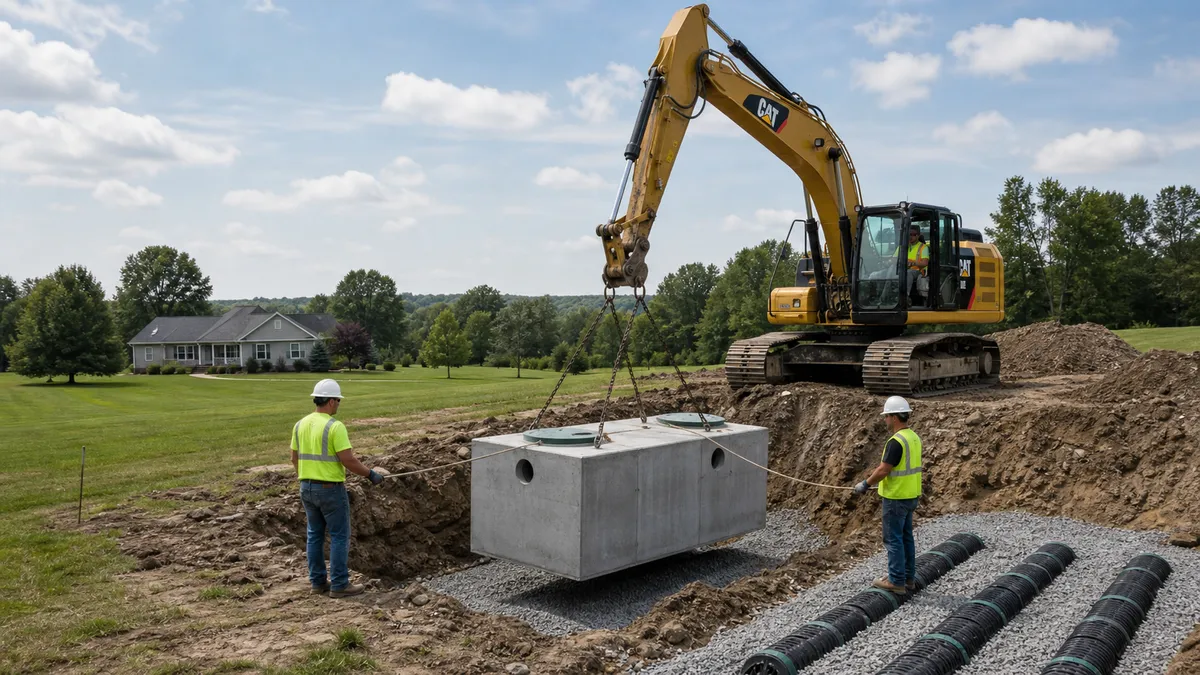
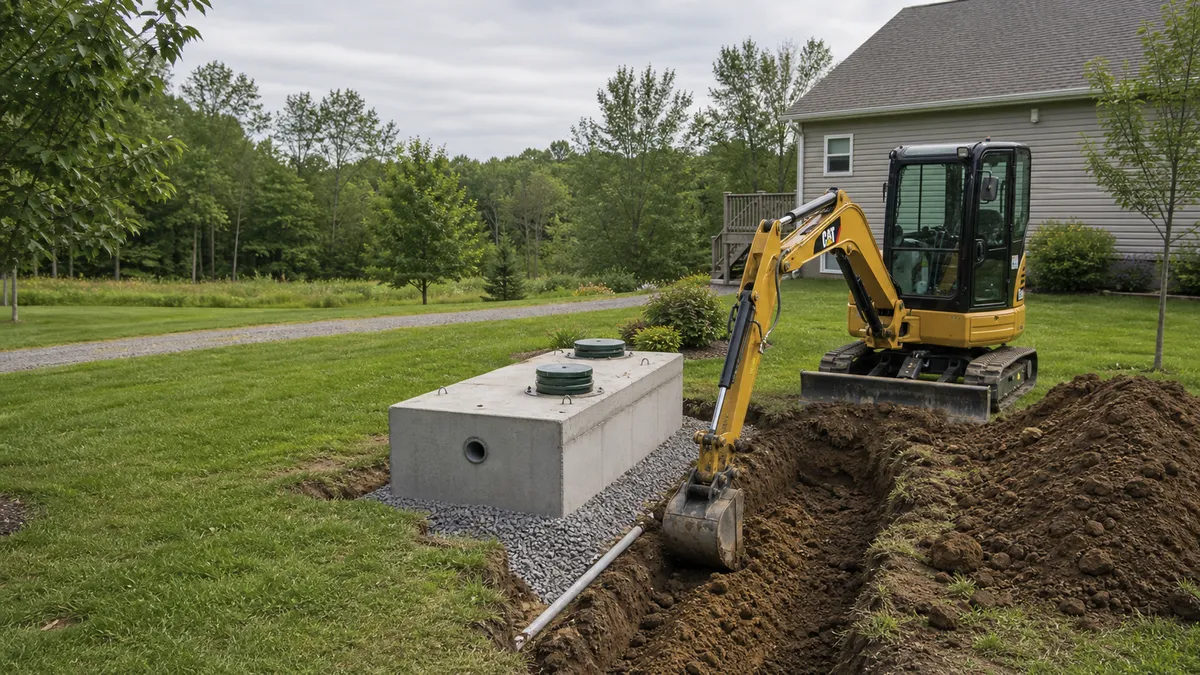
Backwell coordinates the testing, design, permit and installation. Designs are prepared and stamped by a New York licensed Professional Engineer.
Yes. Send the address and you get a written price for design and installation in 1 hour.
Annsville in short
Annsville is a rural town in western Oneida County, running north to the Lewis County line. Its hamlets are Taberg in the southeast on Route 69, Blossvale near the southern town line, Glenmore in the south central part, plus McConnellsville and Blennes Corner. Cobb Brook, Fall Brook, Fish Creek and Furnace Creek State Forests lie wholly or partly in the town. We did not find a public sewer source for Annsville, so this page treats it as what it looks like on the ground: house by house septic.
Backwell coordinates the testing, design, permit and install. Designs are prepared and stamped by a New York licensed Professional Engineer (PE). Annsville is a town where the soil can change from one parcel to the next, so the test pit comes before any talk of system type.
Six soils, two directions
USDA soil data for Annsville shows Worth as the largest series at about 13 percent of the town, then Chenango about 11 percent, Windsor about 11 percent, Westbury about 9 percent, Bice about 7 percent and Empeyville about 6 percent.
The draining side: Chenango and Windsor
Chenango is gravelly outwash, well to somewhat excessively drained, with bedrock deeper than 150 cm. Windsor is excessively drained sandy outwash with high to very high conductivity. These are the outwash terraces along Fish Creek and its branches. Depth is rarely the problem. The problem is that fast soil gives effluent less time to be treated, so the design leans on even dosing and full distance from wells. See pressure distribution design.
The wet side: Worth, Westbury and Empeyville
These are Tug Hill till soils with a fragipan. On Worth, county data puts the pan at about 26 inches. Westbury is somewhat poorly drained with a pan at 25 to 77 cm and wet soil from about 12 inches. Empeyville is moderately well drained with wet soil from about 23 inches. On these, a conventional trench rarely fits.
Bice
Bice is very deep, well drained loamy till on hills and ridges, with bedrock commonly more than 72 inches down. A conventional field is often possible here.
What the state standard asks for
- At least 4 feet of usable soil above rock, unsuitable soil and high seasonal groundwater under a conventional field.
- High groundwater at least 2 feet below the trench bottom.
- Shallow trenches for sites with 2 to 4 feet of usable soil.
- Raised systems: 1 to 2 feet of native soil percing faster than 60 minutes per inch, high groundwater at least 1 foot below grade, slope 15 percent or less, and at least 2 feet of fill percing at 5 to 30 minutes per inch.
- Mounds: high groundwater at least 1 foot below grade, bedrock at least 2 feet down, native soil faster than 120 minutes per inch, and at least 24 inches of approved sand.
- Fields, raised systems and mounds 100 feet from a well and 100 feet from a stream, lake or wetland.
- No field below the 10 year flood level or on slopes over 15 percent for a conventional system.
Source: Appendix 75-A of the State Sanitary Code.
How an Annsville septic job runs
- Send the address. Estimate in 1 hour.
- Deep hole. At least one hole at least 6 feet deep in or next to the field. In Annsville the first thing it shows is outwash or till: clean sand and gravel all the way down, or a dense pan with gray mottling above it.
- Perc tests. At least two per system.
- Design. New construction sized at 110 gallons per day per bedroom; tank 1,000 gallons for 1 to 3 bedrooms, 1,250 for 4, 1,500 for 5.
- Permit. The stamped plans go to the town with the permit application. Alternative technologies also go to the Oneida County Health Department, 800 Park Ave., Utica, which approves them for individual homes.
- Install and inspect.
Annsville problems
Creek lots near the state forests
Fish Creek, Fall Brook and their tributaries run through the town. The 100 foot stream distance and the 10 year flood rule can rule out the low part of a creek lot. See steep slope septic for hillside fields.
Camps going full time
Hunting camps and seasonal cottages off the forest roads often have undersized systems. See seasonal camp to year round.
Buying land
With sand and fragipan side by side, two lots for sale on the same road can need very different systems. Test before you buy. See lot septic feasibility.
Costs and the grant
When the county reviews a system, its fee schedule (revised March 2022) lists $500 for an individual sewage system and $150 for a site survey. Build cost follows the soil. You get a written price per lot in 1 hour.
Fall Brook, East Branch Fish Creek and Rome Reservoir are all on Oneida County's septic grant priority list. Properties within 250 feet can be reimbursed 50 percent of eligible repair or replacement costs, up to $10,000. The application needs an itemized estimate that lists engineering and design costs. The program ends March 31, 2027 or when funds run out.
Timeline
Testing takes one day with an excavator. Raised system fill must settle six months through one freeze and thaw unless it is granular sand or sandy loam compacted in lifts. Outwash lots usually move faster because they rarely need fill.
Sources
- Annsville, New York (hamlets and state forests)
- NYS DOH, 10 NYCRR Appendix 75-A
- Oneida County Health Department, plan review fee schedule (rev. 3/2022)
- Oneida County Health Department, permit fee schedule (rev. 12/25)
- Oneida County, septic system replacement funding
- Oneida County, public water supply and sewage program
- USDA NRCS, Worth series
- USDA NRCS, Westbury series
- USDA NRCS, Chenango series
- USDA NRCS, Windsor series
- USDA NRCS, Empeyville series
- USDA NRCS, Bice series
- USDA NRCS Web Soil Survey (Oneida County, NY065)