Septic Engineer in Canastota, NY
The village is on sewer. The flat, wet farmland around it is not. Soil tests and PE stamped septic plans for the Lenox lake plain outside Canastota.
Soils. Permits. Design.
What it takes to put a septic system in the wet lake plain soils around Canastota.
The village is. Its sewer dates to the 1920s, and the plant at 715 N Main St also treats nine collection districts in the Town of Lenox. Homes outside those areas use private septic.
The village sits on an old glacial lake plain. Soils like Niagara and Minoa are somewhat poorly drained, and about 79 percent of a sample area around the village is rated Very limited for absorption fields. A conventional field needs 4 feet of usable soil, which these soils rarely give.
The Town of Lenox code enforcement office at 205 South Peterboro Street in Canastota. Alternative designs such as mounds also go to Madison County Public Health in Wampsville for a $125 review.
Only portions of Canastota Creek upstream in the Town of Lincoln. The program pays 50 percent up to $10,000 for eligible replacements near Cazenovia Lake, its tributaries and those Lincoln reaches.
Backwell coordinates the testing, permit and installation. Designs are prepared and stamped by a New York licensed Professional Engineer (PE).
Yes. Send the address and you get a written price for the design and installation in 1 hour.
Canastota: sewer in the village, septic on the flats
Canastota's sewer system goes back to the 1920s. The village built its treatment plant in 1966 on North Main Street (today 715 N Main St), discharging to Canastota Creek, and upgraded it in the mid 1980s, in 2008 for storm flow and in 2022 with UV disinfection. The plant treats about 500 million gallons a year and serves the village plus nine separate collection districts in the Town of Lenox.
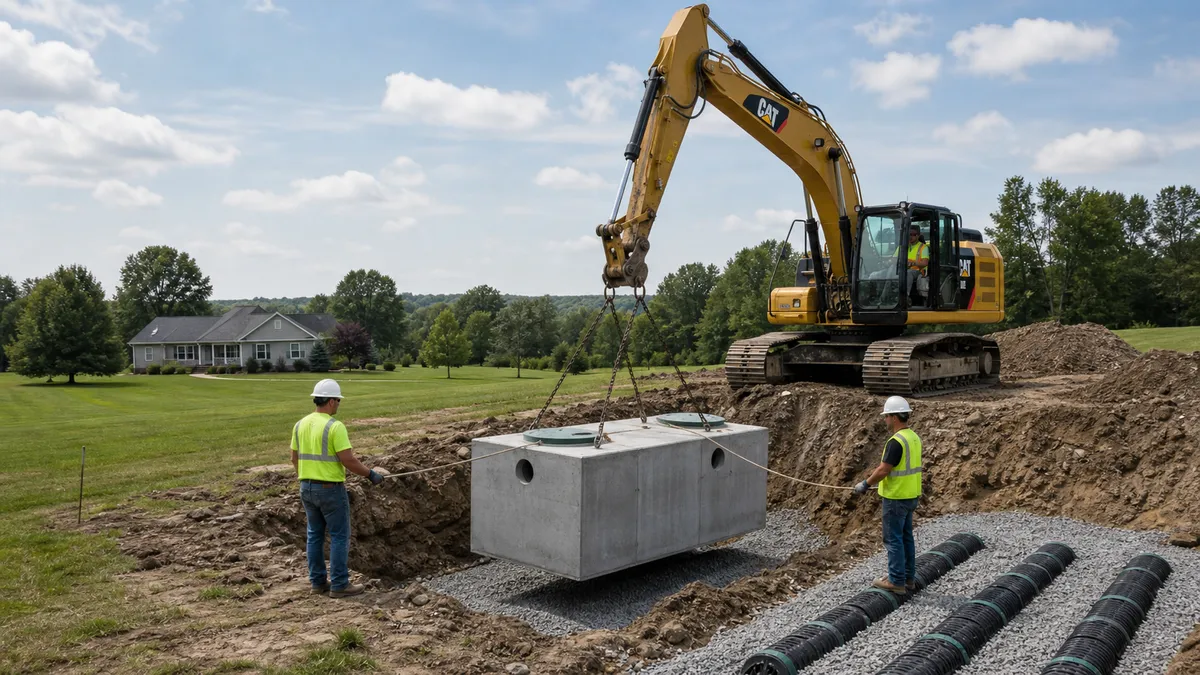
Outside those districts, houses on the Lenox side of Canastota run on private septic. Those are the lots this page covers. Backwell coordinates the soil tests, the design, the permit and the install. Designs are prepared and stamped by a New York licensed Professional Engineer (PE).
Why the old lake bed is hard on leach fields
Canastota sits on the plain left by a glacial lake, and the soils show it. USDA soil data for a sample area around the village lists Lairdsville, Weaver, Niagara, Wampsville, Minoa and Canandaigua at the top, and about 79 percent of the area is rated Very limited for septic absorption fields.
- Niagara is somewhat poorly drained silty lake sediment with high runoff. Water sits near the surface for much of the spring.
- Minoa is somewhat poorly drained fine sandy delta sediment on the lake plain. It percs, but the seasonal water table is high.
- Lairdsville on the rising ground south of the village has bedrock at 20 to 40 inches.
Appendix 75-A asks for 4 feet of usable soil above rock, unsuitable soil and high seasonal groundwater under a conventional field, and highest groundwater at least 2 feet below the trench bottom. On the flats that is rare, so the realistic choices are a raised system or a mound.
Raised system or mound on a Canastota lot
A raised system works when there is 1 to 2 feet of native soil that percs faster than 60 minutes per inch, high groundwater at least 1 foot below grade, slope of 15 percent or less, and at least 2 feet of fill percing at 5 to 30 minutes per inch on top. A mound works when groundwater is at least 1 foot down, rock at least 2 feet down and native soil percs faster than 120 minutes per inch, with at least 24 inches of approved sand over the stone.
Mounds and raised beds are usually alternative designs in Madison County terms, so they go to Madison County Public Health for review. See mound septic design and high water table septic design.
How the job runs
- Send the address. Estimate in 1 hour.
- Deep hole and perc. At least one 6 foot test hole in or next to the field and at least two perc tests. On this ground the gray mottling in the pit is the line that matters, not the perc number.
- Design. 110 gallons per day per bedroom. Tank minimums of 1,000 gallons for 1 to 3 bedrooms, 1,250 for 4 and 1,500 for 5.
- Permit. The Town of Lenox code office at 205 South Peterboro Street issues the septic permit for the town. Alternative designs go to Madison County Public Health, 138 N Court Street, Wampsville, at least 30 days before construction, with at least 2 copies of the plans and a $125 fee.
- Install. Backwell builds to the approved plan, and the county inspects alternative installations.
What it costs
The county review fee for an alternative system is $125 per lot. The rest depends on how much sand and fill the lot needs. A mound on Niagara silt is a much bigger build than a shallow trench on drier ground, so we price from the soil test, not a published average. Send the address for a written price in 1 hour.
About the grant: Madison County's Septic System Replacement Fund pays 50 percent up to $10,000, but on Canastota Creek it only covers portions of the creek upstream in the Town of Lincoln. Lots along the creek in and around the village do not qualify under the current list.
Problems we see around Canastota
Ditches and drains everywhere
The lake plain farmland is cut by drainage ditches. A field needs 100 feet from a stream, lake or wetland under Appendix 75-A, and the design has to show how surface water moves around the field. See wet yard and wetland septic design.
Failing older system on a flat lot
Older beds on wet ground often fail in spring. The replacement design starts with a fresh deep hole. See septic replacement design.
Fill that needs time
Raised system fill must settle for six months including one freeze and thaw, unless it is granular sand or sandy loam compacted in lifts. That choice changes the schedule.
Timeline
Testing is one day. County review needs plans in at least 30 days before construction. Fill settling can add six months unless compacted sand is used. Installation takes days. Wampsville, the county seat where Madison County Public Health sits at 138 N Court Street, is in the same Town of Lenox, and the county does both a site inspection and an installation inspection on alternative systems.
Sources
- Village of Canastota, wastewater treatment
- NYSDEC Environmental Notice Bulletin, Canastota WPCP
- Town of Lenox, codes enforcement
- NYS DOH, 10 NYCRR Appendix 75-A
- Madison County Public Health, water and septic individual systems
- Madison County, alternative household wastewater treatment system application
- Madison County, Septic System Replacement Fund
- USDA NRCS Web Soil Survey and Soil Data Access (Madison County, NY053)
- USDA NRCS, Niagara series
- USDA NRCS, Minoa series
- USDA NRCS, Lairdsville series