Septic Engineer in Whitesboro, NY
The villages here are on the county sewer. The lots that are not, from the Mohawk flats to Walesville, need a septic design built for wet river soil or dense till.
Soils. Permits. Design.
Sewer, soils and county fees for septic work in Whitesboro and Whitestown.
Yes. The Village of Whitesboro is a member of the Oneida County Sewer District, along with Yorkville, Oriskany, New York Mills and the Town of Whitestown. Lots in the town without a sewer main still need a septic system.
No. Clark Mills is a hamlet in the northeast part of the Town of Kirkland. Septic and sewer questions there go through the Town of Kirkland.
Appendix 75-A does not accept ground below the 10 year flood level for a conventional field, and Wakeville soil on the flats has a water table about 15 inches down. Those lots usually need the field on higher ground or a raised design.
Town of Whitestown Codes Enforcement is at 8539 Clark Mills Road, Whitesboro. It enforces the state building code and town zoning and manages the floodplain.
The county plan review fee schedule (rev. 3/2022) lists $500 for an individual sewage system and $150 for an individual sewage site survey.
Properties within 250 feet of the Upper Mohawk River and its tributaries may qualify for 50 percent of eligible costs, up to $10,000, through March 31, 2027.
Yes. Send the address and you get a written price in 1 hour.
Whitesboro septic: start with the sewer map
Whitesboro is a village in the Town of Whitestown, just west of Utica on the south side of the Mohawk River. The Village of Whitesboro, the Village of Yorkville, the Village of Oriskany, the Village of New York Mills and the Town of Whitestown are all members of the Oneida County Sewer District. If you live in the village, your house is very likely on public sewer.
District membership does not put a main in front of every parcel in the town, though. Hamlets such as Walesville in the southwest corner of Whitestown and Coleman Mills, south of Oriskany and north of the Thruway, sit out where houses can still depend on a well and a septic system. One correction we hear often: Clark Mills is not in Whitestown. It is a hamlet in the northeast part of the Town of Kirkland, and its sewer and permits go through Kirkland.
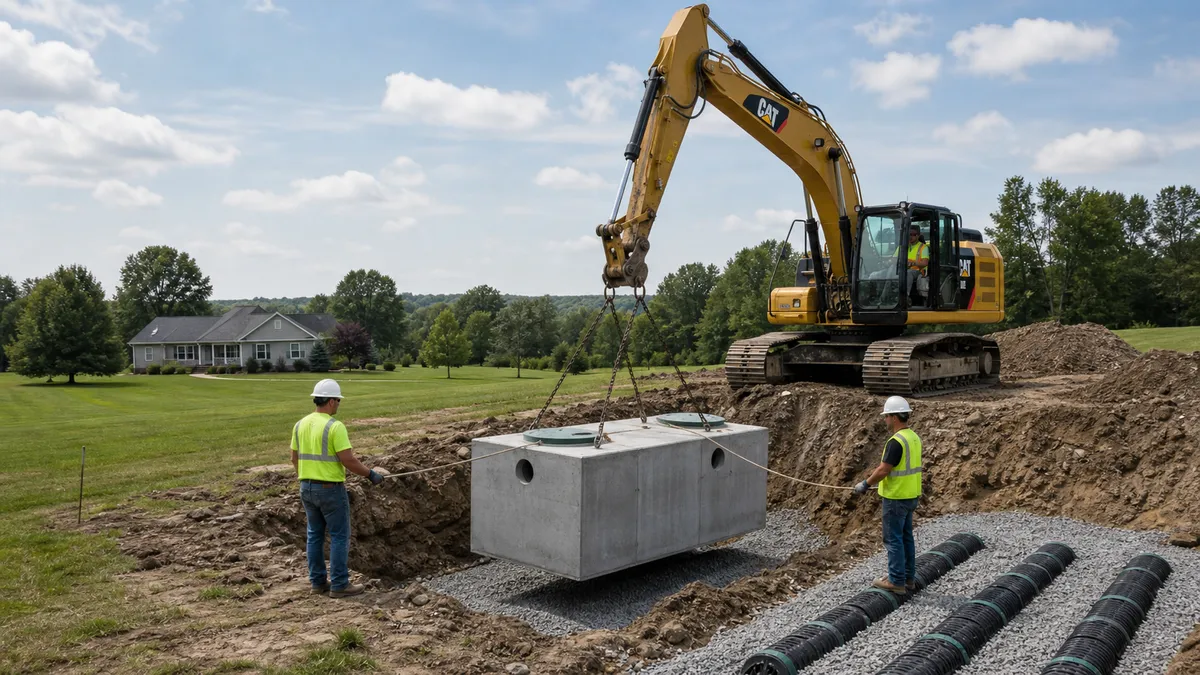
For unsewered lots in Whitestown, Backwell coordinates the soil tests, the design, the permit and the installation. Designs are prepared and stamped by a New York licensed Professional Engineer (PE).
River flats and till: the Whitestown soils
USDA soil data for the area around Whitesboro shows Chadakoin silt loam, Honeoye mixed with urban land, Lima gravelly silt loam and filled ground as the most extensive soils, with Wakeville, Conesus, Wayland and Hamlin also mapped. They split into two groups.
The uplands. Chadakoin is very deep and well drained, formed in till from sandstone, siltstone and shale, with bedrock more than 40 inches down. Lima is moderately well drained limestone till that can be dense, and the survey gives it a minimum annual water table of about 21 inches. On Chadakoin, a conventional trench is often realistic. On Lima, the 21 inch water table is short of the 4 feet of usable soil Appendix 75-A wants under a conventional field, which points toward shallow trenches or a raised system.
The flats. Wakeville silt loam is occasionally flooded and somewhat poorly drained, with a minimum annual water table of about 15 inches, and the survey rates it Very limited for absorption fields. Wayland is floodplain soil as well. Appendix 75-A does not accept ground below the 10 year flood level for a conventional field. On the low land near the Mohawk and along Oriskany Creek, which flows north through the town to the river, the design often has to move the field to higher ground or build it up.
Who handles what
- Town of Whitestown Codes Enforcement, 8539 Clark Mills Road, Whitesboro, enforces the NYS Uniform Fire and Building Codes and the town zoning code, and manages the floodplain in the town. That floodplain role matters on Mohawk and Oriskany Creek lots.
- Oneida County Health Department, Environmental Health, 800 Park Ave., Utica, approves alternative sewage treatment technologies for individual residences and gives technical help to towns and engineers.
- The design professional stamps the plan and certifies the installation.
How the job goes
- Send the address. We check sewer and floodplain first. Estimate in 1 hour.
- Deep hole and perc. At least one test hole at least 6 feet deep and at least two perc tests, per Appendix 75-A. Highest groundwater must sit at least 2 feet below the trench bottom.
- Design. Sized at 110 gallons per day per bedroom for new construction. Fields kept 100 feet from wells and 100 feet from streams and wetlands.
- Permit and county review. Town codes permit, plus county review for alternative systems.
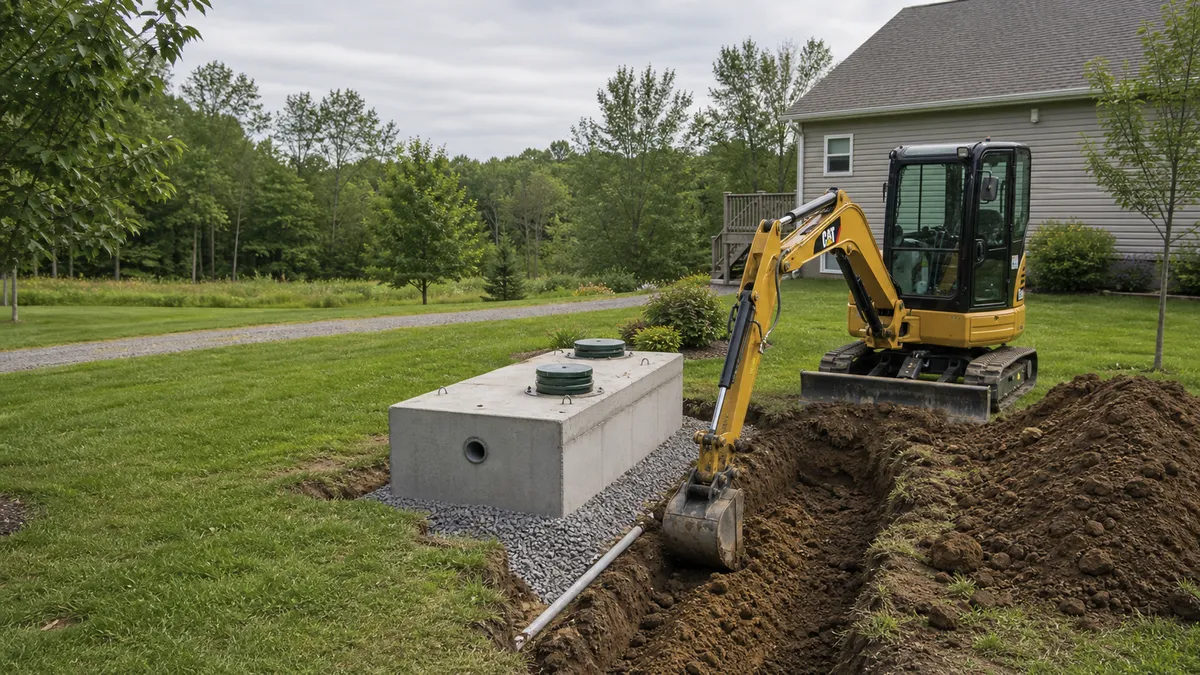
- Install. Backwell builds it to the stamped plan, inspected before cover.
Fees and grant money
The Oneida County plan review fee schedule (revised March 2022) lists $500 for an individual sewage system review and $150 for an individual sewage site survey. Installation cost depends on whether the soil allows a trench or needs fill, so the written price comes after we see the address, in 1 hour.
If you are replacing a failing system within 250 feet of the Upper Mohawk River or its tributaries, the county septic replacement program reimburses 50 percent of eligible costs up to $10,000. Grant work must be approved by the Oneida County Health Department, designed by a licensed engineer and approved by local codes. The program ends March 31, 2027, or sooner if the money runs out.
Problems on Whitestown lots
Lot on the river flats
Wakeville and Wayland ground floods and stays wet. A field there is usually raised or moved. See wet yard and wetland septic design.
Lima soil with a perched water table
A raised system under Appendix 75-A needs 1 to 2 feet of original soil percing faster than 60 minutes per inch, high groundwater at least 1 foot below grade and at least 2 feet of fill percing at 5 to 30 minutes per inch. See raised bed septic design.
Older house, failing field
Start with septic failing or backing up.
Timeline
Testing takes one day. Plans follow. Fill for a raised system settles at least six months, including one freeze and thaw, unless it is granular sand or sandy loam compacted in lifts. Installation is days of equipment time.
Sources
- Oneida County Sewer District, facilities and members
- Town of Whitestown, Codes Enforcement
- Whitestown, New York (Wikipedia)
- Kirkland, New York (Wikipedia)
- NYS DOH, 10 NYCRR Appendix 75-A
- Oneida County Health Department, plan review fee schedule
- Oneida County, public water supply and sewage program
- Oneida County, septic system replacement funding
- USDA NRCS, Chadakoin series
- USDA NRCS, Lima series
- USDA NRCS Web Soil Survey (Oneida County, NY065)