Septic Engineer in Westmoreland, NY
Westmoreland is a septic town. It is not in the county sewer district, and the town issues its own septic permits. On Kendaia and Fredon ground, the design is about water.
Soils. Permits. Design.
Town and county fees for septic design and permits in Westmoreland.
The Town of Westmoreland is not a member of the Oneida County Sewer District, and we found no town sewer district. Homes in the town rely on private septic systems.
The town does, through the codes officer at Town Hall, 100 Station Road. A Town Board record notes a $75 septic permit fee.
Kendaia, the most common soil, has a minimum annual water table about 8 inches down and is rated Very limited for absorption fields. Appendix 75-A requires highest groundwater at least 2 feet below the trench bottom, so the field has to be raised with fill or built as a mound.
On Fredon soils the water table sits within 1 foot of the surface from October to June in most years. The deep hole test reads that from the soil mottling.
The county Health Department approves alternative sewage treatment systems for homes. Its fee schedule (rev. 3/2022) lists $500 for an individual sewage system and $150 for a site survey.
Septic systems are designed to Appendix 75-A, and any county grant funded job must be designed by a licensed engineer. Designs are prepared and stamped by a New York licensed Professional Engineer.
Yes. Send the address and you get a written price in 1 hour.
Every house in Westmoreland needs a septic plan
Westmoreland covers about 43 square miles of west central Oneida County, west of Utica, with the Thruway crossing it. The Town of Westmoreland is not on the Oneida County Sewer District member list, and we found no town sewer district. For practical purposes, a new house or a replacement here means a septic system.
The town runs its own septic permitting. The codes officer reports to the Town Board each month in a report titled Building Permits/Septic Systems, and a Board record notes a $75 septic permit fee. Back in June 2016, the town logged septic permits at $45 each on roads including Bushart Road, Dix Road and NYS Route 5. Town Hall and the codes office are at 100 Station Road.
Backwell coordinates the testing, the design, the town permit and the installation. Designs are prepared and stamped by a New York licensed Professional Engineer (PE).
The town takes in more than one center. Hamlets and named places include Westmoreland itself, Lowell, Hecla, Lairdsville, Bartlett, Dix, Goodrich Corners, Greenway Corners and Spencer Settlement. A lot near a stream or a wetland carries a 100 foot setback from the field under Appendix 75-A, the same distance a field keeps from a well.
Westmoreland soils: wet till and dry till
USDA soil data around the hamlet of Westmoreland shows Kendaia silt loam, on both 0 to 3 and 3 to 8 percent slopes, as the most extensive soil, then Conesus silt loam, with Lima, Phelps, Lyons, Rhinebeck, Pittsfield and Fredon also mapped. Most of the design decisions come from where a lot falls in that mix.
The wet side
- Kendaia is somewhat poorly drained, with a minimum annual water table of about 8 inches. The survey rates it Very limited for absorption fields because of wetness and slow percolation. Appendix 75-A wants highest groundwater at least 2 feet below the trench bottom, so on Kendaia the field goes up, not down: a raised system or a mound.
- Fredon, on outwash terraces, holds a water table within 1 foot of the surface (ranging to 1.5 feet) from October to June in most years. A perc test in August tells you little here. The mottling in the deep hole tells the truth.
- Lyons is poorly and very poorly drained, with slow or very slow permeability and ponding. A field does not belong in a Lyons pocket.
The dry side
- Pittsfield is very deep, well drained loam over calcareous till. The concern is a fast seepage bottom layer, not wetness. These are often the best septic sites in town.
- Conesus is moderately well drained and deep, a middle case where shallow trenches often fit.
Raised and mound rules that apply on wet lots
Appendix 75-A sets the line between system types by soil depth:
- Conventional: at least 4 feet of usable soil above rock, unsuitable soil and high seasonal groundwater.
- Shallow trench: at least 2 but less than 4 feet.
- Raised system: 1 to 2 feet of original soil percing faster than 60 minutes per inch, high groundwater at least 1 foot below grade, slope no more than 15 percent, and at least 2 feet of fill percing at 5 to 30 minutes per inch.
- Mound: high groundwater at least 1 foot below grade, bedrock at least 2 feet down, natural soil percing faster than 120 minutes per inch, and at least 24 inches of approved sand over the stone.
On Kendaia ground with water at 8 inches, the deep hole decides whether even the 1 foot raised and mound threshold is met.
Step by step
- Send the address. Estimate in 1 hour.
- Deep hole and perc. At least one hole at least 6 feet deep and at least two perc tests.
- Design. Stamped plan sized at 110 gallons per day per bedroom, with fields 100 feet from wells and 100 feet from streams and wetlands.
- Town permit. Filed with Westmoreland codes at 100 Station Road.
- County review. Alternative systems go to the Oneida County Health Department, 800 Park Ave., Utica.
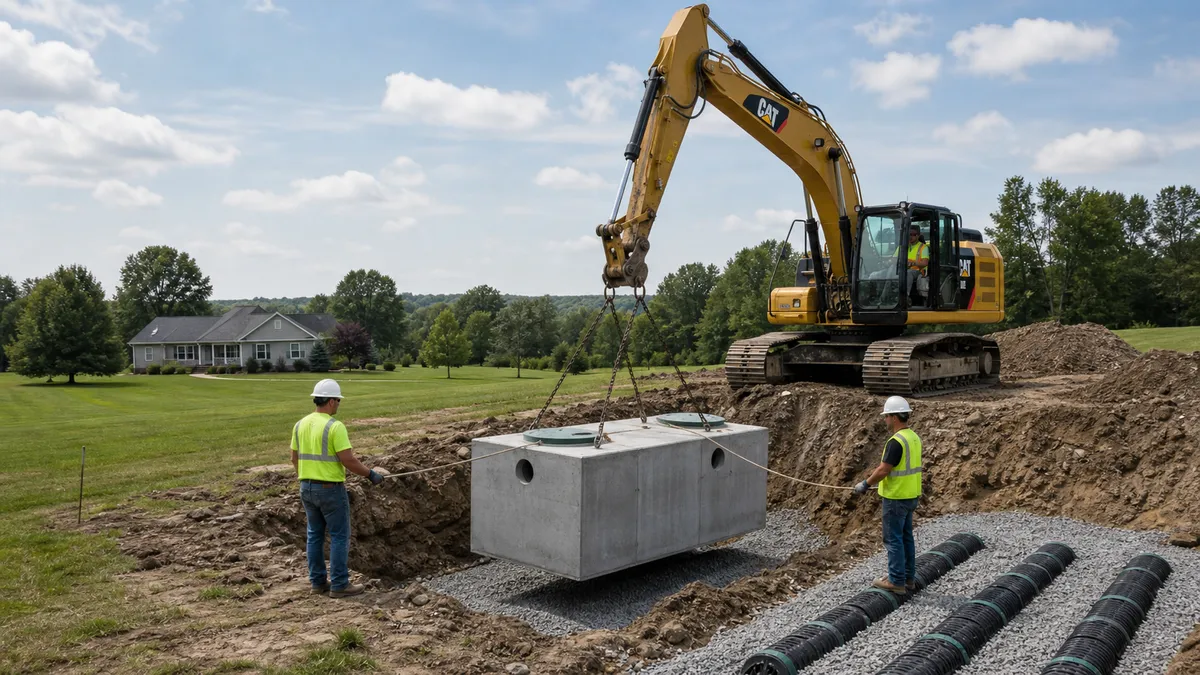
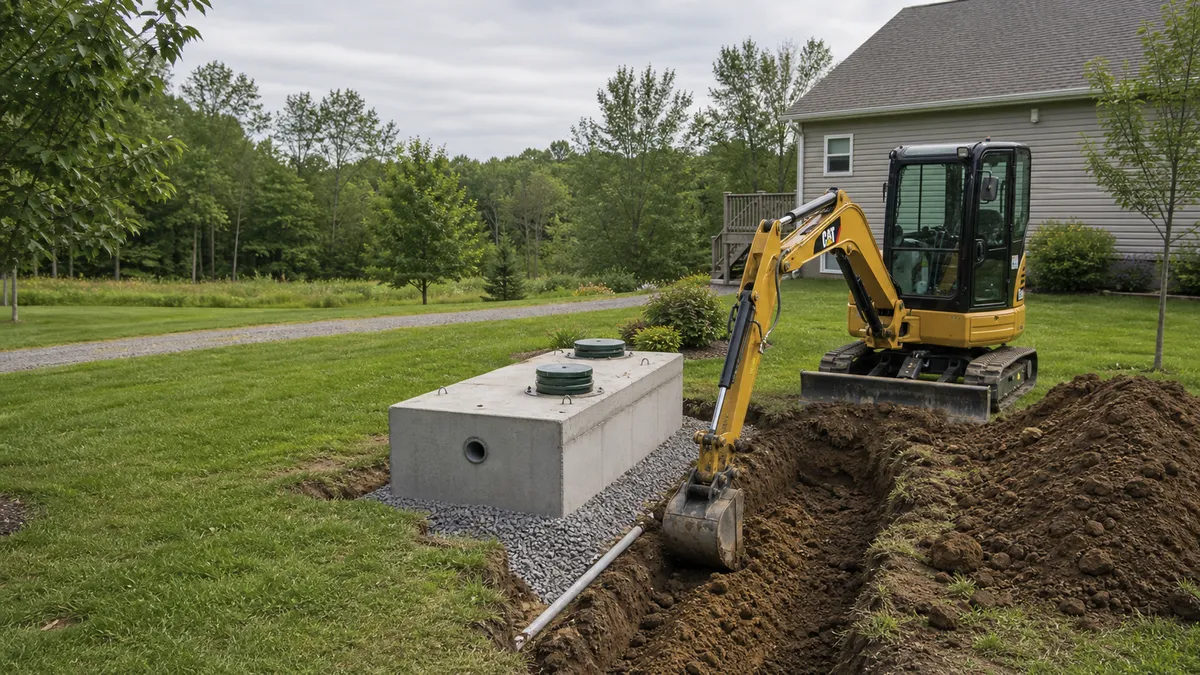
- Install. Backwell builds to the plan, inspected before cover.
What it costs
Published fees are the town's $75 septic permit and, for county review, the Oneida County schedule (revised March 2022) of $500 for an individual sewage system and $150 for an individual sewage site survey. The construction cost swings with the soil: a trench on Pittsfield loam versus a mound on Kendaia. Send the address for a written price in 1 hour.
Common Westmoreland problems
Good soil and bad soil on one lot
Well drained Pittsfield and ponding Lyons are both mapped around the hamlet. A second test pit on the higher ground can move the field onto soil that works. See high water table design.
Wet yard after spring melt
Fredon and Kendaia lots hold water from fall into June. See wet yard septic design.
Failed perc test
Slow soil does not always mean no system. See failed perc test.
Timeline
Testing is one day. Plans follow, then the town permit. Fill for a raised system settles six months through one freeze and thaw unless it is granular sand or sandy loam compacted in lifts. Installation is days of equipment time.
Sources
- Town of Westmoreland, Codes Enforcement
- Town of Westmoreland, Town Board minutes (septic permits, 2016)
- Town of Westmoreland, Town Board record ($75 septic permit)
- Oneida County Sewer District, members
- Westmoreland, New York (Wikipedia)
- NYS DOH, 10 NYCRR Appendix 75-A
- Oneida County Health Department, plan review fee schedule
- USDA NRCS, Kendaia series
- USDA NRCS, Fredon series
- USDA NRCS, Lyons series
- USDA NRCS, Pittsfield series