Septic Engineer in Boonville, NY
Stamped septic plans for homes outside the Boonville village sewer. Soil tests on the Tug Hill edge, from fast Adams sand to wet Camroden till, and a design built for what the pit shows.
Soils. Permits. Design.
What the Town of Boonville asks for, and what the county charges when it reviews a system.
The town's onsite wastewater treatment system permit application says design criteria must be stamped by a design professional and engineered plans are submitted to the town. Backwell coordinates the design, which is prepared and stamped by a New York licensed Professional Engineer.
The Town of Boonville permit fee is $50, payable to the Town of Boonville. If the Oneida County Health Department reviews the system, its schedule (rev. 3/2022) lists $500 for an individual sewage system and $150 for a site survey.
The town application lists well to tank 50 feet, tank to dwelling 10 feet, distribution box to dwelling 20 feet, and a neighbor's well to the system 100 feet. State rules add 100 feet from a well and from a stream, lake or wetland to the absorption field.
Yes. The village runs a treatment plant at 3040 Mill Creek Road that discharges to Mill Creek, and in 2026 it received a $7 million state grant for the plant and the Mill Creek interceptor. Homes outside the village rely on septic.
Adams sand, the most common soil in the town, drains very fast. Fast soil passes a perc test but gives effluent less treatment, so the design pays close attention to even distribution and distance from wells.
Properties within 250 feet of Hinckley Reservoir or its minor tributaries are on Oneida County's priority list. The program reimburses 50 percent of eligible costs, up to $10,000, until March 31, 2027 or until funds run out.
Yes. Send the address and the number of bedrooms and you get a written price for design and installation in 1 hour.
Boonville septic design in two sentences
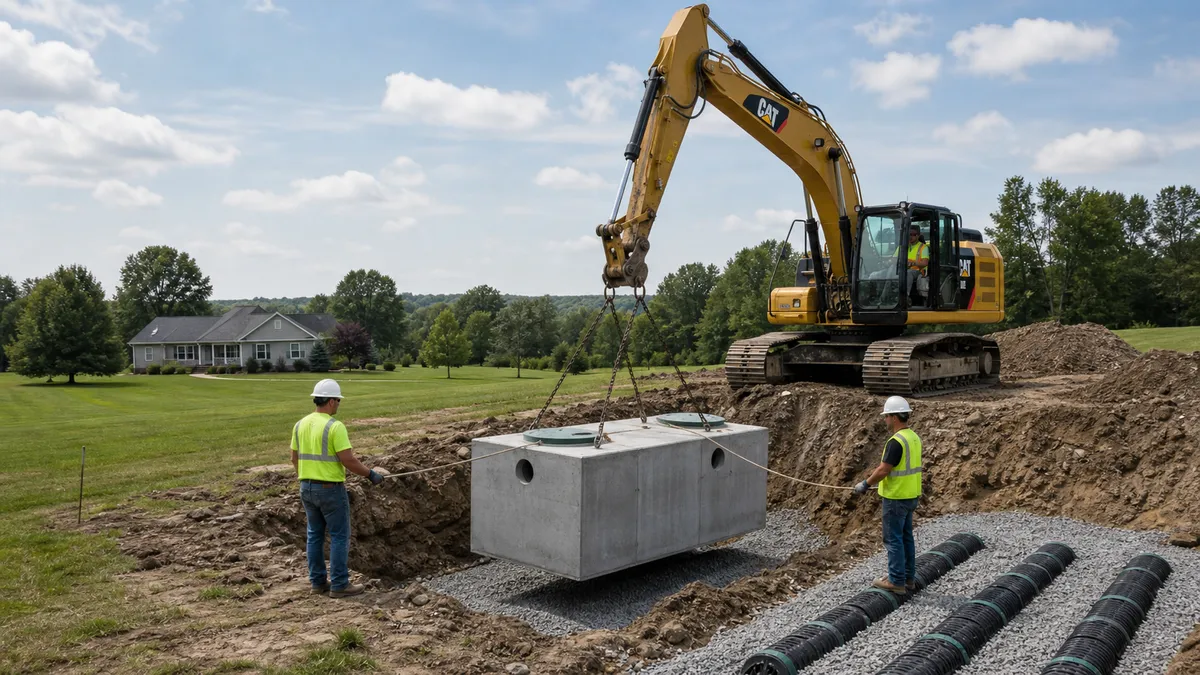
Outside the Village of Boonville sewer, a new or replacement septic system in the Town of Boonville starts with a stamped design: the town's onsite wastewater permit application says design criteria must be stamped by a design professional, and the engineered plans go to the town with a $50 fee. Backwell coordinates the soil tests, the plan, the permit and the install. Designs are prepared and stamped by a New York licensed Professional Engineer (PE).
Village sewer versus the rest of the town
The Village of Boonville treats its own wastewater at a plant at 3040 Mill Creek Road. The plant discharges to Mill Creek, a Class C stream, at about 1.1 million gallons a day under a state SPDES permit held by the village. In March 2026 the state awarded the village a $7 million grant for work on the Mill Creek interceptor and the treatment plant.
Beyond the village, the town covers about 72.6 square miles, bounded by the Black River on the east and Lewis County on the north. Alder Creek, Alder Creek Station, Hawkinsville and Hurlbutville are all on private systems, as are the farms and camps scattered along the old Black River Canal corridor. That is where a septic design is needed.
Two very different soils under Boonville
USDA soil data for the Town of Boonville shows Adams soils covering the largest share, about 23 percent of the town. Bice covers about 10 percent, Pinckney about 6 percent, and Camroden and Malone about 4 percent each. Those soils split into two problems that pull a design in opposite directions.
Adams sand: percs fast, treats less
Adams soils formed in glacial outwash and lake sand. The official series description calls them somewhat excessively drained, with high to very high conductivity, and bedrock is deeper than 183 cm. A perc test in Adams sand comes back quick. The catch is that water moving that fast gets less treatment in the soil before it reaches groundwater. On these lots the design focuses on spreading effluent evenly, often with pressure distribution, rather than on finding enough depth.
Camroden, Pinckney and Malone: the fragipan problem
Camroden is a soil first proposed in Oneida County in 1943. It is somewhat poorly drained with a fragipan at only 14 to 21 inches that water barely moves through. Pinckney has its fragipan at 20 to 30 inches, and county data shows the wet zone beginning at about 22 inches. Malone shows a wet zone from about 9 inches in county data. On ground like that, a standard trench cannot get the separation the state requires, and the design moves to a raised system or a mound.
Bice: the easy ground
Bice soils are very deep, well drained loamy till on hills and ridges, with bedrock commonly more than 72 inches down. Where a Bice lot has room for the setbacks, a conventional trench is often realistic.
Distances on the Boonville permit form
The Town of Boonville application lists its own minimum setbacks: well to tank 50 feet, tank to dwelling 10 feet, distribution box to dwelling 20 feet, and a neighbor's well to the system 100 feet. State rules in Appendix 75-A add 100 feet from a well and 100 feet from a stream, lake or wetland to an absorption field, raised system or mound. On the small village edge lots and the camp lots near the reservoir, the neighbor's well is often what pushes the field to the back corner or forces pressure dosing uphill.
How the job runs
- Send the address. Tell us bedrooms and whether this is new, a replacement or a camp conversion. Estimate in 1 hour.
- Test pit. At least one hole at least 6 feet deep in or next to the field (Appendix 75-A). In Boonville it answers one question first: sand or pan.
- Perc tests. At least two per system.
- Design. Four feet of usable soil allows a conventional field; two to four feet, shallow trenches; less, a raised system or mound.
- Stamped plans to the town. With the $50 permit fee. Alternative technologies go to the Oneida County Health Department at 800 Park Ave., Utica, which approves them for individual homes.
- Install and certify. Built to the plan, inspected before cover.
Problems we see north of Utica
Snowmelt riding on the pan
On Camroden and Pinckney ground the water sits on the fragipan through spring. The design is drawn to the high water shown by mottling in the pit. See high water table septic design.
Camps near the reservoir going year round
Older seasonal systems were sized for weekends. A year round house is designed at 110 gallons per day per bedroom, with a minimum 1,000 gallon tank for 1 to 3 bedrooms. See seasonal camp to year round.
Fast sand next to a well
On Adams sand, keeping the field the full 100 feet from any well matters more because the soil treats less. Sometimes the answer is enhanced treatment ahead of the field.
Fees and the grant
The Town of Boonville septic permit is $50. When the county reviews a system, the Oneida County Health Department fee schedule (revised March 2022) lists $500 for an individual sewage system and $150 for a site survey. Construction cost depends on what the soil allows, so we price each lot in writing instead of quoting a range.
Oneida County reimburses 50 percent of eligible repair or replacement costs, up to $10,000, for properties within 250 feet of a listed priority waterbody. Hinckley Reservoir and its minor tributaries are on the list, and so is the Lansing Kill. The application needs an itemized estimate that breaks out engineering and design. The program ends March 31, 2027 or when the $200,000 runs out.
Timeline
Testing is one day with an excavator. Plans follow the test results, then the town permit through the Codes and Zoning Enforcement office at 13149 State Route 12. A raised system built on fill that has to settle can add six months, including one freeze and thaw, unless the fill is granular sand or sandy loam compacted in lifts. Snow on the Tug Hill edge shortens the digging season, so test early.
Sources
- Town of Boonville, codes and zoning enforcement
- NYSDEC Environmental Notice Bulletin, Boonville WWTP
- WKTV, Boonville gets $7 million for wastewater treatment improvements
- Boonville, New York (town geography)
- NYS DOH, 10 NYCRR Appendix 75-A
- Oneida County Health Department, plan review fee schedule (rev. 3/2022)
- Oneida County Health Department, permit fee schedule (rev. 12/25)
- Oneida County, septic system replacement funding
- Oneida County, public water supply and sewage program
- USDA NRCS, Adams series
- USDA NRCS, Camroden series
- USDA NRCS, Pinckney series
- USDA NRCS, Bice series
- USDA NRCS Web Soil Survey (Oneida County, NY065)